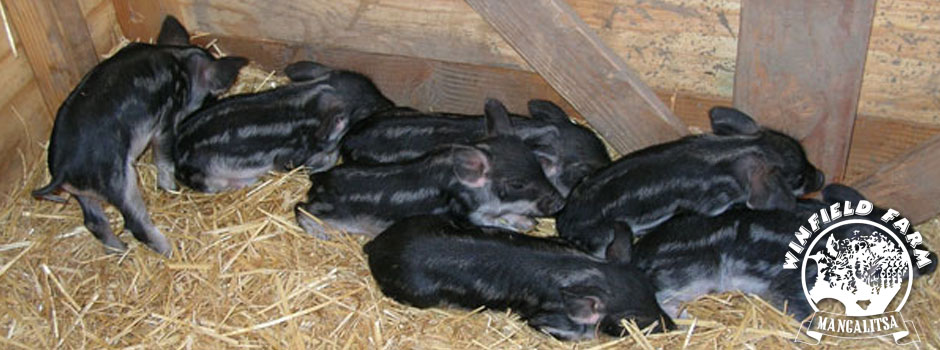
In 2025, Winfield Farm shifted from gourmet pork to subsistence farming. Below you’ll find the story of how we transformed Winfield Farm’s business plan from seasonal veggie farmer to yearlong pig husbandry. You can read about our woolly pig challenges and why we ultimately stopped raising Mangalitsa pigs in a cover story printed in the Santa Barbara Independent in 2025: From Gourmet Pork to Subsistence Farming (also see WF Blog).
HISTORY OF WINFIELD FARM’S BREEDING PROGRAM
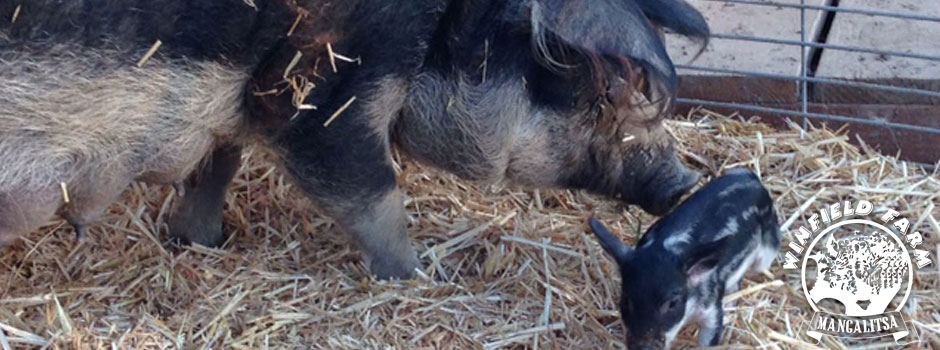
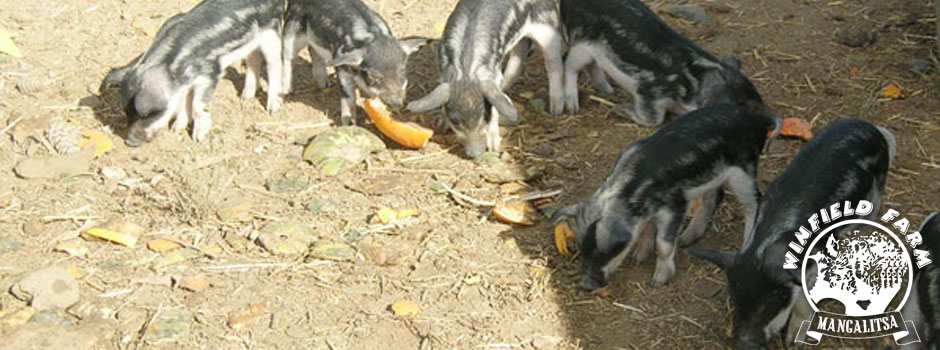
In our ongoing quest for superlative flavor, Winfield Farm’s Mangalitsa program began by happy coincidence. Bruce had long desired a pig (or pigs) to consume the superabundance of produce (especially squash) that we grew during summertime. A good restaurant customer’s interest in charcuterie led us to Mangalitsa wooly pigs, heritage Hungarian lard hogs prized for marbled meat and copious backfat. Mangalitsas are internationally renown for charcuterie, the only heritage “black footed” hog besides Spanish Iberico that can be marketed as “pata negra” premium prosciutto. This happy discovery, and nature’s course, totally transformed Winfield Farm’s business plan from seasonal veggie farmer to yearlong pig husbandry.
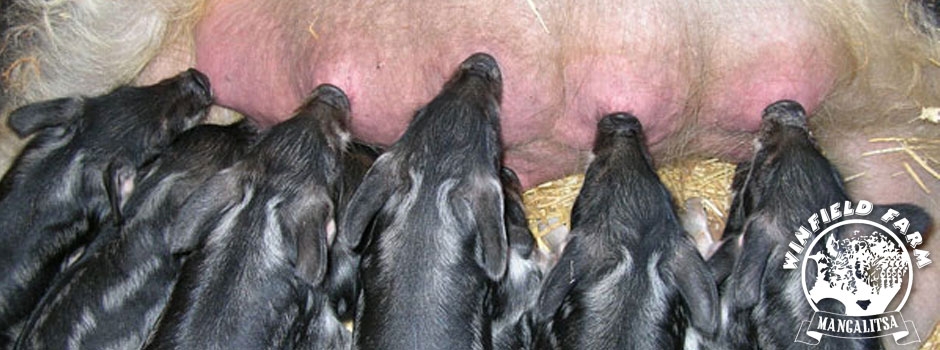
In spring 2013 we purchased two purebred swallow-belly Mangalitsas, and two more, then we rescued the rest of the herd in a divorce sale, bringing our total to 17. Our first gilt, Lucy, farrowed 10 healthy piglets on Halloween 2013. In the following year our first boar, Tyson, fathered 46 piglets, and his sire Augustus, whom we had acquired in the rescue, fathered 19 more. In summer 2014 we traveled to Kansas to pick up a new boar and sow line that produced more piglets that fall. A year later we made another bonsai run to Missouri for more unrelated swallow-belly Mangalitsa breeding stock. Another year, another trip, this time we drove to Chicago to purchase new swallow-belly genetics. And we also bought expensive newly-imported European swallow-belly genetics closer to home, in Northern California.
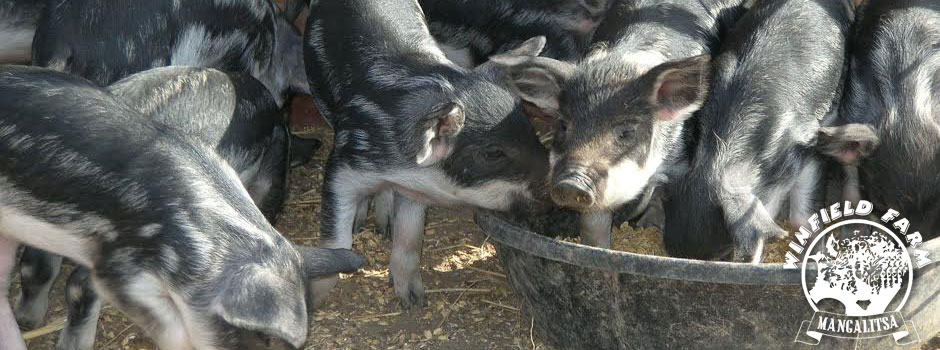
At the height of our breeding program, Winfield Farm harbored more than 120 pigs, including four swallow-belly boar lines and a baker’s dozen swallow-belly sows, who could farrow multiple dozens of piglets each year. Founding members of the Mangalitsa Breed Organization and Registry (MBOAR), Winfield Farm owned, at that point, the largest herd of registered and registerable swallow-belly Mangalitsas in the country. In addition to breeding stock sold, Bruce took close to 500 Mangas to market, an average of about 5 pigs per month – in the months that a USDA butcher was available to cut our pigs, and that became one of several persistent problems.
The only USDA slaughter house between Monterey and the Mexican border that could process pigs skin on (essential for prosciutto) is in Fresno – about 250 miles to the northeast. A five-hour one-way trip driving pigs to slaughter once a month was a challenge (and sharply contradicted efforts to reduce our carbon footprint). The dam cracked further when our longstanding butcher in Paso Robles, only 100 miles away, went out of business. We had no options for several months, until a new butcher bought the building and rehired the cutting crew. But USDA restrictions had closed the smokehouse. The closest USDA approved smokehouse is in Glendale, about 2 ½ hours south of Winfield Farm, another long drive in LA traffic. The COVID pandemic also upended marketing to restaurants for a year or more, and barley prices soared from $310 / ton to more than $700, including a $200+ fuel surcharge for delivery. A ray of hope shined momentarily when our new butcher installed a scalding machine in their mobile slaughter facility to process pigs skin on, but we learned that their new machine couldn’t handle wooly Mangalitsas. The final dam breach came with the realization that Bruce was driving about 1,200 miles round trip every time we produced Mangalitsa cuts, including ham and bacon, for market.
After working for a decade to improve swallow-belly Mangalitsa genetics, Bruce felt responsible for preserving the breed, but he realized that he couldn’t do it alone. So we reached out to farms in the Midwest who voiced interest in continuing the Mangalitsa breeding program. We rented a truck and, in two successive years, towed young breeding stock east, delivering Mangas to several farms as far east as Minnesota. We also arranged to export WF breeding stock to Canada. The bonsai road trips turned out to be busman’s holidays. It was great fun to see the country, and it is eternally gratifying to know that Winfield Farm Mangalitsa genetics are alive and well, perpetuating the pureness of this amazing breed.
More about Woolly Pigs
Nutritional Quality of Pork Produced by Mangalitsa Breed — Winfield Farm / Nistor E. et. al./Scientific Papers: Animal Science and Biotechnologies, 2012, 45 (2)
Pork lipids are an important source of conjugated linoleic acid, which in light of recent studies can provide protection against some forms of cancer and heart disease because of its antioxidant properties. (read more)
Magical Flavor of Mangalitsa — Winfield Farm
Coincidence to pure serendipity, Mangalitsa pigs produce the best-tasting pork on the planet. Mangalitsa bacon is to die for, and Mangalitsa leaf fat is the best baking fat ever. (read more)
Mangalitsa – Wikipedia — The Free Encyclopedia”
Mangalitsa (US spelling), Mangalitza (UK spelling) or Mangalica (original spelling) is a natural breed of pigs from Europe… (read article)
New York Times: Betting on the Next ‘It’ Pig — by Glenn Collins
ONCE upon a time, there were three little pigs — a Duroc hybrid, a Berkshire and an Ibérico… (read the full story)
The Woolly Mangalica Pig — D’Artagnan.com
Known variously as the Mangalitsa or Mangalica, this Old World breed pig is indigenous to Hungary. Its name means “hog with a lot of lard”… (read the full story)
Mangalitsa, The Pig That Resembles a Sheep — AmusingPlanet.com
Mangalitsa or Mangalica is a rare breed of pig of Hungarian origin that has an unusual growth of curly hair over its body, akin to that of a sheep. (read the full story)