Original post: http://www.breakingbutcher.com/
This post is about a certain Mangalitza breed of pig and the beautiful fat that IS this pig. I had no idea how much fat these pigs had until I worked with Yorkshire/Duroc breeds the entire time I was in France and then returned to Indiana to work on my first Mangalitza. I had exposure to the breed before, but that was when I would only watch someone break down a pig, before I knew how to handle one myself. This was before I had seen any other kind of pig except a Mangalitza. I assumed all pigs had this much fat. Then I started hearing commentary about the amount of fat, mostly negative because to raise these pigs just wasn’t financially feasible with the amount of meat available. I didn’t know, I took what I heard and stored it away for a time I figured I would get to form my own opinion and that time is now.
I may have lost a few of my readers already, for that I apologize. Allow me to back up a few steps and try to get everyone on the same post. An increasing number of heritage breed pig farmers have been popping up in the United States, heritage breeds are a special, sometimes rare breed of pig. From what I have gathered most farmers, cooks, and informed consumers have a preference as to which pig he or she fancies. Mangalitza is a type of heritage breed and happens to be the breed of pig that is raised at the farm that supplies meat to the restaurant where I work. This really isn’t a debate about which breed is better to me. I have had delicious products from many different breeds of pigs and I have come to decide that in the right hands basically any pig can be turned into something delicious. However, with that said, the most best breed of pig I have ever eaten is the Black Gascon.
Enough about what is better, I am talking about the Mangalitza and everything else can wait until another day. When I saw the back fat on a Mangalitza the first time after I had returned from France it shocked me. Literal shock, I froze, collapsed, and started convulsing on the floor… that isn’t true. So I picked that bad boy up and tossed him onto the chopping block. I wish that I would have measured the length of the solid mass of fat that towered on the crest of the pigs spine. Just from memory I want to say it was roughly 5-6 inches of beautiful creamy white fat. Fast forward to after three sides of pig where broken down, all products were fabricated, including right around 30 four inch by four inch chunks of lardo ready to cure, and enough back fat to add to freshly trimmed ham meat for saucisson. After everything was cut and salted I was left with pounds and pounds of the best back fat a pig can offer. I rendered some of it for lard and then found myself contemplating what to do with the rest. It seemed a shame to simply render the fat for lard and I didn’t want to freeze it for a later use. I felt that there had to be something to do to showcase this delicious fat and the fact that this is what these pigs are known for. When in doubt, eat.
I have heard people say that chops from Mangalitza’s aren’t really worth the money and hassle of raising the pig. After cutting my own bone in chops and leaving a beautiful cap of fat on each one, enough fat to say to a consumer, “I am a Mangalitza pork chop,” I have to say I was skeptical myself. There just really is not a lot of lean meat to be had in the loin section. I saved part of one of the loins for rillettes and after trimming the fat completely off the meat section of the boneless loin was almost laughably small. Then I had a bite of a seared Mangalitza chop, then another bite, and another, there is hardly a need for meat with fat that flavorful. My opinion quickly shifted and instead of viewing this breed of pig in comparison to another breed of pig I started to view the Mangalitza as the deliciously fatty pig that it is.
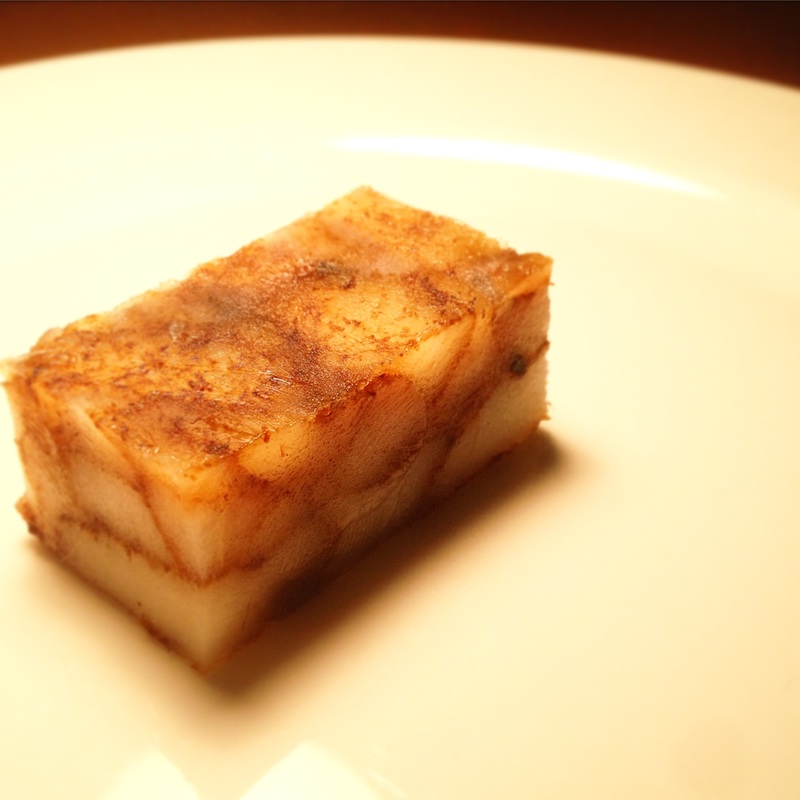
It was this feasting moment between myself and a fatty Mangalitza chop that inspired me to make more from the leftover fat than just lard, although the lard is great. I felt that if I was going to be receiving Mangalitza pigs to fabricate and put on a menu then the fat should be showcased. I wanted to leave more fat on the chops, make more lardo, and figure out how to make all these pounds of back fat into something that could serve to make delicious back fat shine as the main component in a dish. I hit the books and thumbed through multiple pages before my eyes stumbled upon Jamie Bissonette’s book, “The New Charcuterie Cookbook.” In his book he has a great recipe for whipped flavored lardo. He cooks the fat, strains the liquid, presses the fat, and then whips the cooled fat with different flavors to make spreads. This sounds delicious and it is what I intended to do with the fat I had. One of the first things I learned my one and only semester in culinary school is to read a recipe the entire way through before starting on a dish. I was only in culinary school for one semester so I clearly forgot this lesson. What I did was mess up Jamie’s recipe. I added all the flavorings to the raw fat, rendered everything together, and pressed the cooked, flavored fat. I knew that I had messed up, but at this point there was no return. I had no intention of whipping the fat like Jamie recommends. My mind was still in France and it was thinking about one of my favorite dishes called grattons that were made from pressed rendered fat. I went ahead and pressed the flavored mass overnight. The next day I came in and released the now beautifully pressed block of fat from its mold. What a fantastic result, it sliced like a cheese, it showcased the pressed ivory white chunks of fat, and retained just enough flavor to be extremely interesting when eaten like a fatty cheese.
I have sense waited to add most of the flavorings until after the fat is cooked, right before pressing, but the finished product is a thing of beauty. The flavorings get into all the nooks and crannies and cook a slight amount when added to the hot cooked fat, the different shaped fat chunks form a beautiful mosaic presentation, and the flavor is outstanding. A small slice set on my tongue easily melted away and left my mouth coated with fat and flavor. I have converted about 30 pounds of fat back into this cheese like fat product and sense returning from France it is the one thing that I most excited about at this point in my culinary life. In conclusion, I now love the Mangalitza for what they are, extremely fatty pigs. Isn’t this what I trained to do, use every part of a pig for the optimum benefit? If it is Mangalitza’s that I am dealing with I will now find a way to showcase the fat, not shy away from it, because that is what is special about these pigs. So for today, let us raise a glass for the delightfully wooly beasts that are the Mangalitza’s. Enjoy.