by Bruce Steele | May 4, 2026 | Bruce's Substack
Typically spring brings offshore winds, northwesterlies, and upwelling of nutrients. February and March the winds start, spring comes early to California. April is usually very windy, the water cold, green and full of jellies. Salmon water. But this year March was calm, kinda muggy, and much warmer than usual. The winds didn’t come.
Clear warm water is here, an ocean heatwave that presages a monster El Niño. The kelp beds are already weak, and without the upwelled water the kelp doesn’t get enough nutrients . The clear warm water is beautiful to dive in, but as the Niño takes its grip, the life of the reef and the color of the sea life slowly fade white. Coralline algae come in beautiful pinks and violets, they normally cover the rocks, and the calcium that makes up their skeletons provides food for invertebrate grazers like young abalone and sea urchins. As the summer proceeds, the pink color of the reef will fade. The coralline algae will begin to die, and without kelp or coralline the small invertebrates that depend on a typically bountiful vegetive diet begin to succumb. As the heat pushes the respiratory demands of reef life, the lack of nutrients slowly starve it.
Everything turns a ghostly white, the kelp gone except maybe some red kelps that somehow hang on, but nowhere near enough to feed everything. Most small invertebrates succumb, and the large abalone, turban snails, and sea urchins live off stored body reserves. Sea urchins can live a hundred years and they have lived through this before, but they get weak and don’t spend energy on reproduction. For the large sessile invertebrates it is a waiting game, and usually by next year the winds, upwelling and kelp return but sometimes, like in 82-83, the damn thing stretches on into a second year and even the hardiest denizens of the reefs begin to fail. There are some urchins that benefit the carnage because they are predatory and meat eaters, and they move into shallow water where they don’t usually live. Other things, like aggregating sea cucumbers, increase in number too, and get by on diatoms and detritus because there just isn’t much else there.
The abalone get so tired they begin to relax, and you see the whole meat exposed as the shell rests on the sand. Abalone often live under ledges, and the weight of their 7-8” shells and gravity results in abalone exposing themselves to predation, but for the most part the predators are gone too.
After months of starvation the El Niño winter arrives and with it huge storms driven farther South than most years. Swells can reach over twenty feet and the period stretch to 22 seconds. It is hard to describe the havoc that results on the now weaker life on the reefs. Imagine if you will a river rapids, someplace where you know you’d die if you fell in. Now imagine being in that river but having the flow switch back and forth . Now imagine rocks, boulders the size of Volkswagens getting picked up and thrown. As one big rock breaks loose it crashes into the next, and in some places fields of rocks as wide as a freeway and stretching to the beach are rearranged in a way where nothing living there survives, nothing. Rubble
Then one day after a couple of years of heat the winds return, the water turns over again, gets colder, and life returns. The white reef gets to looking kinda dirty with a diatom cover. The diatoms grow something like brown grass and detritus settles into the diatom lawn. Then recruitment of giant kelp and laminaria begins in the mud that settled into the fields of diatoms. The large invertebrates that survived begin a spawn period that gives them a jump on the now reduced number of small and micro predators that would normally feed on the newly recruited abalone or sea urchins. Getting a jump on recruitment predation only comes on the decadal or multi decadal timeframes of the Super El Niño recurrences.The reefs will regrow, but not exactly like they were before the dieoffs . Because some species get the jump on recruitment, they can establish in areas where predation or micropredation formerly kept them in check. Kelp can reestablish where the purple urchins have disappeared, or disappeared long enough for kelp to establish strong footholds and resistance, at least temporarily, to the hordes of urchins.
We call it an alternate state ecosystem. It is disturbance driven, we are midstream .
by Bruce Steele | Apr 17, 2026 | Bruce's Substack
I lived through the 1982-83 and 97-98 El Niños as a commercial sea urchin diver. I know what a super El Niño does to the nearshore rocky intertidal. Death! It is coming again and currently has begun in the Galapagos. SST’s there have reached historic highs already: 30C or 86F. The coral bleaching watch is at level two and forecasts 12 weeks out are still level two. Heat, less oxygen, less nutrients, higher respiratory rates, less food, less kelp … mass death.
A super here in Southern California results in massive invertebrate die-offs, kelp losses ( in an already weak kelp system ) mass bird die-offs, mass pinniped die-offs, and the potential for large hazardous algae blooms.
1982-83 and 97-98 were followed by strong La Niña years directly after the die-offs that I witnessed . There was something like the recovery that follows a forest fire, and it was wonderful to see life come back with such vigor. But in the intervening four decades since those last supers, the average SST has increased and the La Niña has become weak. The kelp and the nearshore reefs need cold water and nutrients to rebuild, and just going from far too hot back to tepid doesn’t result in the blooms that I saw forty years ago.
There are currently huge areas where California’s nearshore reefs are dominated by purple urchins. Purple urchins hit thermal limits around 75F and suffer huge mortality events when the SST exceeds their thermal limit. They will likely see huge population reductions. This is something I have waited forty years to see again. I paid my permit fees to keep my license to dive sea urchins this year. I first bought my license in 1973 and have kept it ever since ($1,000 this year). I am going to go diving this year. My farm will likely have to deal with the river flooding badly . Diesel at $8 a gallon locally will make both fishing and farming very difficult. I really hope to see a La Niña after this is over, but not seeing one isn’t something you hear scientists worried about.
I am getting ready for the floods but I fear the river. I am getting ready for the ocean to die and recover, but somehow I expect it will only recover to something less than the world I once knew.
The coral won’t recover from this in places I never saw, I never knew. Salmon season opened locally but I heard they were catching bonito in Avila and squid showed up in Southeast Alaska.
by Bruce Steele | Aug 20, 2025 | Bruce's Substack, Farming
I guess I’m trying to prove something proven millions of times thousands of years ago.
There will be villages bringing in grain again someday, but for now it’s just one old man on his hands and knees and not so romantic. I harvest with a nice sharp pair of kitchen shears. Handful by handful, I carefully place the wheat into a big cardboard box all lined up and neat so I can, one handful at a time, pull it out again to thresh. If it’s nice and neat it works better. My threshing floor is a big tarp set out in a field where it can catch lots of wind. It doesn’t rain here, so at least I have time to make it a daily half hour of work threshing and winnowing until I get through everything. Hand milling on 10,000 year old technology isn’t all that difficult, but it takes me an hour to get enough flour for one nice round loaf of bread. I haven’t timed the harvest and threshing times, but per pound they go faster than the hand milling. Harvest is time sensitive, whereas the milling can wait months, so milling can be something to while away winter hours.
I choose techniques that require zero steel. Yes, my grubbing hoe is steel, and my hand shears too, but they can both be converted back to stone, as they were in the Neolithic.
I have come to believe the quern stone was the invention that enabled civilization.
My project is to grow grain crops by hand with a hoe, but my project also involves milling the grain on a rhyolite metate that I pecked into a working form. I can mill about two cups of fine flour and another two cups of bran and semolina in an hour. The last part of the project has been capturing a sour dough starter and baking various sour dough loaves. Rye, rosemary acorn and spelt are some of the grains I have grown and used in the small loaves that I bake.
I know this has all been done before, and they tell us from such humble beginnings we built cities. Growing, threshing and winnowing fifty pounds of wheat isn’t difficult . There are plenty of crops far more fickle than wheat. My 50lb. red durum crop came off eight rows together in a thousand sq. ft. of garden space. Red durum is very productive and far easier than spelt to process into clean grain.
Milling time is a bit of a constant, like how much time it takes to hoe a given area of garden. Other chores, like dehulling grain, can be fairly quick or frustratingly slow depending on the grain you use. There is no secret technique, the hand tools are timeless: the quern, the mano, the wind.
I can tell you it’s easy, there are thousands of cultures to prove that a peasant with some seed and a quern stone can feed a family – lot of time or timeless tradition.
But we have largely forgotten making stone tools, or winnowing grain. Pecking Querns has probably always been a bit of a specialty, and farthest from a skill your digital assistant will ever help you with. Grind stones require a venture into our past, and finding your first effective quartzite hammer-stone and whacking it against another rock is a real walk into our past. Our hands remember quickly. The stone you want comes round, and another season of grains too, and the years slip away, until your work is part of what always was, like your tools and your time here on the land.
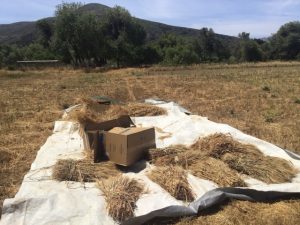
Wheat bundles in field
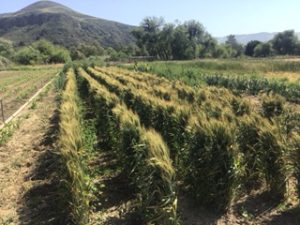
Red durum wheat in field
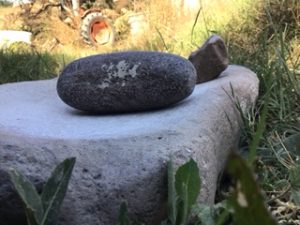
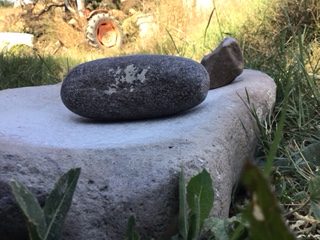
Quern stone & mano
by Bruce Steele | Jul 25, 2025 | Bruce's Substack
Bruce documents his knowledge and accomplishments in subsistence farming on Substack. His Substack URL is Bruce Steele – Substack substack.com This is his latest post about stone milling tools.
***
Stone milling tools were on Aunt Shirley’s porch in Moorpark . They were mostly stone bowls and pestles used for preparing acorns. They came from the bean fields when a plow would turn them up. Aunt Shirley put dirt and succulents in them, one bowl on each step.
The bowls and the rocks they came from have come to into my life, one bowl or metate (quern stone) at a time. I started pecking bowls with a steel hammer and chisel, but smoothing them has always been done with a mano, and usually that same mano would eventually marry with the bowl, the surfaces worked together for a perfect fit.
For me pecking a metate without steel tools has been long dead lessons relearned. Saddle Querns were produced by every civilization prior to steel tools. The Quern made civilization possible. Wheat really wouldn’t have done us much good without a Quern. But when steel chisels came along so too did the Querns, and steel chisels enabled bee hive style round milling stones to be created and they replaced the old saddle shaped ones that served us for at least 8,000 years before steel and rotating mill stones.
I use three stones: The big relatively long and flat stone that will be shaped into the saddle, a river rock that is shaped like a rolling pin, and a quartzite hammer stone. The mano (rolling pin) needs to be of a harder stone than the saddle, and you can start to hit the saddle with it to remove bit by bit a crumble of grit. As the mano repeatedly hits the quern it smooths the end of the mano, and as the quern takes shape so does the mano. The quartzite hammer stone is smaller than the mano and it is used to peck surfaces after the larger mano has roughed it into shape. Also as you put more and more work into your quern, more delicacy is required to avoid breaking it. So a lot of the final shaping is with the quartzite hammer stone.
An interest in milling tools led to an interest in milling acorns and crops we humans milled in the past. Acorns kinda led to pigs, but that is a different story. Milling acorns is relatively easy because they are soft and can be milled wet. Wheat and grains are milled dry and require different tools than the bowl and pestle used for acorns.
Quern stones need to be hard because nobody wants grit in their flour. Our ancestors didn’t like grit either . Knowledge about what stones work is easy enough if you copy what stone our ancestors chose. Granite or basalt querns are common. You can look into what stones were used locally at a natural history museum near you.
So after pecking my quern and grinding some rice to clean it and rid it of grit, I tried grinding some dehulled spelt . I used a #50 sieve to sift the flour . The results are nice light colored flour with no grit.
[My interest has grown] From pecking stone bowls to preparing acorns, from hundreds of pounds of foraged acorns to pigs. From wheat to pecking a quern: Egg noodles, soba noodles, breads, cream of wheat from the bran, desserts.
It is easy enough to rake up 500 pounds of acorns and dry them for storage. With nothing more than a grubbing hoe and a hand sickle, one man can grow, harvest and process 50 pounds of wheat, another fifty pounds of spelt and several hundred pounds of corn on about a half acre and still have room for plenty of fresh vegetables.
A hoe and some stone milling tools are the basic tools that enabled our distant relatives access to enough food to support a village. Those same tools, without mechanization or steel, still can provide.
Once upon a time, the lords took the quern stones from the peasants. They were taking their freedom to farm untaxed. If all the grain had to go to the manor’s mill to get flour for bread, everything could be tallied and taxed. There is some freedom still in gardening and milling without anything but human power.
A stone hoe is still a future project but I suspect it would work as well as the steel grub hoe I currently use.
Red Durum Wheat, 50 pounds finished grain from a 1,000 sq.ft. garden space and a grub hoe. Threshed and winnowed by hand. Mostly milled with an electric mill but walking back is optional, right?
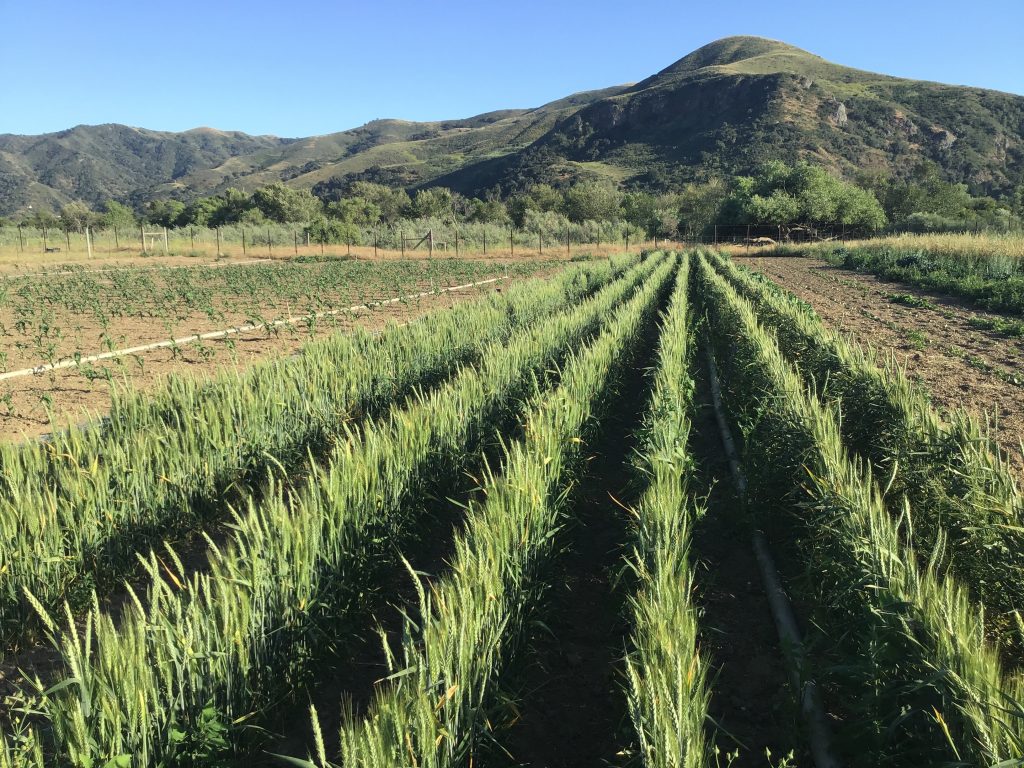
Wheat field at Winfield Farm
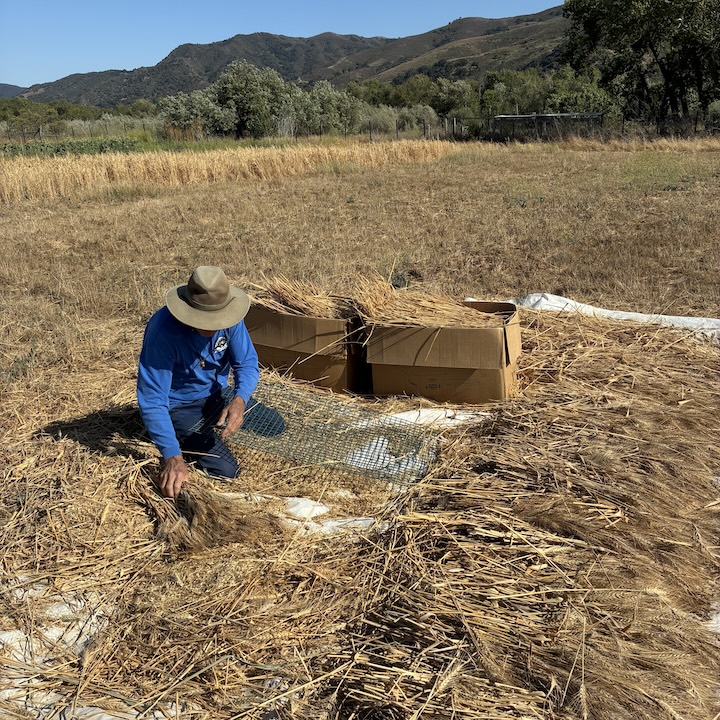
Threshing wheat by hand
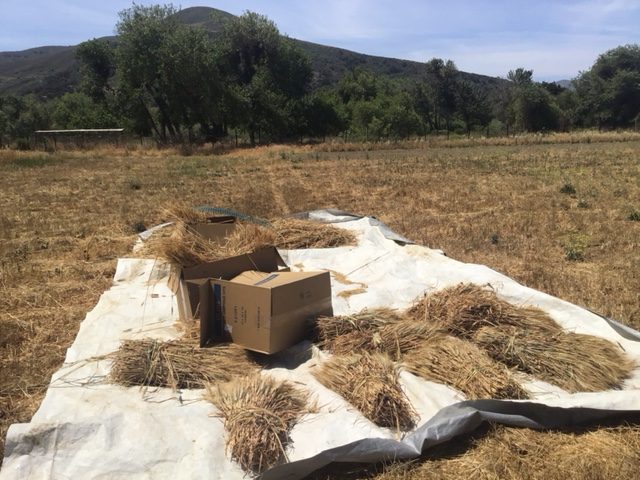
Wheat bundles in field
by Bruce Steele | Mar 31, 2025 | Farming
by Bruce Steele, originally published on Substack
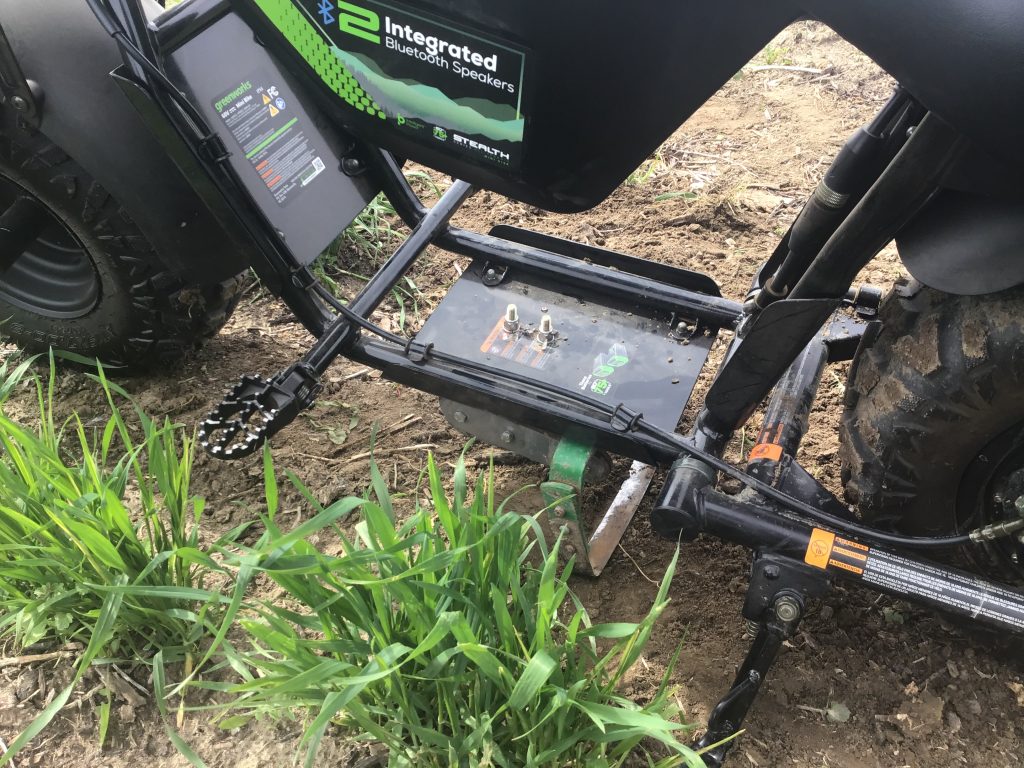
I combined an 8” hoss tools oscillating hoe with an electric mini bike. It is both fun to use and utilitarian. It is a one off and I am always happy when a google search doesn’t reveal anything similar.
This electric cultivator together with an electric tractor are the only power equipment I use to farm/ garden. My farm has had a 5.8 kW solar array for ten years and two powerwalls for a little over five years. My irrigation, refrigeration and home electric needs have been 88% solar powered for about decade . The solar and batteries have paid back the purchase price of my system . I still have grid supplied power but my electric bill averages about $30 a month .
I have been raising market pigs for the last decade and the solar system has supplied all the energy to keep my eight chest freezers operating. I will admit any transport of product or feed has been done with internal combustion . I am tired of feeding fossil fuels into trucking in a business that is not much better than break even. My farm has produced about a million dollars of pork but my days as a swineherd are dwindling.
I had a garden , a farm stand and a few years as a market gardener before the pigs came along. The pigs were initially intended to feed on all the vegetables that kept going into compost from the farm stand but they kinda took over. After a decade however I would like to restart my former vegetable stand with a goal to measure productivity of an electric farm.
How many calories can one farmer and electric tools produce? Just like my solar/ battery system paid back its purchase price with reduced electric bills how long does it take to produce enough vegetables to repay the cost of the new tools? If there is some way to calculate the embedded energy costs of producing the whole system of solar electrics and farm tools then how many food calories need to be produced to repay the embedded fossil fuel costs? These are valid questions and they have quantifiable answers.
I will be recording weights of vegetables and grains produced but farming entails cover cropping and soil building with legumes and added compost. These projects require energy and are necessary for healthy soils and productive crops. The energy expended for soil building can only be recouped with vegetables and grains produced but some accounting for the work required to maintain soil health is still necessary . Furthermore soil building and adding organics are one of the few ways we have at our access to pull atmospheric carbon back into the soil.
I do hope my project draws the attention of some agriculture college or other farmers interested in ag electrics. The tools are off the shelf available and I have a few acres to farm.
So zero fossil fuels for farm equipment, fertilizer, farm electric needs or irrigation and to the best of my abilities to avoid fossil fuel transport of production.
Winfieldfarm
Buellton Ca.