ABOUT US
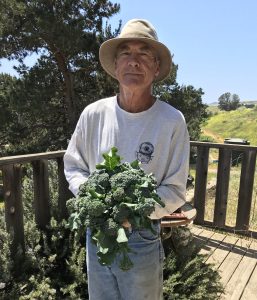
A five-generation native Californian whose roots in farming date back to the 1860s, when his relatives traveled west in covered wagons, Bruce Steele has had a lifelong goal to “have a garden larger than Aunt Shirley’s.” His affinity for growing things, as well as his animal husbandry skills, came naturally, following in the family’s footsteps.
But Bruce’s interest in the natural world stretches far beyond Winfield Farm. Forty-plus years ago he began a different type of farming – diving for sea urchins in the ocean off the Santa Barbara coast. Bruce accumulated an uncommon knowledge of ocean rhythms and mother nature’s cycles after countless thousands of hours underwater. In his spare time, he planted an edible garden on Santa Barbara’s Mesa, which became the object of field trips for local school children to come see what was growing.
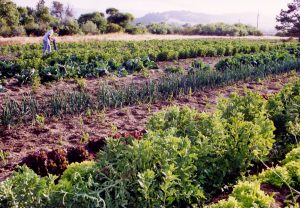
Bruce’s desire for a BIG garden came to fruition when we moved from Santa Barbara to Buellton in 2000 and purchased 30 acres along the Santa Ynez River. Driving along Highway 246 in spring and summer in those early years, you might have spied Bruce in the field on his antique tractor, or weeding the rows by hand. He still maintains the approximately eight acres that he cultivates single-handed, although he replaced the old Massey with an electric tractor a few years ago.
Winfield Farm lies in the 100-year floodplain of the river. The back 20 acres are riparian habitat, home to a golden stand of southern cottonwoods and several endangered species. The river runs through it periodically, and one year overflowed onto our fields. In 2003 we opened a seasonal farm stand on our property, selling a wide variety of organically grown produce to the community and local restaurants –– heirloom tomatoes, melons, onions and the best sweet corn in the valley. In 2013, to consume the inevitable superabundance that a large garden produces, we added a few rare Hungarian Mangalitsa wooly pigs to the operation. Bruce settled on the breed after extensive research, confirmed the day he delivered produce to one of his restaurant customers who also cured prosciutto, and he saw a Mangalitsa leg the chef had purchased for the purpose. The Eureka moment came when Bruce learned how much the chef had paid for that leg. He remembers saying to the chef, “I think I’m in the wrong business!.”
You can read more of the history of Winfield Farm’s Mangalitsa breeding program here. The Santa Barbara Independent also ran a cover story about Winfield Farm and our wooly marketing travails, a painful chronology that led ultimately to our decision in 2025 to stop breeding Mangalitsa pigs. But there were highlights during the nearly 13 years of this adventure: Mangalitsa pigs are a delightful breed, joyful, friendly, easy keepers. During this time Bruce worked to improve our swallow-belly Mangalitsa genetics, to the point that Winfield Farm wound up with the largest herd of registered swallow-belly mangas in the Mangalitsa Breed Organization and Registry (MBOAR).
Winfield Farm was a founding member of the group. When we finally decided to curtail breeding, we made two bonsai runs, in successive years, distributing our WF breeding stock to other farms as far away as Minnesota and Canada. We’re pleased that WF swallow-belly genetics are alive and well in areas where the logistics of heritage pig-raising are far better than they are here in California.
The latest chapter of the Winfield Farm playbook is simply a return to the past, with a twist. Bruce is a self-described climate hawk, very concerned about the rapid increase of CO2 in the environment and its inevitable impacts on the planet. For more than two decades he has researched and monitored ocean acidification and the carbon cycle. His ultimate challenge has long been to produce food sustainably in a future deprived of fossil fuel. That is our renewed mission.
Winfield Farm went solar nearly 10 years ago, and Bruce now dedicates his time to producing food the old-fashioned way, with a grub hoe, assisted by his electric tractor and e-minibike cultivator. A couple of years ago, as a New Year resolution, we embarked on what Bruce called ‘the challenge,’ eating only foods that Bruce grew or foraged. With no preparation, we went for a month on a diet of acorns and weeds (we also had eggs from our chickens and, of course, Mangalitsa pork). Bruce’s recipes were amazing! (He’s the chef in residence.)
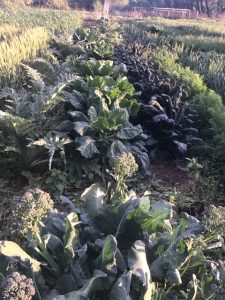
The following year, Bruce planted a ‘victory garden’ and we managed four months easily with no trips to the supermarket (except for milk and toilet paper – milking a cow 365 days a year is not in our cards, at least not yet). Bruce says subsistence living is not only doable, it’s tasty, with a little forethought, manual labor and ingenuity. He started a Substack page and has become a literarian. You can read his posts at https://steeleb.substack.com. His latest challenge is growing, threshing, milling and baking bread – very tasty bread! — all done by hand and hoe, with no fossil fuel.
We posted a couple of Bruce’s substack offerings on the topic on the WF Blog. You can read how he did it here.
Wife Diane (also a published writer – DB Pleschner Writes) plans to recreate Bruce’s substack posts and other relevant content, including Bruce’s recipes, on the WF Blog.
We’re dedicating the Winfield Farm website to document our progress in sustainable subsistence living. Please bookmark this site and enjoy.

Bruce & broccoli