by Bruce Steele | May 1, 2015 | Mangalitsa Pigs, What Chefs Say
by Kerry Acker | www.epicurious.com | February, 2014
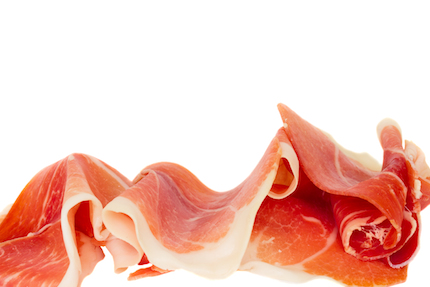
Not all pork products are created equal. Just imagine for a moment that money was no object, that no supernal slice of lavishly marbled ham or haute hunk of succulent pork was too high-end or high-falutin’ for your budget. Here, our mini guide to some of the finest, most exclusive, pork, ham, and bacon in the world.
Jamon Iberico de Bellota
Celebrated El Bulli chef Ferran Adria once said of this traditionally cured Spanish ham, “Iberian pork meat is extraordinary. There’s nothing like it elsewhere in the world. There’s a great difference between a superior ham and all the rest.”
Raised along the Spain/Portugal border, the pata negra (black-hooved) pig roams free-range through old-growth oak forests, dining on herbs, grass, and, most significantly, acorns (bellota means “acorn”), resulting in an intensely flavored, distinctly nutty, and richly marbled meat unparalleled in the ham universe.
Get It: A 14.5-pound bone-in whole Jamon Iberico de Bellota ham from elite Spanish brand Cinco Jotas retails for $1,290 at La Tienda. But, wait, you’ll need to properly slice it, too, so consider investing in the Cinco Jotas Cortador kit–including a 13-pound bone-in Bellota ham, a black ham holder, two carving knives, serving pincers, and a protective chain-mail glove–which will set you back $2,450.
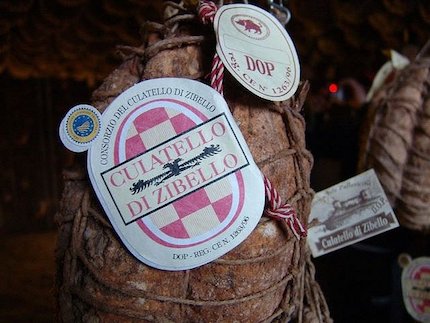
Culatello di Zibello
Among the rarest, most highly esteemed charcuterie in Italy, culatello is a boneless ham with a velvety texture and a robust, slightly sweet flavor. Produced in the foggy Po Valley, outside of Parma, culatello (“little backside”) is made from the muscle in the rear leg of the pig, and is related to prosciutto, but pig purists consider the version labeled with the D.O.P. “Culatello di Zibello” superior to its cousin. Because it takes a whole ham to make the culatello, and producers must adhere to strict D.O.P. regulations–including using only pigs born and raised in Lombardia or Emilia-Romagna, and a slow aging (without refrigeration) of 12 to 20 months–Culatello di Zibello is pretty hard to find. (Approximately 20,000 pieces of culatello are produced annually.)
Get It: Head to Italy’s lovely Antica Corte Pallavicina, a hotel/restaurant situated in Polesine Parmense and run by Chef Massimo Spigaroli, chairman of the Consortium of the Culatello di Zibello since its inception and widely considered one of the best producers of the exclusive ham. You can visit the on-site cellars, where the ham is aged to meltingly tender perfection, then sample it afterward at the Michelin-starred restaurant.
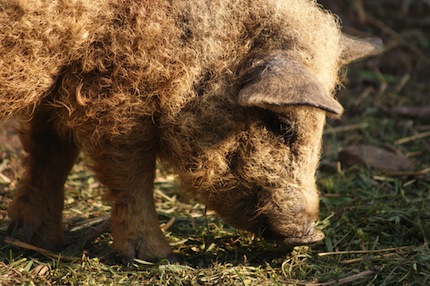
A Mangalitsa pig
Mangalitsa Pork, Bacon, and Lard
This rare breed of pig, the result of a 19th-century Austro-Hungarian experiment cross-breeding a wild boar with a pig raised for lard, is pretty darn funny-looking: Its distinct “fleece” coat gives it the look of a sheep-pig–which is why the Mangalitsa is also known as a “woolly pig”–and the pigs can weigh over 300 pounds. The animal was near extinction until the 1990s, when a Hungarian breeder revived it, and in recent years a handful of American farmers have started raising Mangalitsas. Though the woolly pigs are more expensive to produce than other heritage breeds, the buttery meat has been enjoying considerable popularity among chefs: Mangalitsa pork has been served on menus at the likes of the French Laundry, Le Cirque, and Blue Hill Stone Barns, and it’s also increasingly available as cured ham, bacon, and other products.
Get It: D’Artagnan sells a bone-in 12- to 16-pound Mangalitsa ham–dry-cured in Spain–for $400, Murray’s offers bacon ($17/12 oz.) from New Jersey-raised Mangalitsa pigs, and Florida-based Pasture Prime sells ground Mangalitsa pork, lard, and custom pork.
Edwards’ Surryano Ham
When it comes to dry-cured American ham, Surry, Virginia’s Edwards’ Surryano is a fabulous bet. Produced from Berkshire hogs and other heritage breeds–who dine on peanuts, grass, corn, and soy, according to Food Republic’s interview with Sam Edwards–the meat is dry-cured, smoked over hickory wood for seven days, then aged for 400 days. The ham that results is rich, smoky, and silky, and beloved by such chefs as David Chang, who serves it at Momofuku Ssam Bar.
Get It: A 15- to 17-pound bone-in Surryano will set you back $215, while $39 will get you 3.4 ounces of sliced Surryano heaven.
Benton’s Bacon
North Madisonville, Tennessee’s Benton’s Country Hams, famous for its world-class traditional dry-cured ham and (also dry-cured) bacon, is another American company that just makes us proud. New York Times writer John T. Edge said it best: “Allen Benton is the rock star of American bacon. There’s just something very primal about his bacon. It’s like barbecue and is so distinctive.” Chef devotees of Benton’s intensely, beautifully smoky bacon are many, and include David Chang, Sean Brock, and Hugh Acheson, to name just a few.
Get It: Four 1-pound packs of Benton’s famous hickory-smoked bacon cost just $26 via Benton’s website, but bear in mind that there may be a 5-week delay in delivery–which you will totally understand once you taste this extraordinary bacon, which would satisfy even the pickiest one-percenter.
Originally posted: 2/18/2014 : http://www.epicurious.com
by Bruce Steele | Apr 26, 2015 | Mangalitsa Pigs
Original post: http://www.breakingbutcher.com/
This post is about a certain Mangalitza breed of pig and the beautiful fat that IS this pig. I had no idea how much fat these pigs had until I worked with Yorkshire/Duroc breeds the entire time I was in France and then returned to Indiana to work on my first Mangalitza. I had exposure to the breed before, but that was when I would only watch someone break down a pig, before I knew how to handle one myself. This was before I had seen any other kind of pig except a Mangalitza. I assumed all pigs had this much fat. Then I started hearing commentary about the amount of fat, mostly negative because to raise these pigs just wasn’t financially feasible with the amount of meat available. I didn’t know, I took what I heard and stored it away for a time I figured I would get to form my own opinion and that time is now.
I may have lost a few of my readers already, for that I apologize. Allow me to back up a few steps and try to get everyone on the same post. An increasing number of heritage breed pig farmers have been popping up in the United States, heritage breeds are a special, sometimes rare breed of pig. From what I have gathered most farmers, cooks, and informed consumers have a preference as to which pig he or she fancies. Mangalitza is a type of heritage breed and happens to be the breed of pig that is raised at the farm that supplies meat to the restaurant where I work. This really isn’t a debate about which breed is better to me. I have had delicious products from many different breeds of pigs and I have come to decide that in the right hands basically any pig can be turned into something delicious. However, with that said, the most best breed of pig I have ever eaten is the Black Gascon.
Enough about what is better, I am talking about the Mangalitza and everything else can wait until another day. When I saw the back fat on a Mangalitza the first time after I had returned from France it shocked me. Literal shock, I froze, collapsed, and started convulsing on the floor… that isn’t true. So I picked that bad boy up and tossed him onto the chopping block. I wish that I would have measured the length of the solid mass of fat that towered on the crest of the pigs spine. Just from memory I want to say it was roughly 5-6 inches of beautiful creamy white fat. Fast forward to after three sides of pig where broken down, all products were fabricated, including right around 30 four inch by four inch chunks of lardo ready to cure, and enough back fat to add to freshly trimmed ham meat for saucisson. After everything was cut and salted I was left with pounds and pounds of the best back fat a pig can offer. I rendered some of it for lard and then found myself contemplating what to do with the rest. It seemed a shame to simply render the fat for lard and I didn’t want to freeze it for a later use. I felt that there had to be something to do to showcase this delicious fat and the fact that this is what these pigs are known for. When in doubt, eat.
I have heard people say that chops from Mangalitza’s aren’t really worth the money and hassle of raising the pig. After cutting my own bone in chops and leaving a beautiful cap of fat on each one, enough fat to say to a consumer, “I am a Mangalitza pork chop,” I have to say I was skeptical myself. There just really is not a lot of lean meat to be had in the loin section. I saved part of one of the loins for rillettes and after trimming the fat completely off the meat section of the boneless loin was almost laughably small. Then I had a bite of a seared Mangalitza chop, then another bite, and another, there is hardly a need for meat with fat that flavorful. My opinion quickly shifted and instead of viewing this breed of pig in comparison to another breed of pig I started to view the Mangalitza as the deliciously fatty pig that it is.
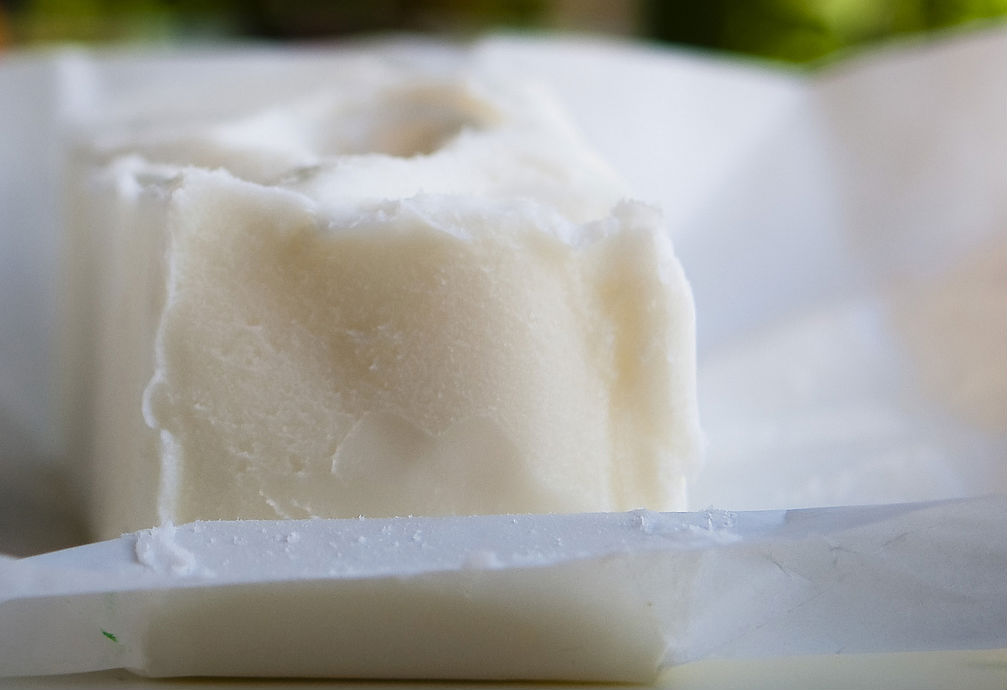
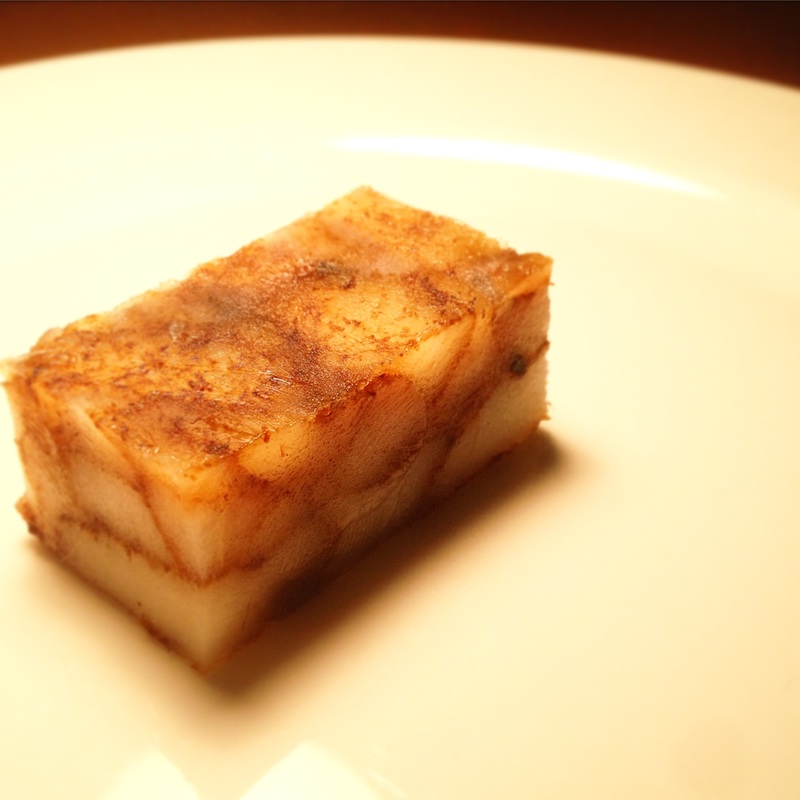
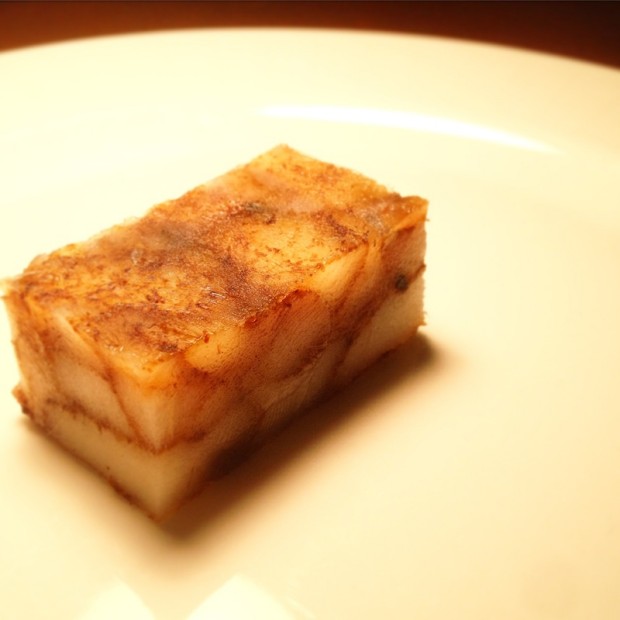
It was this feasting moment between myself and a fatty Mangalitza chop that inspired me to make more from the leftover fat than just lard, although the lard is great. I felt that if I was going to be receiving Mangalitza pigs to fabricate and put on a menu then the fat should be showcased. I wanted to leave more fat on the chops, make more lardo, and figure out how to make all these pounds of back fat into something that could serve to make delicious back fat shine as the main component in a dish. I hit the books and thumbed through multiple pages before my eyes stumbled upon Jamie Bissonette’s book, “The New Charcuterie Cookbook.” In his book he has a great recipe for whipped flavored lardo. He cooks the fat, strains the liquid, presses the fat, and then whips the cooled fat with different flavors to make spreads. This sounds delicious and it is what I intended to do with the fat I had. One of the first things I learned my one and only semester in culinary school is to read a recipe the entire way through before starting on a dish. I was only in culinary school for one semester so I clearly forgot this lesson. What I did was mess up Jamie’s recipe. I added all the flavorings to the raw fat, rendered everything together, and pressed the cooked, flavored fat. I knew that I had messed up, but at this point there was no return. I had no intention of whipping the fat like Jamie recommends. My mind was still in France and it was thinking about one of my favorite dishes called grattons that were made from pressed rendered fat. I went ahead and pressed the flavored mass overnight. The next day I came in and released the now beautifully pressed block of fat from its mold. What a fantastic result, it sliced like a cheese, it showcased the pressed ivory white chunks of fat, and retained just enough flavor to be extremely interesting when eaten like a fatty cheese.
I have sense waited to add most of the flavorings until after the fat is cooked, right before pressing, but the finished product is a thing of beauty. The flavorings get into all the nooks and crannies and cook a slight amount when added to the hot cooked fat, the different shaped fat chunks form a beautiful mosaic presentation, and the flavor is outstanding. A small slice set on my tongue easily melted away and left my mouth coated with fat and flavor. I have converted about 30 pounds of fat back into this cheese like fat product and sense returning from France it is the one thing that I most excited about at this point in my culinary life. In conclusion, I now love the Mangalitza for what they are, extremely fatty pigs. Isn’t this what I trained to do, use every part of a pig for the optimum benefit? If it is Mangalitza’s that I am dealing with I will now find a way to showcase the fat, not shy away from it, because that is what is special about these pigs. So for today, let us raise a glass for the delightfully wooly beasts that are the Mangalitza’s. Enjoy.
by Bruce Steele | Apr 18, 2015 | Mangalitsa Pigs, What Chefs Say
Jaume Guerra looks at me with a blank stare when I ask how he became interested in the world of Spanish hams. “Ham is a part of life in Spain,” he says, as if it was inevitable that he would become a master carver of piernas. I’m meeting with Guerra for a tutorial in Spanish jamónes, which, like any food or drink, become increasingly complex and fascinating the more you learn about them. As a greater variety of hams from Spain becomes available at U.S. grocery stores and from specialty purveyors, including Despaña and D’Artagnan, jamón aficionados may find themselves suddenly bewildered by the proliferation of choices in the meat department.
Jamón serrano, the Spanish ham almost every meat eater knows, has been available in the U.S. for about 17 years, Guerra explains, but it has recently been joined by the ibérico hams, the cebo and bellota varieties, and the lesser known (and considerably more expensive) mangalica. What are the differences among these three? And aside from asking for a sample and letting your taste buds make the decision for you, what should you know when you go to buy a Spanish ham?
Guerra gave TLK a crash course on the subject, explaining everything from how and what the pigs are fed and how long the hams are cured, to the characteristics you should look for in an exceptional Spanish ham, the carving instructions you should offer at the meat counter when you’re placing your order, and how you should serve and eat your ham at home.
Next, a look at the most famous Spanish hams…
Jamón Serrano
Jamón serrano is a working-class ham, the variety you keep on hand for day-to-day consumption, cooking (say, for croquetas and simple bocadillos), and for kids, according to Guerra. While your local meat counter is likely to have a wide selection of serranos, Guerra cautions that few of the brands sold in the U.S. are of high quality. “Large, corporate producers can afford to enter the export market,” he explains, “and the result is an abundance of mediocre hams.” Because they are exported in greater quantities and are cheaper than other Spanish hams, serranos, which are dry-aged for about a year, are often the victims of shortcuts in that aging process, which is what endows all Spanish hams with their rich flavor.
In Guerra’s opinion, the best jamón serrano available in the U.S. is by Jamónes Segovia. Don’t make the mistake of thinking that a ham marketed as having a denominación de orígen, or D.O., assures its quality. “Treat ham the same way you treat wine,” Guerra advises. “A wine with a D.O. from Rioja only means it’s from Rioja and was made under certain conditions; the D.O. itself doesn’t assure that you’re drinking a great wine.”
Jamón Ibérico
Jamón ibérico is a step—a big one—above serrano, because most of the pigs that yield the cebo and bellota varieties of ibérico are free-range and their aging processes are longer. Bellota is better known in the U.S. than cebo, primarily because the acorn-fed pigs have achieved near mythical status here, thanks to media outlets that have portrayed the pigs as coddled darlings. According to Ignacio Saez de Ibarra, general manager of Pata Negra and Imperial Chorizo in New York, a farmer can only have so many pigs, since a single bellota hog needs two full acres of acorn trees to achieve its harvesting weight.
In both cases, though, the fact that the pigs get to wander freely means that they’re exercising more than pigs being raised and fattened in commercial pens, and that, in turn, means they’re developing more intramuscular fat. The result? A richer flavor than the serranos. Ibéricos are also aged longer: cebos for 18-36 months, and bellotas for a minimum of 36 months.
“The Ibéricos are meant to be savored,” says Guerra, “to be part of an experience, to open the appetite. They’re a rich ham, ideal for degustaciónes or tastings.”
Jeffrey Weiss, author of the excellent and comprehensive guide to Spanish charcuterie, Charcutería, the Soul of Spain, offers tips for bringing the ibéricos to your table. Serve these with a fino sherry, he recommends; “It’ll knock your socks off!” At his restaurant, jeninni kitchen + wine bar, he likes to pair jamones with grilled bread and seasonal curtidos, “little pickled goodies that we make at the restaurant.” You can get his recipe for sweet and sour pickled garlic here.
Next, one of Spain’s most expensive exports…
Jamón Mangalica
Jamón mangalica reigns supreme among the Spanish hams, despite the fact that the heritage pigs from which it is sourced aren’t raised in Spain at all but in Hungary. The mangalica pigs are uniquely suited for the cold climate where they live, having developed a thick coat, and—most important to those who want to eat it–thick layers of intramuscular fat.
The mangalica pigs are open-pasture foragers that eat barley, corn, grass, soybeans, sunflowers, and wheat in small, free-range groups. Once they’re fattened and ready for aging, they head to Spain, where master jamoneros begin the long process of curing. It’s this ham that takes the longest amount of time to age to perfection, usually three years. “It’s the slow curing that gives mangalica its flavor,” Guerra explains, and its deep, rich, glossiness is best suited for degustación rather than piling onto a piece of crusty bread.
How to Get the Best Ham
Few butchers in the United States are experts when it comes to Spanish hams, says Guerra, and it’s helpful if you approach the meat counter with a bit of your own knowledge to ensure you’re buying the best quality and getting good cuts. Here are Guerra’s pro tips for buying Spanish jamónes:
• Look for evidence of tirosina. “Many people make the mistake of thinking that the white, crystalline flecks or threads on Spanish ham are undesirable, when the opposite is actually the case,” says Guerra. Tirosina (or tyrosine, in English) is an amino acid, and those white crystals are evidence that the ham has been aged slowly and adequately. You won’t see them in a ham whose aging process has been accelerated.
• Ask the butcher not to trim la corteza, the yellow layer of fat encasing the pierna. Even though it’s not edible, it protects the meat, serving a similar function as a rind on a hard cheese.
• Ask the butcher to slice the ham thin. Thick cuts of Spanish hams will obscure the richness and complexity of their flavors.
Pata Negra’s Saez de Ibarra adds that packaging doesn’t necessarily advertise the differences among the hams, especially between the cebos and bellotas. If in doubt, he says, “ask for longer curation periods, always closer to 18 months, at least.”
Where to Buy Spanish Hams
In New York City, Guerra recommends Despaña, which is the only retailer where the hams are sliced by hand. As for supermarkets, Fairway carries the hams mentioned here. Finally, Guerra himself can supply you with a pierna if you hire his master carving services for a party or private event. His price includes not only his expert slicing skills, but the pierna at cost.
Outside New York, all three hams, including the mangalica, can be ordered online or by phone from D’Artagnan.
Original post: http://thelatinkitchen.com
by Bruce Steele | Mar 24, 2015 | What Chefs Say
Chefs and restaurants are becoming proponents of sourcing humanely raised animals, because it’s better for the planet and the palate.
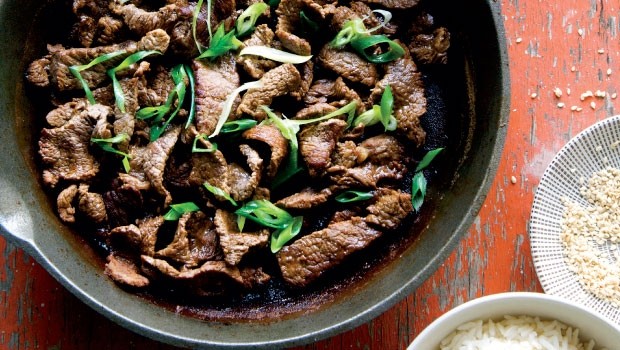
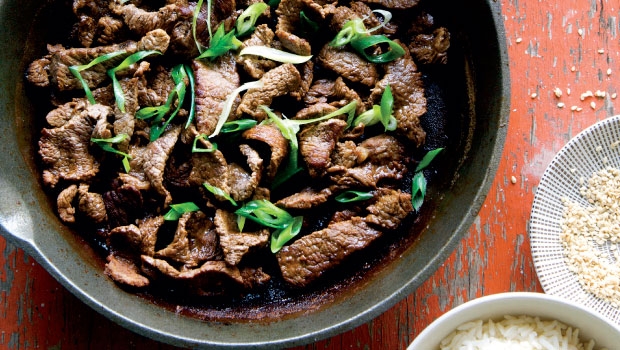
Beef Bulgogi Meat & Livestock Australia
In his formative years as a chef, Conor Hanlon didn’t think too much beyond the kitchen.
“I was much more concerned about keeping my head above water than about where we were sourcing ingredients,” Chef Hanlon acknowledges.
But now, as executive chef of the W Hotels in Miami and chef de cuisine at its upscale eatery, The Dutch, sourcing is no longer an ignored topic.
Chef Hanlon’s broadened enlightenment began seven years ago when he read about the Mangalitsa pig, a little-known Hungarian breed characterized by its fatty, marbled meat. Fascinated, he spent four months trying to find the pig, often called the Kobe beef of pork. When he finally secured the animal and cooked it, the experience proved transformative.
“That’s when the light bulb went off in me,” Chef Hanlon says. “Whenever something is being raised, there’s someone behind it—and the way [that person] is raising the animal translates into its taste.”
In subsequent years, Chef Hanlon became increasingly more engrossed in the issue of animal welfare and how animal care translates to both the plate and the dining experience.
“Because I love what I do, I want humanely raised products,” he says.
A multi-layered issue touching hot-button topics such as animal rights, environmental stewardship, and social justice, animal welfare has become a frequently discussed subject in the restaurant industry, one propelled by consumers and chefs alike.
“This is everybody’s issue,” says Jason Gronlund, vice president of culinary for Smokey Bones, a 65-unit casual-dining chain based in Orlando. “Just because we have to feed the population doesn’t mean we can take shortcuts in the care of animals.”
Though animal welfare is a subjective term with shifting meaning among chefs, farmers, producers, and consumers, Meat & Livestock Australia business development manager Catherine Golding says the principal elements of animal welfare remain evenhanded and clear: Animals should be treated with respect and care according to best practices in animal husbandry throughout their lives.
That extends “from the paddocks they were born and raised in to when they are transported for sale and at the processing plant,” says Golding, whose organization works with industry and government in Australia to promote fact-based best practices in animal husbandry.
All Creatures Great and Small
From cattle and dairy to pork and poultry—and even farm-raised fish—animal welfare continues to weave into the public’s consciousness. Cage-free and pasture-raised are no longer fringe terms, but pepper grocery store aisles and restaurant menus.

Dan Gibson has witnessed the transformation firsthand.
After experiencing 9/11 in New York City, Gibson traded fast-paced Manhattan for life on the farm. In 2002, he built a grass-fed herd at Grazin’ Angus Acres in Ghent, New York, and began selling in New York’s green market system in 2006. Even among the most conscientious chefs, Gibson says many struggled to understand the advantages of his meats compared with those arriving from a concentrated animal feeding operation (CAFO). Over time, he says, that has changed.
“There’s a significant and growing amount of the population that cares about this issue and is voting with their pocketbook every day,” Gibson says.
The burgeoning movement inspired Gibson to open Grazin’, a diner serving only Animal Welfare Approved (AWA) products, in 2011. AWA is a labeling program for meat and dairy goods that ensures animals were raised to the highest welfare and environmental standards.
Located in Hudson, New York, Grazin’ is a hit among the locals and frequently serves guests who have made the 120-mile trip from New York City specifically to visit his eatery. In 2014, sales jumped nearly 50 percent over the previous year. Those results and swelling interest have motivated Gibson to locate a Grazin’ outpost in New York City later this year.
“And we’re not going to stop there,” Gibson says.
Today’s consumers, many contend, are more sophisticated and interested in food than ever, accessing millions of resources to explore all aspects of food, from nutrition’s impact on the body to ethical sourcing.
“Food is in the consumers’ sight all the time now … and as demands change, you have to abide by that,” Smokey Bones’ Gronlund says, specifically noting the rise of organic goods and paleolithic diets.
According to AWA, raising animals intensively, either indoors or confined on dirt feedlots, harms animal welfare and, ultimately, human health and the greater environment. The organization, which is based in Arlington, Virginia, charges that headline-grabbing news about the rise of antibiotic-resistant bacteria, environmental pollution, and animal-welfare abuses spotlight the broken nature of the nation’s food system. Furthermore, AWA contends that the nutritional quality of meat, milk, and eggs is intrinsically linked to the welfare of animals and the impact of farming systems on the environment.
“Shouldn’t we all want to make sure that animals’ needs and wants are met?” AWA program director Andrew Gunther asks.
For many, the answer is a definitive yes, which has heightened calls for the elimination of cages and crates, and driven awareness around the ethical sourcing of animal products as well as restaurants’ roles and responsibilities.
Gunther calls animal welfare a “market pressure that’s coming,” and one that is only going to grow given Gen Y’s interest in social and environmental issues.
“All chefs should have this on their horizon because it’s vital to their business, especially given how much the market has shifted towards people wanting to know the background of their food,” Gunther says. “It’s better to get ahead of the game and secure your place in the market rather than sit on your hands.”
A more conscientious and questioning populace, meanwhile, has urged restaurants to define their brands by deeply vetting sources and pushing humanely raised goods as a marketplace differentiator. As Smokey Bones’ Gronlund notes, no restaurant wants negative press.
Increasingly, serving the greater good extends from the flavor on the plate to all the practices and processes involved in food preparation.
“Though it costs more to serve free-range chicken, it’s a product you can stand behind and be proud to serve,” Chef Hanlon says.
Looming beyond the ethical concerns and marketplace movement, however, there’s the critically important issue of taste. Beef, lamb, and other animal products raised according to best practices in animal husbandry simply taste better, many argue.
“It is a more tender, juicy, and, overall, just better-tasting meat,” Golding contends.
By returning to the original practices of animal husbandry, a counter to the mass commercialization of food, Chef Hanlon believes animals enjoy richer diets that result in more robust flavor profiles on the plate. He says the pasture-raised cattle of Australia avoid the sweet, starchy taste of their corn-fed domestic counterparts.
“When you put cattle in a lot and feed them the same product day after day, there’s no diversity,” Chef Hanlon says. “When the cattle are in a pasture, however, eating different grasses and grains each day, those flavors come through.”
Put more succinctly, he says: “Why take an animal that never ate corn and make it eat corn? It doesn’t make sense.”
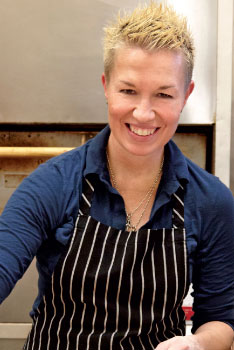
Celebrity chef Elizabeth Falkner, a James Beard Award nominee, believes a comparative taste test would deliver clear results.
“If more people tasted an animal that had been cared for and one that had been neglected, they would come to the same conclusion,” Chef Falkner says. “You can just taste the difference.
“And if nothing else,” she continues, “at least there has to be better karma in sourcing products from animals that have been treated the right way.”
Clarifying the Cause
While many can be sold on the rationale of sourcing goods from humanely raised animals, actually bringing those goods into the restaurant is a process that presents its own hurdles.
Rising consumer interest in food sourcing has created a litany of packaging terms that spark more confusion than clarity. According to AWA’s guide, Food Labels Exposed, terms such as fresh and all-natural have little meaning. Fresh, for instance, simply means that the internal temperature of the meat never dropped below 26 degrees Fahrenheit.
Similarly, all-natural has nothing to do with animal welfare, but rather signals that the meat contains no artificial ingredients or added colors, and that it was minimally processed. Even the term humane is employed loosely on packaging.
“Humane claims are now widely used to convince consumers the food manufacturer is making a special effort in the way animals are raised. However, there is no legal definition or minimum welfare standard for the term humane,” AWA reports.
This uncontrolled Wild West image of labeling has given defined third-party credentials—such as AWA or Certified Humane, two organizations that both perform birth-to-slaughter audits—added credence in the marketplace.
“These third-party agencies give credibility and also brand protection,” Gunther says, adding that leaning on a third-party helps a restaurant counter arguments between animal rights groups and producers.
Cattle and sheep products sourced from Australia, Golding adds, are also raised according to strict animal-welfare regulations. “The standards are legislated by law and enforced by state governments across the country,” she says.
At Smokey Bones, Gronlund says his team leans on its Australian-based vendor, JBS, to ensure the animal goods that Smokey Bones’ procures are humanely harvested and meet the restaurant chain’s defined specifications.
“We’re 100 percent clear in our expectations,” Gronlund says.
Then, of course, there’s the issue of price, a supremely important matter in an industry known for tight margins and intense competition. According to the AWA’s Gunther, the markup on some humanely raised products is significant. AWA-approved chicken, for instance, can be twice as expensive as other options in the marketplace.
Gibson, who is also a supplier to restaurants, says it takes much longer to finish cattle on grass, about three times as long as the 12–15 months needed at a CAFO. That investment of time is reflected in his prices. Ground meat goes for $10 per pound while filet runs $40 per pound. To some operators, absorbing higher prices is simply the cost of doing business in an evolving, more curious, and conscientious society.
At Grazin’, his own restaurant, Gibson simply charges what he needs to and explains the deeper value inherent in his products.
“There are lots of people who don’t think about livestock, but they’re not my customer,” Gibson says. “If you’re mindful about how an animal is raised, taken, and processed—and that’s important to you—then you’re going to seek me out. It’s that simple.”
Others, however, understand the need to be more flexible, nimble, and strategic in their sourcing. Competing in the casual-dining category, Gronlund says Smokey Bones must balance sourcing and pricing to stay cost-efficient and competitive. He says that process begins by looking at the restaurants’ target consumers and determining their hot-button issues.
“You have to know what matters to your customers,” he says.
To test that, Falkner says restaurants might ease into sourcing humanely raised products, perhaps investing in items it can first spotlight as specials before committing to regular menu items. “Then, track the success of those products and see if there’s a correlation,” Falkner says.
To further combat the higher costs, Gunther says some chefs decrease the portion size and take care to explain their sourcing efforts, which positions the restaurant to earn guest loyalty.
Falkner suggests restaurant leaders educate their service staff on where products come from and, in the case of animals, how they are treated. Front-of-the house staff can then relay this information to diners to build a more compelling story.
In addition, Falkner says restaurants might buy cuts that are not prime and use such products strategically, such as using the humanely raised product to complement the main entrée.
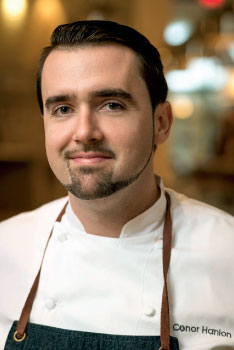
It’s a theory Chef Hanlon subscribes to at The Dutch. In November, for instance, Chef Hanlon topped a dish of roasted baby root vegetables with lamb shoulder braised with red wine. He then pulled apart the lamb and served it as a rich sauce over the vegetables.
“It’s about finding a happy medium,” Chef Hanlon says.
As informed by the past as he is in tune with the future, Chef Hanlon acknowledges he needs to selectively pick his battles concerning animal welfare and sourcing. His team at the W Hotels uses up to 1,000 eggs each day, an immense volume that makes obtaining free-range eggs cost-prohibitive. Still, he remains mindful and committed to other ways he can source humanely raised goods.
“No one opens a restaurant to close the restaurant,” Chef Hanlon says. “I have to pick the things that are important to me and run with that in a smart way. It’s about being realistic and pragmatic. We can’t do it all, but we can do some things that make a difference.”
Original post: http://www.fsrmagazine.com | Daniel P. Smith | Sustainability | February 2015