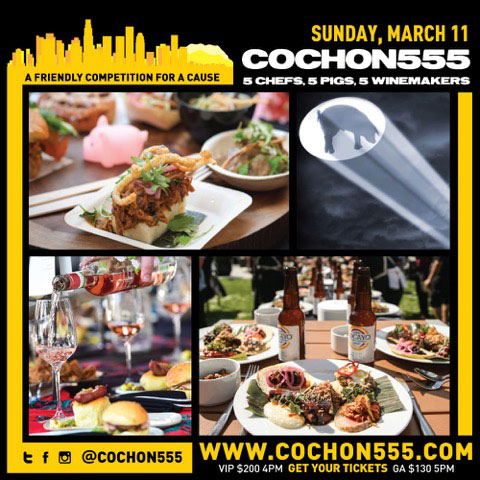
If you love a good cause and want to attend one of the country’s most talked about culinary events, then clear your weekend calendar when Cochon555 returns to Los Angeles on March 11, 2018 at the incredible Viceroy Santa Monica. Imagine an elaborate 30-course, stand-up, super sustainable dinner featuring amazing beverages where you get to help pick the best bite from some of the best local chefs.
This year’s all-star cast of chefs – who specialize in whole animal cooking and are paired with farmers responsibly raising delicious heritage breed pigs – include Sammy Monsour of Preux & Proper, Brian Redzikowski of Kettner Exchange, Thomas Bille of Otium, Lord Maynard Llera of Mason and Hugo Bolanos of Wolfgang Puck at Hotel Bel-Air. ButcherMichael Puglisi of Electric City Butcher rounds out a stellar lineup.
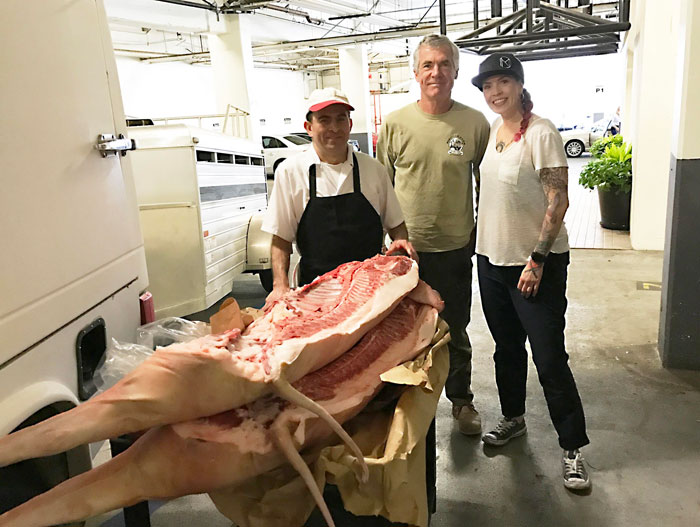
We at Winfield Farm are delighted to partner this year with Executive Chef Hugo Bolanos (@hugoalejandrobolanos) of Wolfgang Puck at Hotel Bel Air. On March 1 we will deliver a 200-pound heritage Mangalitsa from which Chef Hugo will make 6 magical dishes.
To win the friendly competition for a cause, a chef’s menu must woo twenty celebrity judges with their “Judge’s Plate” scored on utilization; technique; and overall flavor and be voted “best bite of the day” by guests. The winning “Prince or Princess of Pork” in Los Angeles will advance to the national finale, Grand Cochon, a head-to-tail, winner-takes-all showdown for the crown in Chicago on September 30th.
The ultimate aim of Cochon555 is to provide education to chefs and consumers and create experiences that guests can sink their teeth into: honest food from real farmers. The goal is to raise the bar on building a sustainable and profitable relationship for brands and chefs participating in culinary festivals. For an in-depth look at the distinguished providers behind the Cochon555 movement, to view a video, and to purchase tickets, please visit http://cochon555.com/us-tour/2018-la/
Tickets for general admission start at $130; VIP tickets (early admission + exclusive access to cocktail competition and allocated wines and spirits) are $200.
Where: Viceroy Santa Monica – 1819 Ocean Ave, Santa Monica, CA 90401
When: Sunday, March 11
Time: 4 p.m. for VIP entry, 5 p.m. for General Admission
The name“Mangalica” means “roll-shaped,” it could befrom theSerbo-croatischem “mangala svinija–pig thatiswell fed“, “Mangulica” or“Mangulac – easy fatbecoming” orby the Romanian“mancare –eat” may be derived.
Manynames are used for theMangalitsa, hisraces andcrossbreds: Mangalitsa, woolhairedpig, curly-haired pig,BarisandOrdas(crossbred) orBogauner(Bakony ancestor ofMangalitsa). In different countries are different spellingsforMangaltiza:
Mangalica(Hungarian), Mangulica(Serbian), Mangalita(rum), Mangalitsa(AmE), Mangulac, Mangaliza, Mangalicza. The races of theMangalitsapigs(HungarianBlondeMangalitsa) inHungarianSzöke, Fecskehasu(HungarianMangalitsaswallowbellied) andVoroscalled(HungarianRedMangalitsa).
Theprimary breedinginKisjenohas pioneeredthis development.A documentfrom 1833showsinvolved the transportationof twelveSchumadinka(Sumadija, Sumadia) fatpigs(2/10) as bredinTopscider, Belgrade,the SerbianPrince MilosObrenovic,thePalatine of Hungary, Joseph Anton Johann ofAustriainitsDömäneKisjeno. This“Milos–pigs” were pairedwithSzalontaiandBakony–pigs. Their descendantsbecame the basisfor subsequentfatpigbreeding. The“blood–Kisjeno” spread all overthe numerousbreeding flocksin Hungary.
Mangalitza as the leading lard type breed, the products ofthis pigfueledmainlythe population of theAustro-Hungarian Empire. The reason of his popularity was the fat.After a longtimerunner, the pigs were fattenedupto 250 to300 kg,. 20to 25cmbackfatnot uncommon.
Before the introductionof the DanubeSteam Navigationand construction ofrail shipmentsof pigfarms they had to bring the pigs to the Viennaslaughterhouses in weeklongwalks by feed.1871,38.330fatpigsfrom GyorandSopronwere driven to the Viennamarket.
In the1890sinBudpesta pigmarketsystemandthepig slaughterhouse was built. Hungarianlivestockcensusin 1895showeda population of6,447,143pigs(MATLEKOVITS 1900;Tormay1896). 94%of them belongedtothe lard type pig.
Hungarywith 407pigsper 1000 inhabitants, the country with the mostpigs in Europe. 189473%to Central andWestern Europewere exported.
This firstgolden age of Hungarianfatpigbreedingendedin 1895introduced fromAmerica,swine plague, export restrictions andrival, foreignpigmeatbreeds. The stockrecovered onlyin 1911, but was againdecimatedin the war years.
In 1927, theHungarianNational Association ofFatPigBreeders(Mangalicatenyésztok OrszágosEgyesülete, MOE)establishedandrecognizedtheMangalitsa pigofficiallyas a separate breed. The Mangalitsaexperienced after theSecond World War,a new boom. The number of registeredbreeding pigsincreasedby 1943to 30.000pieces.
From the 50s of the 20thCentury, the demand for pork productschanged radicallyandpig breedswith leanmeat qualitysupplanted theMangalitsa pig. Duringthe lateseventiesindustrialpigestablishedwith importedpigmeatbreedsandstandardizedhealth conditionsinwarehouses, theMangalitsa pigwas maintainedonlyinzoos oroccasionallybysmallfarmersfor their own use.
In 1973, theMangalitsain Hungarywas placed underprotectionandintroduceda subsidizedgene reservebreed. Until 1980within10 farmsit was possible to rebuilt a breeding line of the threeraceoptions:Blonde, Red and swallowbellied
Onlyan exportagreement with Spainfor the production ofSerrano ham(Jamón Serrano) from 1990causedan economic boomofMangalitzas.
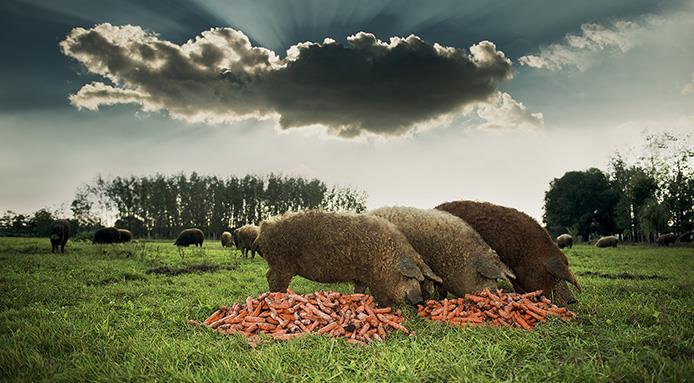
Known as Mangalica, Mangalitsa or Mangalitza, this is the pig prized for its high fat marbled meat that has been hailed as the Kobe beef of pork and attracted critical acclaim from chefs around the world.
As delicious as it is, tracking down this curly haired rare breed hog is still somewhat of a challenge, despite its growing popularity.
In response to the huge Facebook interest we had from our initial article introducing the delights of the succulent meat, we’ve decided to put together a list of some of the farms, shops and restaurants where you can get your hands on this tasty find.
From a rural farm in Wales to a three Michelin-starred restaurant in New York find out where you can try this tasty delicacy and you’ll be hooked.
Meanwhile, those wanting to go the whole hog should mark the annual Mangalica Festival Budapest in their diary for three days of celebrations from 10 to 12 February 2017 (TBC) and anything and everything related to Mangalitsa.
Preface — Mangalitsa pigs (like the rare Hungarian breed raised at Winfield Farm) are the only other pigs besides Iberico that can officially be labeled “pata negra”. In fact, Spanish charcutiers rediscovered Mangalitsas in Hungary in the early 1990s while looking for new sources of premium quality lard hogs and found Mangalitsa, and their interest saved the breed from extinction. Mangalitsas also are descended from European boar lines.
[Photographs: Max Falkowitz]
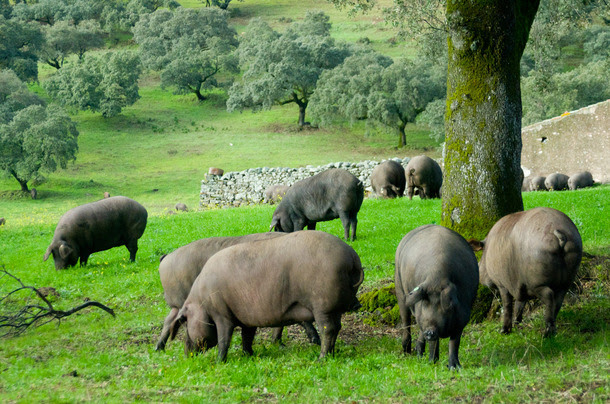
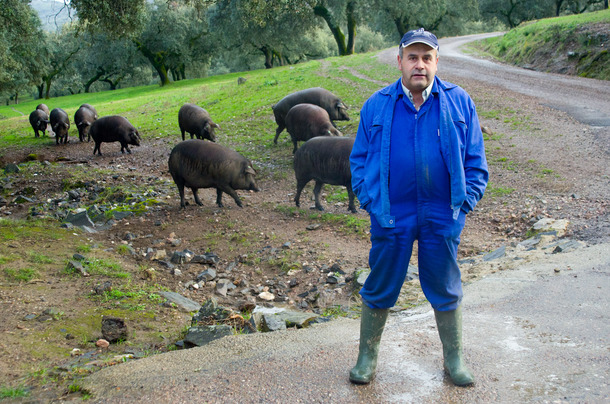
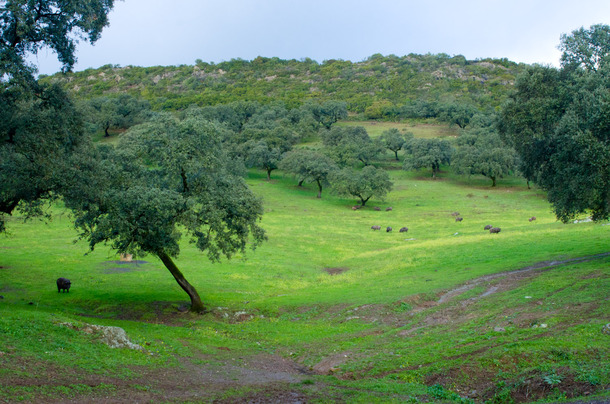
It’s a misty Wednesday afternoon and the pigs are hard at work. So is their porquero Juan Carlo, who’s busy guiding them across this 1,700 acre farm to the land’s choicest acorns. At sunrise, Juan Carlo rouses about 340 pigs from their farmhouse and sets them to work. At sundown he corrals them back to the ranch. This year marks his 25th on the job.
In a few weeks the pigs’ work will be done: they’ll be sufficiently fattened up from their grazing to be slaughtered, butchered, and turned into some of the most expensive ham in the world—at my local source, $220 for a hand-sliced pound. Why so much? Because it’ll be jamon Iberico puro de bellota, acorn-fed pure breed Iberico ham, and sold under the Cinco Jotas (5J) brand, one of the oldest and most well-respected in Spain.
It’s a misty Wednesday afternoon and the pigs are hard at work. So is their porquero Juan Carlo, who’s busy guiding them across this 1,700 acre farm to the land’s choicest acorns. At sunrise, Juan Carlo rouses about 340 pigs from their farmhouse and sets them to work. At sundown he corrals them back to the ranch. This year marks his 25th on the job.
In a few weeks the pigs’ work will be done: they’ll be sufficiently fattened up from their grazing to be slaughtered, butchered, and turned into some of the most expensive ham in the world—at my local source, $220 for a hand-sliced pound. Why so much? Because it’ll be jamon Iberico puro de bellota, acorn-fed pure breed Iberico ham, and sold under the Cinco Jotas (5J) brand, one of the oldest and most well-respected in Spain.
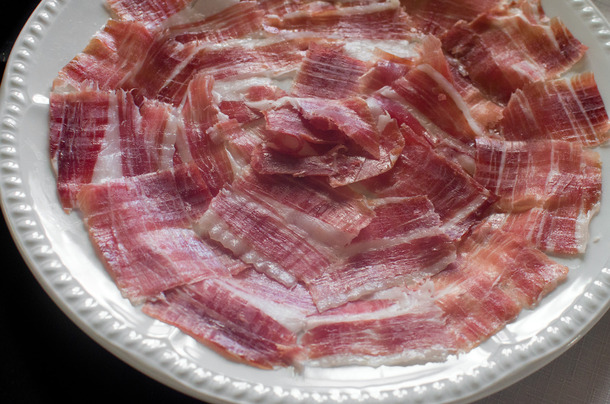
Acorn-fed jamon Iberico is intensely sweet. It’s floral, earthy, and nutty like good Parmesan, with fat so soft it melts right in your mouth. For many ham lovers it’s as good as good gets, and it never comes cheap.
This storybook-green plot of land, dotted with knobby trees and cooled by the breezy Iberian climate, is one of many across Spain and Portugal that raises pigs for Sanchez Romero Carvajal, the company that produces 5J ham. But all those pigs eventually make their way to a small town called Jabugo where hams cure in a 130-year-old cellar designed for the task. From start to finish, the ham-making process is simple: grant good pigs the freedom to be good pigs, let them feast on the land, then cure their flesh with little more than salt and air.
For most eaters, that’s where the story begins and ends. But there’s more to it—a process that blends unwavering tradition and modern technology to produce this sought-after ham. To share what work that involves, Carvajal invited me to tour their farms and ham curing facility. Though the visit wasn’t all-access—there wasn’t time to see the pigs’ nurseries or the actual slaughter facilities, for instance—no questions were off-limits. Here’s how it all happens.
Behind the Label
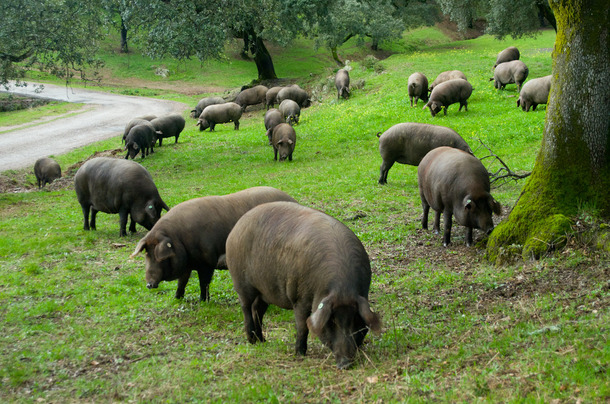
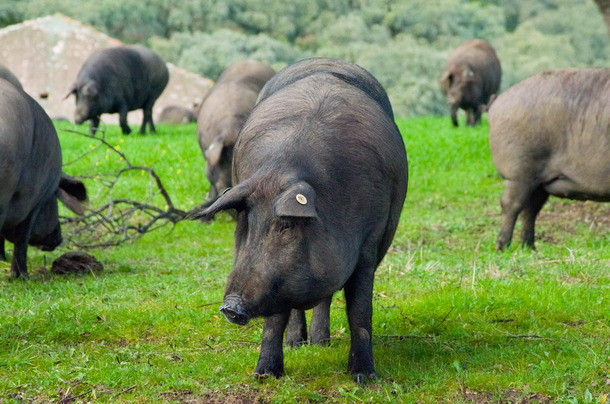
In the world of Spanish ham, there are two premium classifications: Iberico pigs and acorn-fed pigs. Unlike white pig breeds like Serrano, black-skinned Iberico pigs are descendants of the Mediterranean wild boar, and are colloquially called pata negra (“black foot”) for the hoof that accompanies each ham. They’re athletic animals, runners and rooters, and thanks to the structure of their intramuscular fat, their meat is more flavorful, juicy, and distinctive.
Iberico pigs are expensive. They have smaller litters, yield less meat per head, and take time to mature, which is why many ham producers around Spain cross-bred them with other varieties. Up until recently, ham made from pigs that were as little as half-Iberico could be sold as jamon Iberico, but new legislation now requires Iberico ham to be labeled according to the percentage of the pigs’ Iberian ancestry. 5J is one of the few brands to exclusively use pure Iberico pigs.
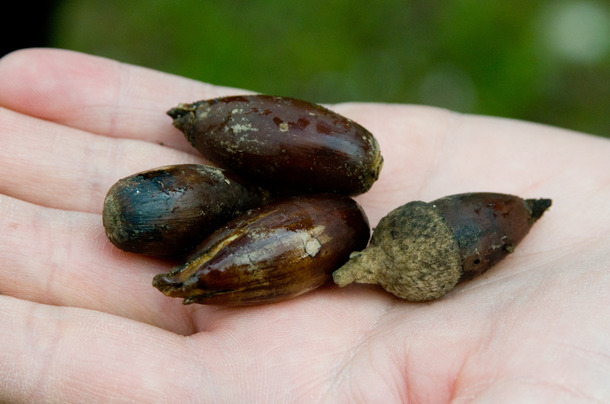
Then there’s the acorns, the bellota, which fall from oak and cork trees from early October to early March on the farms where the pigs are raised. They’re high in fat, a large percentage of which is unsaturated oleic fatty acid, and eating them is what makes the pigs’ fat so soft and creamy, on the verge of melting at room temperature. Acorns also contribute to the ham’s nutty flavor and aroma, as essential to the product as the meat itself. Of all commercially raised Iberico pigs, only 5% are both pure breed and acorn-fed.
From Piglets to Porkers
Spanish ham culture has a vocabulary all its own. There are porqueros, not shepherds; pigs are “sacrificed,” not slaughtered; and the farms where they’re raised are called dehesas.
The dehesas are a national treasure: each one to two thousand acres of forest partially converted to pasture, often hundreds of years old, with rolling grassy hills amidst crops of acorn-producing oak and cork trees. Just as acorns are an essential ingredient to the ham, so too are the dehesas. These pigs need to run around all day, over the hills and through the woods, for their muscles to develop and for the ham to taste the way it does.
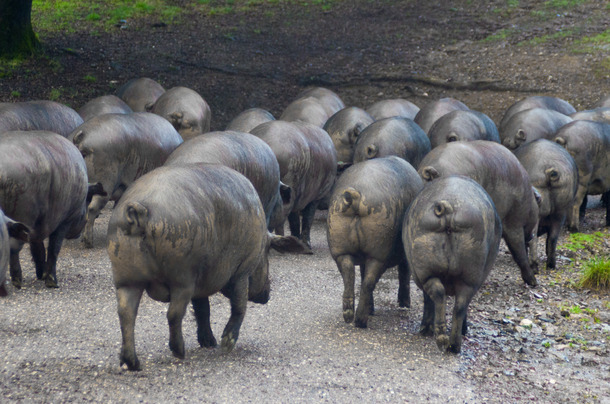
Over 18 to 24 months, the pigs will root around the dehesa, grazing on grass, mushrooms, bugs, herbs, whatever they can find. Come October all through March, the montanara, or acorn-dropping season begins, and the pigs march into action. Fatty acorns are the pigs’ favorite food, and with a mandated five acres of dehesa per pig, there’s plenty of room to look for them. By the pigs’ second montanara, they’ll have feasted enough to reach their kill weight, about 360 pounds.
Managing the pigs isn’t just left to nature. Carvajal inspectors pay anonymous visits every two to three weeks to check on their treatment and diet. They also sample the pigs’ fat to analyze its oleic acid content—too little and the pigs won’t meet quality standards, too much and they’ll be impossible to cure into ham.
You may have heard that pigs are as smart or even smarter than dogs. On the dehesa they behave more like sheep dogs than sheep. Curious about newcomers, they’d inch closer and closer to me, some even posing nicely for the camera, before bolting away. Unlike livestock domesticated into complicity, these wild boar descendants stay smart.
The Long Cure
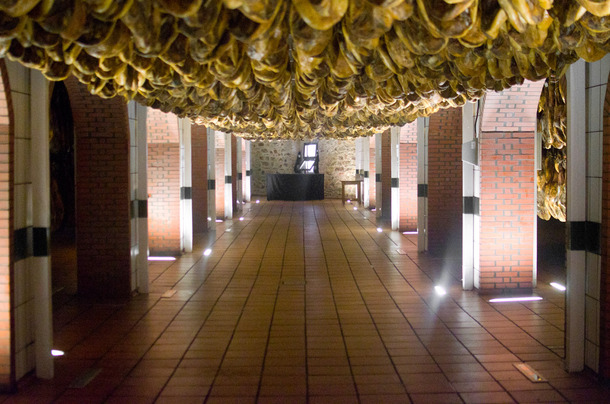
The curing facility in Jabugo is over 100 years old: part modern office space, part ancient farm house. In one courtyard you can still see hundreds of hooks on the ceiling from when ham was cured out in the open. These days they rest in a sprawling brick-walled cellar.
Before they get there, the pigs must be slaughtered. They’re knocked out with CO2, and once a pig is deemed unconscious by a vet, a worker slits the artery along its throat until it bleeds out. Legs, loins, and shoulders go toward making Carvajal products, and the remaining fresh meat is sold to Spanish restaurants. The ham-bound legs are then skinned, salted, rinsed, dried, and sent to the curing cellar, where they’ll remain for about a year and a half.
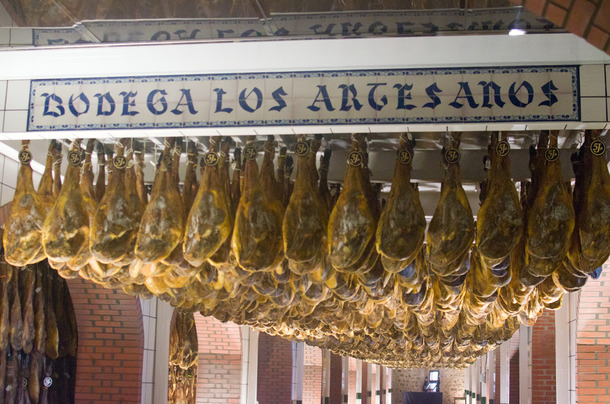
See those hanging bits at the top? All ham.
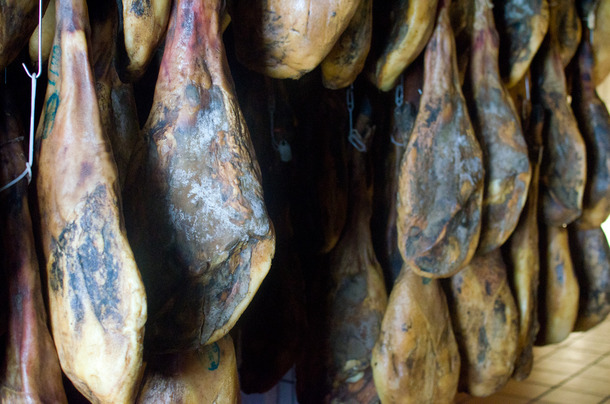
Carvajal’s 130-year-old cellar is an underground city of ham; step downstairs and you’re slapped with an aroma that’s something like rising bread, aged cheese, and your deli’s cured meat display—multiplied by the 40,000-odd hams inside. With little signage it’s a marvel anyone knows their way around. “Don’t worry,” an employee tells me, “I get lost in here all the time.”
Thick brick walls, a breezy, hilly climate, and a stable population of ham-friendly microorganisms are most of what the meat needs to finish its journey into ham. Skilled specialists monitor the cellars at all times, noting fluctuations in temperature and humidity, but their adjustments are amusingly low-tech. Need to change the temperature? Open or close a window. Air too dry? Spill some water on the floor.
It’s more complicated than that, of course—hams too close to a window may get moved if they dry out too quickly, and the legs are regularly rubbed down with oil to prevent insects from taking up residence—but the most vital and final measurement Carvajal takes is very much a human one.
Before any ham leaves the cellar, it gets a sniff test. A trained nose can purportedly detect 100 aromas from a premium ham, some sweet, some meaty, some nutty. Different regions of Spain have their own hammy terroir, and even different cuts of the same leg bear unique aromas.
A mere eight noses are charged with inspecting all the hams. The job is so specialized that one ham sniffer, a third generation Carvajal employee, isn’t qualified to sniff cured loin (another 5J product) because the aromas are too different. (That’s his father’s job.)
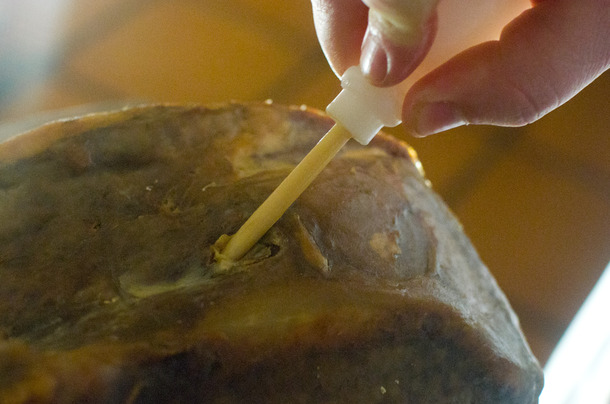
With a short, stubby needle called a cala, the ham sniffer pokes down to the bone, quickly takes a whiff, and covers the breach with a smear of fat. There’s just a second or two to detect the balance of sweet, earthy, fermented, and floral aromas that signal a well-cured ham, and only a ham that passes the sniff test in four inspection sites makes its way out the door. If anything goes wrong, the nose knows.
Even for ham-loving Spaniards, 5J ham is a luxury good, which is why Carvajal also sells a more affordable ham under a Spanish-only brand called, eponymously, Sanchez Romero Carvajal. It’s made from the same pigs and cured in the same cellar, just not held to quite as stringent conditions. Only at the cellar do quality control experts decide which hams get the 5J label and which ones don’t.
To Market, to Market
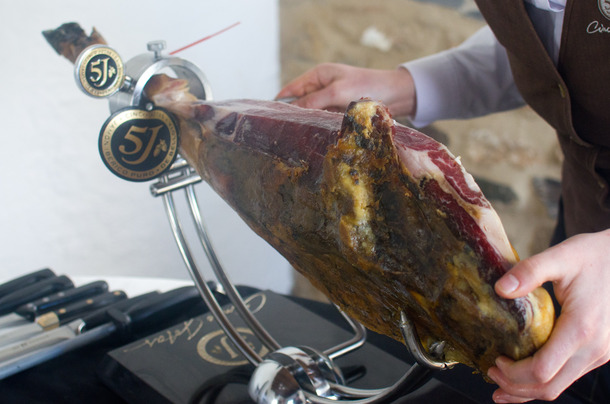
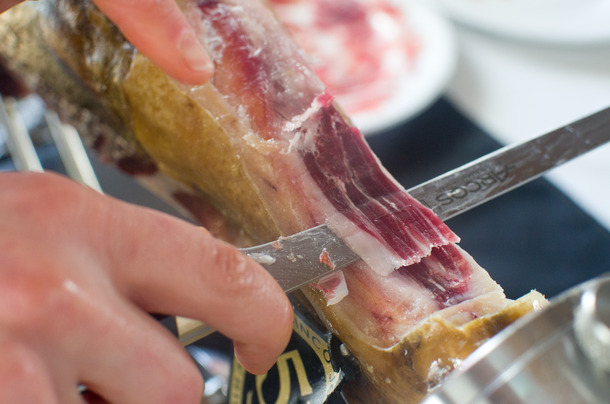
From there the ham moves on to a grateful world, though in truth many whole hams have already been spoken for by bars, restaurants, and large-scale clients that reserve them while they’re still aging. Jamon Iberico shouldn’t be sliced by machine—the soft fat would sheer out and the lean, bony legs make horizontal slicing difficult—so when Carvajal sells whole hams to a new restaurant or store client, they also provide training in how to slice the ham by hand. (You can see a good introductory video here.)
The company also employs 60-odd expert carvers who fabricate all of its pre-sliced packaged ham. Like cutting fish for sushi in Japan, carving Spanish ham is an artisan job of its own. The perfect slice is nearly see-through, small enough to eat in one bite, and carved at a level angle to get the most consistent and efficient slices from the ham as possible.
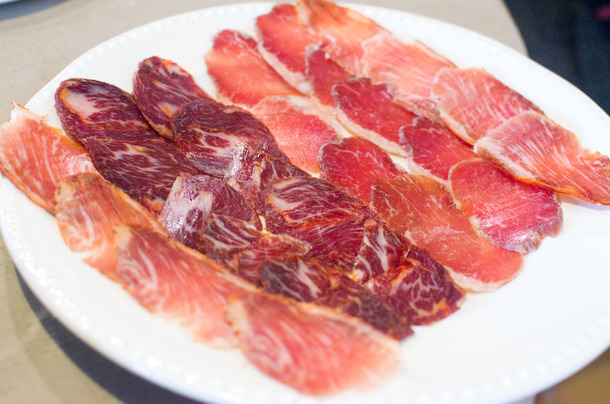
Remember how expert ham sniffers can detect four different aromas from the same ham? You may not be able to pick up on all the nuances, but it’s easy to see that different cuts of ham look and feel different, from the maza’s clean striations of fat to the ribeye-like marbling of punta—or the hard-to-reach “butcher’s cut” of the ham, the chewy, flavor-packed cana near the hoof. A skilled carver knows how to make the most of them all, mixing up a plate of ham with multiple cuts for contrast.
Which brings us back to where we started: why does good jamon Iberico cost so much? It’s more than the expensive pigs, spacious farmland, or acorn-rich diet. It’s more than the time and investment needed to prepare and cure hams properly, or the laboratory science and quality control behind the scenes.
Carvajal also sells cured loin and shoulder products.
At the end of the day the question comes down to scale—how much can you produce when every step along the way is so labor-intensive? What substitute is there for highly trained specialists who in some cases are born into the job?
Good pigs, living and dead, need time. And as with plenty of other luxury goods, there’s a choice to do something fast or to do it right. Fortunately for us (and the pigs), there are still some people more interested in the latter.
Shopping — your cart will add and display your selections on each product page below. You may continue to shop and add items to your order until you wish to checkout. Use the dropdown list under Mangalitsa Market for quick access to our products.
Minimum order $40.
PLEASE CALL 805.686.9312 BEFORE ORDERING ONLINE TO ENSURE PRODUCT IS AVAILABLE.
We supply Mangalitsa pork to local restaurants and some cuts are in high demand. Also not all sausage flavors are available all the time, but can be custom ordered.
We will of course refund any portion of an order placed that we cannot fulfill, or with your approval we may substitute product of comparable value. However, to ensure and simplify your order, please contact us first, before placing your order on PayPal.
Don't forget, you can pre-order particular cuts or sausage flavors and we can have pigs custom processed to your specifications. Just email us your preferences. Processing is seasonal, typically spring and fall. Thank you for your interest in Mangalitsa pork.