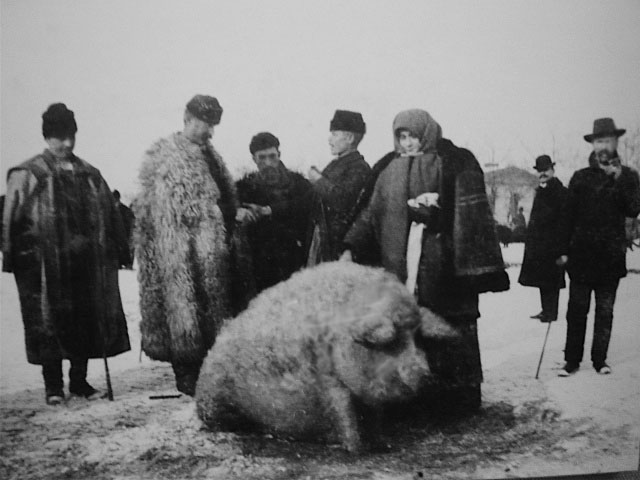
by Bruce Steele | Jan 14, 2015 | History
The Mangalitsa even inspired its own Operetta. In 1885 Johann Strauss II wrote “The Gypsy Baron,” wherein a wealthy pig farmer (Kálmán Zsupán) declares:
Ja, das Schreiben und das Lesen
Ist nie mein Fach gewesen,
Denn schon von Kindesbeinen
Befasst ich mich mit Schweinen,
Auch war ich nie ein Dichter
Potz Donnerwetter Parapluie!
Nur immer Scheinezüchter
Poetisch war ich nie!
Translated:
I’ve no time for learning writing,
breeding pigs is too exciting
and I’ve got no time for reading,
for the pigs will keep on breeding
So I’ve never been a reader,
for reading I don’t care two figs,
I’m just a humble breeder,
who keeps on breeding pigs
“When a man chooses pigs over literacy you know you’ve got some powerful lard!” — Wilhelm Kohl
Excerpt from The Cookbook “The Mangalitsa Pig – Royalty is coming to America” — By Mate Dobesch, Wilhelm W. Kohl, Peter Toth, Beata Bencsics, Eszter Szalai

by Bruce Steele | Jan 13, 2015 | History
In recent years Mangalitsa (pronounced MAHN-ga-leet-za) pork has retaken the foodie world by storm.
With their abundant fat, the curly-haired Mangalitsa pigs of Hungary were all the rage a century ago – favored by nobility in the Austro-Hungarian empire. Mangalitsas were bred for their silky white-as-snow lard on the Hungarian farms of Archduke Joseph in the 1830s. Herds shrank with the collapse of the Austro-Hungarian Empire after World War I and declined further with the introduction of fast-growing white pigs and cheaper vegetable oils after World War II.
With the fashion trend to lean meat, Hungarian wooly pigs, a heritage breed lard hog, nearly went extinct.
Mangalitsas were saved from extinction on a farm at the edge of Hungary’s Great Plain, in efforts to preserve Hungarian heritage. Now that succulent, flavorful pork is back in style, along with increasingly popular charcuterie, Mangalitsa pigs are making a comeback.
Mangalitsas are reknown for charcuterie, cured meats such as prosciutto and sausage. Mangalitsa is the only other heritage “black footed” hog besides Spanish Iberican that can be marketed as “pata negra”, premium prosciutto.
The Mangalitsa pig is genetically very similar to the Iberian pigs of Western Spain that produce the famous Jamon Iberico. And like their cousins, the Mangalitsa pig is renowned for the quality of the fat that it produces, which is low in saturates and high in oleic acid. This comes from the feed given to the animals, which primarily consists of wheat and acorns.