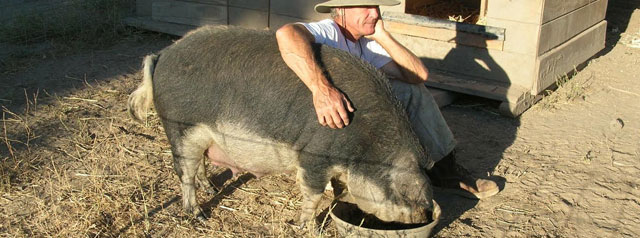
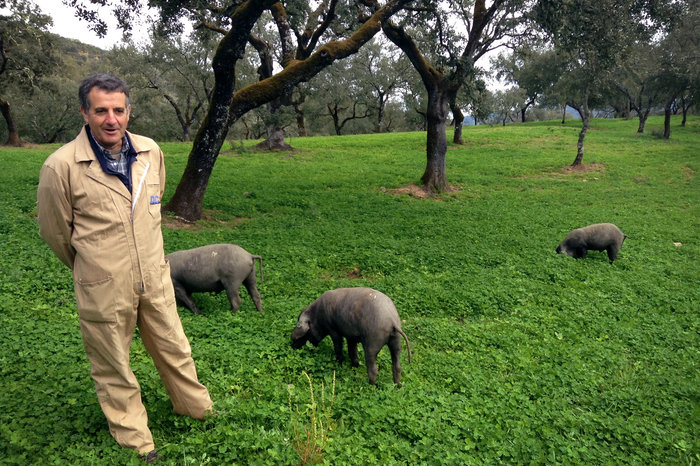
by Bruce Steele | Apr 18, 2015 | Mangalitsa Pigs, What Chefs Say
Jaume Guerra looks at me with a blank stare when I ask how he became interested in the world of Spanish hams. “Ham is a part of life in Spain,” he says, as if it was inevitable that he would become a master carver of piernas. I’m meeting with Guerra for a tutorial in Spanish jamónes, which, like any food or drink, become increasingly complex and fascinating the more you learn about them. As a greater variety of hams from Spain becomes available at U.S. grocery stores and from specialty purveyors, including Despaña and D’Artagnan, jamón aficionados may find themselves suddenly bewildered by the proliferation of choices in the meat department.
Jamón serrano, the Spanish ham almost every meat eater knows, has been available in the U.S. for about 17 years, Guerra explains, but it has recently been joined by the ibérico hams, the cebo and bellota varieties, and the lesser known (and considerably more expensive) mangalica. What are the differences among these three? And aside from asking for a sample and letting your taste buds make the decision for you, what should you know when you go to buy a Spanish ham?
Guerra gave TLK a crash course on the subject, explaining everything from how and what the pigs are fed and how long the hams are cured, to the characteristics you should look for in an exceptional Spanish ham, the carving instructions you should offer at the meat counter when you’re placing your order, and how you should serve and eat your ham at home.
Next, a look at the most famous Spanish hams…
Jamón Serrano
Jamón serrano is a working-class ham, the variety you keep on hand for day-to-day consumption, cooking (say, for croquetas and simple bocadillos), and for kids, according to Guerra. While your local meat counter is likely to have a wide selection of serranos, Guerra cautions that few of the brands sold in the U.S. are of high quality. “Large, corporate producers can afford to enter the export market,” he explains, “and the result is an abundance of mediocre hams.” Because they are exported in greater quantities and are cheaper than other Spanish hams, serranos, which are dry-aged for about a year, are often the victims of shortcuts in that aging process, which is what endows all Spanish hams with their rich flavor.
In Guerra’s opinion, the best jamón serrano available in the U.S. is by Jamónes Segovia. Don’t make the mistake of thinking that a ham marketed as having a denominación de orígen, or D.O., assures its quality. “Treat ham the same way you treat wine,” Guerra advises. “A wine with a D.O. from Rioja only means it’s from Rioja and was made under certain conditions; the D.O. itself doesn’t assure that you’re drinking a great wine.”
Jamón Ibérico
Jamón ibérico is a step—a big one—above serrano, because most of the pigs that yield the cebo and bellota varieties of ibérico are free-range and their aging processes are longer. Bellota is better known in the U.S. than cebo, primarily because the acorn-fed pigs have achieved near mythical status here, thanks to media outlets that have portrayed the pigs as coddled darlings. According to Ignacio Saez de Ibarra, general manager of Pata Negra and Imperial Chorizo in New York, a farmer can only have so many pigs, since a single bellota hog needs two full acres of acorn trees to achieve its harvesting weight.
In both cases, though, the fact that the pigs get to wander freely means that they’re exercising more than pigs being raised and fattened in commercial pens, and that, in turn, means they’re developing more intramuscular fat. The result? A richer flavor than the serranos. Ibéricos are also aged longer: cebos for 18-36 months, and bellotas for a minimum of 36 months.
“The Ibéricos are meant to be savored,” says Guerra, “to be part of an experience, to open the appetite. They’re a rich ham, ideal for degustaciónes or tastings.”
Jeffrey Weiss, author of the excellent and comprehensive guide to Spanish charcuterie, Charcutería, the Soul of Spain, offers tips for bringing the ibéricos to your table. Serve these with a fino sherry, he recommends; “It’ll knock your socks off!” At his restaurant, jeninni kitchen + wine bar, he likes to pair jamones with grilled bread and seasonal curtidos, “little pickled goodies that we make at the restaurant.” You can get his recipe for sweet and sour pickled garlic here.
Next, one of Spain’s most expensive exports…
Jamón Mangalica
Jamón mangalica reigns supreme among the Spanish hams, despite the fact that the heritage pigs from which it is sourced aren’t raised in Spain at all but in Hungary. The mangalica pigs are uniquely suited for the cold climate where they live, having developed a thick coat, and—most important to those who want to eat it–thick layers of intramuscular fat.
The mangalica pigs are open-pasture foragers that eat barley, corn, grass, soybeans, sunflowers, and wheat in small, free-range groups. Once they’re fattened and ready for aging, they head to Spain, where master jamoneros begin the long process of curing. It’s this ham that takes the longest amount of time to age to perfection, usually three years. “It’s the slow curing that gives mangalica its flavor,” Guerra explains, and its deep, rich, glossiness is best suited for degustación rather than piling onto a piece of crusty bread.
How to Get the Best Ham
Few butchers in the United States are experts when it comes to Spanish hams, says Guerra, and it’s helpful if you approach the meat counter with a bit of your own knowledge to ensure you’re buying the best quality and getting good cuts. Here are Guerra’s pro tips for buying Spanish jamónes:
• Look for evidence of tirosina. “Many people make the mistake of thinking that the white, crystalline flecks or threads on Spanish ham are undesirable, when the opposite is actually the case,” says Guerra. Tirosina (or tyrosine, in English) is an amino acid, and those white crystals are evidence that the ham has been aged slowly and adequately. You won’t see them in a ham whose aging process has been accelerated.
• Ask the butcher not to trim la corteza, the yellow layer of fat encasing the pierna. Even though it’s not edible, it protects the meat, serving a similar function as a rind on a hard cheese.
• Ask the butcher to slice the ham thin. Thick cuts of Spanish hams will obscure the richness and complexity of their flavors.
Pata Negra’s Saez de Ibarra adds that packaging doesn’t necessarily advertise the differences among the hams, especially between the cebos and bellotas. If in doubt, he says, “ask for longer curation periods, always closer to 18 months, at least.”
Where to Buy Spanish Hams
In New York City, Guerra recommends Despaña, which is the only retailer where the hams are sliced by hand. As for supermarkets, Fairway carries the hams mentioned here. Finally, Guerra himself can supply you with a pierna if you hire his master carving services for a party or private event. His price includes not only his expert slicing skills, but the pierna at cost.
Outside New York, all three hams, including the mangalica, can be ordered online or by phone from D’Artagnan.
Original post: http://thelatinkitchen.com
by Bruce Steele | Mar 22, 2015 | Mangalitsa Pigs
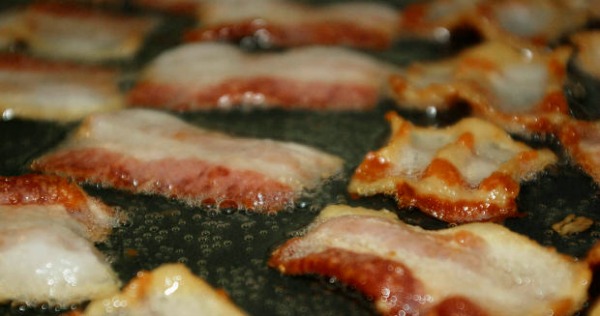
Looks like those 3 extra pieces of bacon you had for breakfast this morning were actually saving your life. OK, that might be pushing it, but we’ve got good news for you pork lovers out there. Researchers at ETH Zurich just uncovered that foods packed with niacin – Vitamin B3 – are linked to a longer life. A team of researchers fed a selection of roundworms a good dose of niacin and the introduction of this new element increased their lifespan by one-tenth longer, in comparison to their Vitamin B3-deficient worm friends.
You can find niacin in paprika, sun-dried tomatoes, marmite (yech), peanuts but most importantly bacon. The study purports that niacin fools the body into thinking that it’s performing physical exercise, even if you might just be channel surfing on the couch. If you were thinking about scooping up that bacon-covered donut for dessert later today, you might as well, just consider that taking a tip in the fountain of youth.
Note, roundworms do not equal people. So, take this all with a grain of salt(ed bacon).
H/T GeekOSystem
Natalie James
Food & Travel writer | blogger. Rap lover. Magic maker. I’ve got this city on my fork.
Read the original post: http://www.foodbeast.com
by Bruce Steele | Mar 20, 2015 | History, Mangalitsa Pigs, What Chefs Say
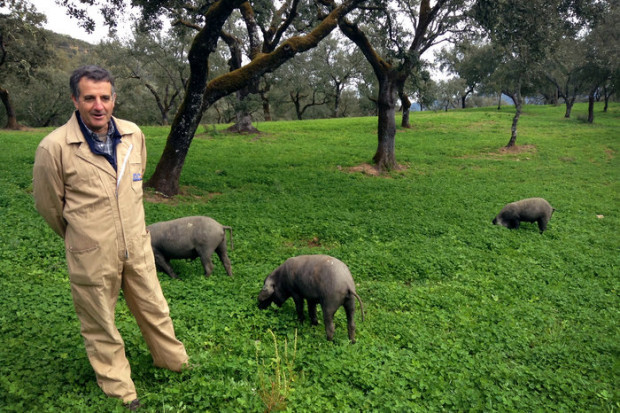
Pig farmer Armando Escaño stands with his Iberian pigs on his farm on western Spain’s dehesa. Escaño raises pigs for jamón ibérico, Spain’s most prized ham. | Lauren Frayer for NPR
In Spain, an age-old way of surviving the winter is getting some new attention from foodies worldwide. It’s called la matanza — literally, the killing of a pig. It’s an ancient ritual in danger of dying out, amid an influx of commercial abattoirs and modern supermarkets. But Spain’s matanza is now getting renewed interest from farm-to-table food enthusiasts.
Armando Escaño calls out to his fat black pigs as they chomp on acorns under cork trees. Escaño comes from a centuries-long line of pig farmers on western Spain’s dehesa, a UNESCO-protected landscape where this country’s most prized ham — jamón ibérico — is produced.
“You can see the future in the past. It’s lasted thousands of years and is therefore sustainable.”
– Chef Dan Barber
Lured by that delicacy, tourists are now making these empty green hills a new foodie destination. They’re coming to see how Armando’s pigs live — and how they die.
“Matar means ‘to kill’ in Spanish — but the word ‘matanza’ actually refers to the whole process that takes two to three days, which starts with the actual slaughtering, but involves the seasonings of the meats and charcuteries,” says Miguel Ullibarri, a tour guide and jamón expert who organizes culinary tours of the dehesa region. “There’s lots of cooking involved — quite a lot of drinking as well!”
Ullibarri’s company, A Taste of Spain, brings visitors to learn about the farm-to-table, free-range, organic eating that’s been the norm here for centuries. Tourists typically spend a few days in Spain’s dehesa, a landscape of rolling hills dotted with cork oaks and fat black pigs. They learn about the relationship between wildlife and landscape conservation: Each Iberian pig requires nearly 5 acres of grazing land, on average. They also learn about the pigs’ relationship to cork — some 80 percent of global cork exports come from this border region of Spain and Portugal.
“These age-old practices carry with them a very complicated ecological understanding, and an intimate engagement with the environment, because technology has not penetrated the agricultural landscape like it has in America,” says Dan Barber, the chef and co-owner of Blue Hill and Blue Hill at Stone Barns, who has toured western Spain with Ullibarri. “You can see the future in the past. It’s lasted thousands of years and is therefore sustainable.”
Barber writes about his discovery of Spanish food traditions in his latest book, The Third Plate.
Like Barber, Ullibarri’s guests tour jamón-curing facilities, and they sometimes attend a matanza — the pig slaughter.
“It’s important to know where your food comes from — even if the experience is unpleasant.”
– Juan Miguel Ramos, mayor of Linares, Spain
“They simply pick the animal up, and lay him on a table — all the while, they’re all stroking him and trying to keep him calm,” recalls Bob Hancock, a Kentucky native who went on one of Ullibarri’s tours a few years ago. “They simply just cut the artery, and the pig is bled out. They don’t do what they do here in the States, [where] they either stun or shoot the animal to knock the animal out. The pig was simply calm until his life was gone.”
The pig is massaged to calm him, and to prevent the flow of adrenaline into his muscles — which can change the flavor of the meat.
Hancock was so impressed with what he witnessed in the matanza that he decided to raise pigs at home in Kentucky. “It was a completely different experience! You could really feel the respect they gave to the animals,” he says.
Iberian black pigs can weigh 500 pounds, having doubled their weight in the two-month acorn season, right before the slaughter. Outside the acorn, or bellota, season, the pigs eat grass, other plants, corn feed — even insects. The matanza has always been an intimate community affair. Tour operators must get to know local officials personally and persuade them to allow foreigners to attend in small groups.
“The matanza is such a core part of the culture, in the sense that it’s how people fought to stay alive — it provided the food for the year. So for them, it’s not a hobby that’s taken lightly — it’s not roasting your ribs on the weekend,” says Ryan Opaz, a Minnesota native who now lives in Portugal and runs a food and wine tour company, Catavino.
Opaz has received increasing numbers of requests for tours that include the matanza and hopes to add them to his company’s itineraries next year — but he says it must be done carefully.
“It’s not a pretty sight for some people. So there’s a bit of voyeurism here. What the tourists are looking for is that full visceral experience,” says Opaz, a former butcher himself. “If it’s done respectfully, it’s truly like stepping back a century — which is great.”
Ullibarri says his company was reluctant at first to include the matanza in its tours. Guides spend days explaining the historical and cultural context of the matanza before guests watch the killing. They want to be careful to respect the wishes of local officials, who don’t want their age-old practices to appear backward to foreigners.
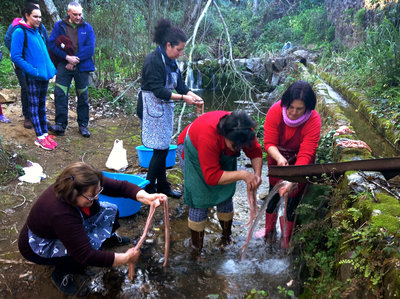
Women wash pig’s intestines in the local river near the village of Linares, Spain. After the matanza, or pig slaughter, every part of the animal is used, nose to tail. The intestines — cleaned with water, lemon and vinegar — will be used as sausage casings.
Lauren Frayer for NPR
NPR was invited to attend a matanza in the Spanish mountain village of
Linares, population 300.
“It’s a rural tradition we want to preserve,” says Linares’ mayor, Juan Miguel Ramos. “It’s important to know where your food comes from — even if the experience is unpleasant.”
In Linares, the matanza is done in a farmyard not far from the town square. Villagers drag the pig onto a wooden table that looks like an altar — they use the Spanish word sacrificar, to sacrifice, rather than to kill. Grown men coo and pet the pig, to keep it calm. A man wields a sharp knife, and women rush forward with buckets for the blood.
“¡Está muerto! ¡Sangre! — It’s dead! Blood!” a man screams. The whole process takes less than 15 seconds.
“The rest is women’s work,” says Carmen Ramos, chuckling, her arm elbow-deep in a bucket of hot blood, which she stirs vigorously to keep from coagulating. The blood will be mixed with rice, oats and spices to make morcilla, a type of Spanish blood sausage.
The pig’s heavy carcass is carefully lifted onto a wooden cart and hauled into the town square for butchering. And a festival begins. Flamenco music blasts from speakers affixed to the town hall; children dance on cobblestones.
The women take the pig’s intestines down to the river, where they wash them in a cold stream with lemon and vinegar. The intestines will be used as sausage casings. Every part of the pig is used — nose to tail, and down to the hooves, which are boiled for gelatin.
“We came out to the countryside to show our little girls the old tradition,” says Isabel Romero, a Spanish tourist from the city of Malaga, who brought her daughters, ages 11 and 6. “It’s the first time they’ve seen that pork doesn’t always come from the supermarket.”
After his matanza tour, Bob Hancock went home to Kentucky and installed a Spanish wood oven in the bakery he owns — and started raising pigs himself.
“There’s a huge wave of people getting into a nose-to-tail style of eating. They’re not just going to the three-star Michelin restaurants. They’re doing exactly what I did,” he says. “And slowly but surely, the way we are looking at our food here is changing — for the better.”

Village women chop herbs for use in sausage at a matanza festival in the village of Linares, population 300, in the Sierra Aracena, in southwestern Spain. | Lauren Frayer for NPR
March 18, 2015 | by Lauren Frayer | NPR | Read original post: http://www.npr.org/
by Bruce Steele | Feb 22, 2015 | Mangalitsa Pigs
WINFIELD UPDATE –
A visit from Wilhelm Kohl, author of “The Mangalitsa Pig: Royalty is Coming to America”
[slider id=”visit”]
The power of social media to connect the world is amazing! Wilhelm Kohl co-authored “The Mangalitsa Pig: Royalty is Coming to America”, to document the history of these amazing Hungarian wooly pigs and share recipes from Hungarian chefs.
Wilhelm discovered the Winfield Farm website Mangalitsa page and subscribed to our e-letter, then responded to our Christmas greeting. Trading emails and phone calls back and forth, we learned that he is partner in a Mangalitsa farm in Michigan raising red and blonde Mangalitsa wooly pigs, is writing a sequel featuring American Mangalitsa farms and recipes from American chefs, and – the amazing part – he asked to visit us for the purpose of including Winfield Farm and Bruce in his new book!
Wilhelm arrived at the farm on February 18, accompanied by his photographer, Barbara Meyer zu Altenschildesche, a Royal red Mangalitsa farmer in the Netherlands who also runs a confinement breeding operation, raising Manga piglets for export, some to the United States.
Small world!
Barbara and Wilhelm showed up at feeding time, and spent the afternoon in the field, photographing our swallow-belly Mangalitsas. Barbara made friends with our 450-pound foundation boar Augustus (Gus), “speaking” to him and scratching his belly (albeit through the fence of his paddock).
Following the introduction to our porcine menagerie, we gave Barbara and Wilhelm the proverbial cooks tour of restaurants in the Santa Ynez Valley who have purchased Winfield Mangalitsa pork.
[slider id=”synchefs”]
On Wednesday evening we visited Root 246 Restaurant in Solvang for a special dining experience. Root 246 bills itself as offering the ultimate in farm-to-table cuisine. Chef Seth Nelson exceeded expectations with an elegant entrée, Winfield Farm bone-in Mangalitsa loin chops, brined in whey crafted from house-made ricotta cheese, which also adorned the plate.
On Thursday Barbara photographed our newest addition to the farm, 17 six-week old Manga piglets – so adorable with their wooly coats still colored with racing stripes. (The stripes fade when the pigs mature.) Then we were off to lunch at Industrial Eats in Buellton, a bustling European-style restaurant featuring two custom “beehive” pizza ovens and its own charcuterie case. Owners Jeff and Janet Olsson, who also operate New West Catering and have been great customers of Winfield Farm produce, bought our first Mangalitsa – in fact Jeff has purchased several over the last year. His interest in charcuterie –– he makes yummy prosciutto, melt-in-your-mouth lomo (which we devoured as it was served on their large meat plate) and other cured delicacies from our pigs –– is a big reason why we settled on raising Mangalitsa pigs in the first place. (Mangalitsa, a heritage lard breed originating in Hungary, is renown worldwide for charcuterie… and a natural fit for us after visiting Hungary four times and falling in love with the country.)
After lunch we visited Chef Pink and Courtney Rae DeLongpré at Bacon & Brine – a relatively new and very popular lunch spot in Solvang that features ONLY local sustainable produce — and Winfield Mangalitsa pork when available.
Barbara posted a series of photos of our visit to Chef Pink on her Mangalitsa Breed Facebook page afterward, commenting “Facebook is amazing. .. without it we never would have met.”
Our culinary tour concluded Thursday evening at Full of Life Flatbread in Los Alamos, where owner/chef Clark Staub served us a five-course Mangalitsa feast truly fit for Royalty! First came home-made levain bread with avocado and Mangalitsa lardo, garnished with rose-pickled Winfield Farm “Gen Red” onions, grown from seed stock that Bruce created himself. Then we dove into a wild boar and Mangalitsa “Scotch” egg, and shaved puntarell, fennel and radish salad bedecked with Mangalitsa speck. A signature Flatbread ‘pizza’ featured house-made shamen’s bread with rosemary lardo.
The entreé was oven-roasted bone-in Mangalitsa loin roast on a bed of charred blood orange, with fennel and paprika, served with broccolini, fingerling potatoes and wild nettles. To top off the meal Euro style, we finished with little gem lettuce salad with cherry tomatoes, sheep’s milk cheese and Mangalitsa ‘croutons’. All in all, a truly amazing!!! dining experience crowning a visit that we won’t forget!
Wilhelm and Barbara departed early on Friday morning and we will continue to stay in touch. In fact, Wilhelm suggested that I write Bruce’s profile for his new book – he called it a great story… from covered wagon days (Bruce’s family crossed the prairie in the mid 1800s to settle in CA), to sea urchin diving to Mangalitsa farming. As Bruce says, he’s moving up in the world!
Postscript: Now that we have some 80 Mangalitsas to raise for market, we have begun our own social media campaign. Please check out our new Mangalitsa webpage and News Blog, as well as our Winfield Farm Facebook page (www.facebook.com/WinfieldFarmBuellton)
Also FYI: We now have USDA certified, frozen cryovac-packaged Mangalitsa rib chops, a few Boston butt and Tri-Tip roasts (2 lb pkg), smoked ham (2 lb pkg) and bacon (1 lb pkg), as well as trotters and smoked ham hocks. Characteristic of this heritage breed, we also have lots of leaf fat! Please visit our Mangalitsa Market online to order.
We will be going to market again in April. Please sing out now to reserve your Mangalitsa pig (or custom cuts).
All the best,
Bruce and Diane
Photo credits: DB Pleschner | Barbara Meyer zu Altenschildesche — Visit the gallery for full size and additional photos taken during this visit.
by Bruce Steele | Jan 22, 2015 | Mangalitsa Pigs
Winfield Farm Mangalitsas are raised naturally on pasture, and are fed barley and organically grown pumpkins and squash, much of it grown right here. All pigs going to market are finished on acorns, walnuts, and almonds when available – their diet like the famed Iberico pigs that are cured for premium prosciutto – pata negra.