The Neglected Harvest: Acorns

With 41 million Americans facing hunger currently, the search for solutions is constant – all but a scarce few are overlooking the abundant yet neglected harvest many communities fail to see outside their doorsteps despite their very real hunger. America’s acorns could be feeding millions – directly and indirectly. Acorns have long been eaten by people and animals all over the northern hemisphere – there’s nothing to stop us from eating them again or using them to raise animals. For example, some of the finest prosciutto comes from acorn-fed free-roaming Iberico pigs in Spain. Instead of acorns being a landscaping nuisance, we need to embrace them for what they are: hyper-local, nutrient-dense, gluten-free, perennial, wild-foraged food!

The Miracle Acorn

Acorns don’t come every year: instead they form masts, massive yields that occur in intervals every two to a dozen years. You might have a nut tree in your yard like a pistachio that alternates the years it fruits. This large yield allows for an easy harvest and processing, which requires only drying and leaching of the tannins. It is rare, but sometimes an oak tree grows acorns that has no tannins – it is a sweet acorn! We all can gather our own acorns, process them, and eat them or feed them to our animals. You don’t need to be an expert on acorns to gather enough acorns for an entire year within a few hours with a rake and dustpan. It truly is a natural abundance during those mast years!

Imagine gathering all your flour needs for the year in one afternoon. It’s similar to the way hunters take home one or two deer in a few weekends of hunting and save on buying meat from the store the entire winter or even next year. Natural abundance has that kind of ability – it’s what gave early humans the free time to imagine, reflect, and invent new ways of thinking and being. We could be leveraging natural abundances that are already in place to fight hunger and free ourselves from annual grains by embracing the perennial foods already in place.

Living on Acorns

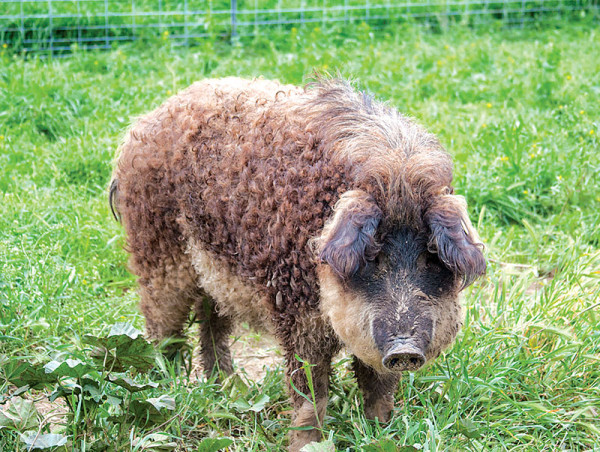
For several seasons now, Winfield Farm’s Bruce Steele has been only eating food grown and raised on his farm as part of a challenge that he and a friend took upon themselves. He relies on acorns in his diet, and he’s planning on scaling up even more by growing oak trees to raise acorns to feed his Mangalitsa pigs which he sells for meat and uses their lard for biodiesel to run his farm in tandem with solar power.
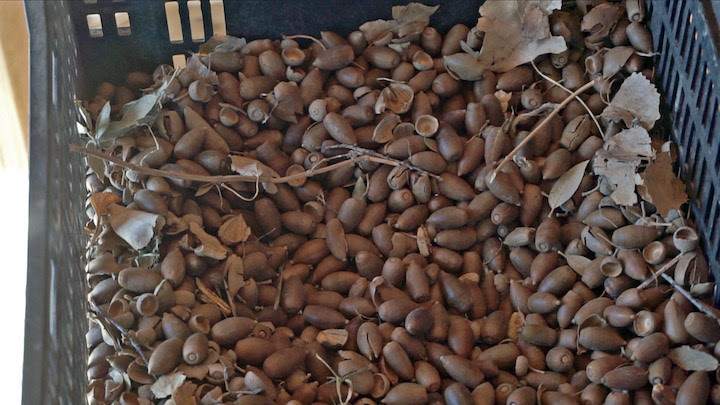
Bruce Steele shares his insights here on drying, leaching, processing, researching, and using acorns:

After collecting acorns you need to spread them out and dry them. This process takes a couple months. Acorns that are cracked or acorns that try to germinate will spoil and need to be thrown away. Sun drying is ideal, but acorns need to be moved indoors if rain or fog threaten. Acorns that fall early in autumn have better drying conditions than acorns that fall later during rain season. Acorns that have dried will separate from the shell and facilitate ease of use with the Davebuilt nutcracker. The nutmeat needs to be separated from the shells, a somewhat time consuming part of processing acorns, but it is during this process that you need to sort out any spoiled or moldy nuts.

The next step is rehydrating the nutmeat overnight with some water in a refrigerator. They can then be a put into a blender (one cup meats and two cups water) and blended into a wet cornmeal consistency. The nutmeat and water are then transferred into one quart mason jars and put back into the refrigerator. Once a day, pour off the liquid but be careful to not pour out the white layer of starch that floats above the blended nutmeat – you can use a natural fiber cheesecloth to do this. After you’ve drained off the tannin-rich liquid, add fresh water. Repeat this process until when you hold a bit of the acorn mush in your mouth, it isn’t bitter at all. This can take 3 – 10 days depending on your acorn type. This is called cold water leaching.

Different acorns require different amounts of time for leaching. Holm oak needs fewer days of leaching than native California oaks. If you can locate Holm oaks, I would suggest using them. There are many different types of oak trees and acorns – you need to experiment with each type to determine how long they take to remove the bitter tannins. This step is critical to making acorn flour for human consumption. If you have access to California black oaks that live at above 3,500 feet in the Sierra then you should try to collect and process them because they were favored by Native American tribes.

I have processed California Live Oak, valley oaks, cork oaks, holm oaks, and Gambel oaks from Arizona. Black oaks are a good species to target. In Arizona there is a species of sweet oak with very low tannins called Emory oaks. All of these western oak species can be processed into acorn flour, but some take more leaching time than others, and some just taste better when you are done.

Once you have finished the leaching process, pass the water, white starch, and nut meat through a strainer, and keep the water: it will have the white starch in it. You can wait till the starch settles and decant the water. This is the part of acorns that the Koreans use for Dotorimuk (Korean acorn jelly). It is very useful as a thickener and can be utilized much like cornstarch. The strained nutmeat can be spread thinly onto a cookie sheet and sun dried. Once dry, a flour mill will turn the dried nutmeat into acorn flour.
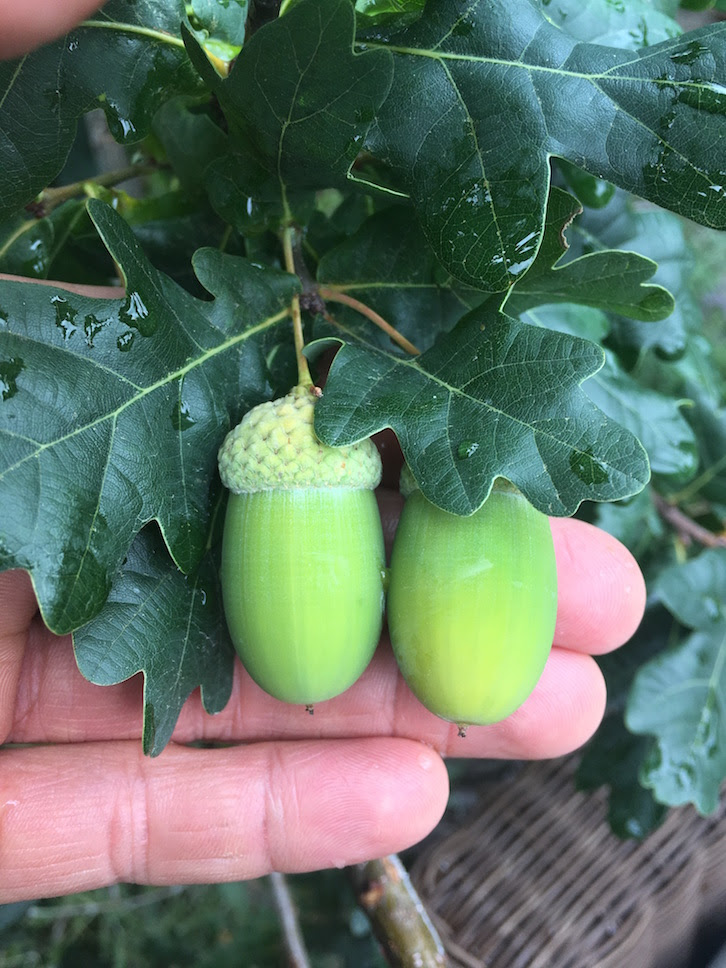
Bruce’s methods are just one way to process acorns for food purposes – there are several other ways to do it: you can even leave the acorns in a net bag in a stream for 3-7 days to let the tannins flow out that way! Learning to use your acorn products requires some experimentation in various recipes. Acorn flour has no glutens and will not rise like wheat flour. Some people mix it with wheat flour for cakes or cookies, but if you are using it as a gluten-free flour, then you need to experiment with using beaten egg whites to lighten cookie, cake, or pancake recipes. If you don’t want to use eggs, you could use any other binder you choose. Mark Salter, acorn aficionado, has tried and likes tapioca starch, arrowroot starch, and even cattail starch!

The Oaken Future

While you may not have an oak tree in your yard, your area likely has some, and if not, there’s likely an indigenous edible equivalent in your area that is being similarly neglected. The native oak savanna is an assembly of interrelated species, not just the acorn-bearing canopy tree. As we embrace the cornerstone of an ecosystem and food system that worked in concert, we will see the return of other beneficial species for medicine, fiber, and food. By supporting the oak savanna and native biodiversity, we support so much of what the oaken savanna generated and protected.

When you crack open an acorn, you are participating in a long tradition that spans the northern hemisphere, and one that can open the door to end hunger, break off our reliance upon industrialized agriculture, and embrace an abundant world of wild foods and foraging abundance!

Here’s the article as a PDF, as seen in Issue 09 of Permaculture Magazine.
COCHON 555 LA competition

Winfield Farm is delighted to partner with Chef Jason Neroni, from The Rose Cafe in Venice, in the COCHON 555 LA competition at the Viceroy in Santa Monica this Sunday, March 13. Chef Neroni is preparing magical dishes from a Winfield Farm Mangalitsa. Taste the magic on Sunday afternoon. Please come to the celebration and experience the magic yourself – tickets are still available and can be obtained here: http://events.cochon555.com/los_angeles_2016_industry

cochon

Jane Says: You Shouldn’t Be Afraid of Nitrites

We get more nitrites from our saliva than we consume in products such as hot dogs or bacon.

(Photo: John Anthony Rizo/Getty Images)

“My family and I would love to indulge occasionally in good-quality bacon, sausages, hot dogs, and other cured meats, but I worry about the nitrites. Arent they dangerous?
Caleb James

To get a handle on nitrites, it helps to understand the role salting plays in curing meats. In On Food and Cooking, food scientist Harold McGee writes that salting, like drying, preserves meat by depriving bacteria and molds of water. “The addition of salt—sodium chloride—to meat creates such a high concentration of dissolved sodium and chloride ions outside the microbes that the water inside their cells is drawn out, salt is drawn in, and their cellular machinery is disrupted. The microbes either die or slow down drastically.” Chemistry is inherently operatic, when you think about it.

Other salts, such as those found in rocks, water, and even vegetables (hold that thought!), also play a critical role in curing meats. One of them, potassium nitrate, has been pressed into service for a very long time. Potassium nitrate’s common name is saltpeter (from sal and petra, the Latin words for “salt” and “rock”) because early food preservers scraped the saltlike crystalline substance off the nearest boulder to preserve their kill with. It wasn’t until around 1900 that scientists discovered that certain salt-tolerant microorganisms transform a small portion of nitrate into nitrite, which, in a genuine aha moment, turned out to be the true active curing agent. Once this was known, McGee explains, producers could replace saltpeter in the curing mixture with much smaller doses of pure nitrite. This is now the rule except when it comes to traditional dry-cured hams, for example, “where prolonged ripening benefits from the ongoing bacterial production of nitrite from nitrate.”

The use of nitrite remains an integral part of traditional curing methods for several reasons:

•   It reacts in the meat to form nitric oxide, which binds to the iron atom in the red pigment myoglobin and prevents the iron from causing the fat to oxidize. That binding also produces the rosy pink-red color of cured meats—what we’ve been used to aesthetically since about the 10th century, when the Romans began adding saltpeter to meat to obtain that desired color.

•   In terms of flavor, it contributes a characteristic sharpness that keeps evolving; a country ham aged for 18 months, for instance, has had time to develop a deep, resonant whang. And because nitrite is a powerful antioxidant, it helps keep the flavor of cured meats vibrant and free from off-flavors.

•   Nitrite also squashes a variety of pathogens, including, most important, Clostridium botulinum, the bacterium that can cause rare but deadly botulism. Botulus is a Latin word for “sausage,” by the way, and the bacterium came by its name from its pathological association with Wurstvergiftung, or “sausage poisoning,” first investigated in the late 18th century in Germany.

But if you’re worried about consuming these preserving agents, let me break this to you as gently as I can: Even if you wouldn’t touch a ham sandwich, pepperoni pizza, or salumi plate with a 10-foot pole, you can no more avoid nitrate and nitrite than fly to the moon. According to sources such as “Human safety controversies surrounding nitrate and nitrite in the diet,” published in the journal Nitric Oxide: Biology and Chemistry, our saliva, surprisingly, “accounts for approximately 93.0% of the total daily ingestion of nitrite while foods account for a very small portion of the overall daily nitrite intake. This is due to the chemical reduction of salivary nitrate to nitrite by commensal bacteria in the oral cavity.” Forget cured meats; if you’re really concerned about nitrite, better stop swallowing.

Or, for that matter, eating vegetables, which contain the largest component (about 87 percent) of our dietary intake of nitrate. Those with the highest levels of nitrate are red beets, spinach, radishes, celery, lettuce, cabbage, fennel, broccoli, cucumbers, and leeks. If you’re interested in diving deeper, check out “Nitrate in vegetables,” a report by the Scientific Panel on Contaminants in the Food Chain of the European Food Safety Authority published in the EFSA Journal. I don’t imagine nitrate smoothies are going to be labeled as such at juice bars anytime soon, but optimizing the nitrate content in beet juice is of great interest to athletes and sports nutritionists.

While we’re on the subject of vegetables, let’s take a moment to contemplate “nitrite-free” bacon, hot dogs, etc. If you read the packages carefully, you’ll notice that what they actually say is “no nitrates or nitrites added.” Big difference in meaning there. What the producers use instead is celery powder or celery juice, both concentrated sources of nitrate, which is converted to nitrite by a bacterial culture.

An organic or natural hot dog may contain better-quality meat, but it also may contain just as much nitrate/nitrite or more as your everyday ballpark frank. In a 2011 business piece for The New York Times, William Neuman cited a study published in the Journal of Food Protection that year, which “found that natural hot dogs had anywhere from one-half to 10 times the amount of nitrite than conventional hot dogs contained. Natural bacon had from about a third as much nitrite as a conventional brand to more than twice as much.” Meat producers don’t have it easy in this case; truly nitrite-free products routinely fail in the marketplace because consumers don’t like them—people are accustomed to the color and flavor that comes with the curing process. But it’s high time the USDA took a fresh look at what is one heck of a confusing labeling issue.

So what makes nitrate and nitrite so controversial in the first place? In large enough amounts they are indeed toxic, the way anything is, even water. The main toxic effect is methemoglobinemia, a rare (and reversible) condition. Accidental poisonings aside, you would have to ingest thousands of hot dogs at a single sitting in order to overdose. The most eaten by Joey Chestnut, who won his eighth Nathan’s Hot Dog Eating Contest this year, is 61.

But cancer, of course, is everyone’s main concern. The potential of nitrate/nitrite to form carcinogenic N-nitrosamines in cured meats was first identified in 1971, according to the historical summary in the Nitric Oxide article mentioned above. “Their formation can take place only under special conditions where secondary amines are present, nitrite is available to react, near neutral pH is found, and product temperatures reach greater than 130°C, such as during the frying of bacon.”

The resulting shit show—er, groundswell of public concern—led to new regulations that lowered the amount of added nitrites, and new production practices were implemented. Among those practices was the addition of ascorbic acid (aka vitamin C, sodium ascorbate, erythorbic acid, sodium erythorbate), which inhibits the chemical reaction that can lead to the formation of nitrosamines. Additional limits exist for bacon: Nitrate is not permitted, so that actual concentrations of nitrite can be more precisely controlled; it’s also required to have either 550 parts per million added sodium erythorbate or sodium ascorbate, regardless of curing method, to inhibit the potential for nitrosamine formation during frying.

In a 2009 nationwide survey of cured meats and vegetables, it was “concluded that consistently lower levels of residual nitrate and nitrite than those from a survey reported by the National Academy of Sciences in 1981 existed.”

“Residual nitrite levels of 7 ppm in cooked sausages (hot dogs), 7 ppm in bacon, and 7 ppm in hams which have fallen from 10–31 ppm, 12–42 ppm, and 16–37 ppm, respectively, when compared to data reported in the NAS study,” the study continued. Overall, the survey found a nearly 80 percent reduction in nitrite levels in food products between 1975 and 2009. “Based on this data,” the authors write, “it can be concluded that cured meats provide minimal contributions to the human intake amounts of nitrate and nitrite.”

Interestingly, the Nitric Oxide piece also points out that in the 1990s, a new consumer product containing nitrate was introduced. “Toothpaste for sensitive teeth is now common and contains high levels (5% or 50,000 ppm (mg/kg)) of potassium nitrate. While under FDA regulatory purview, this newer source of human exposure has had no public controversy which is an interesting social question considering the debate concerning cured meats and the known salivary reduction of nitrate to nitrite.”

The advice to avoid cured meats because of possible risks related to cancer continues to resurface periodically. But since 1981, when the National Academy of Sciences first examined the scientific literature and concluded there was no link between nitrate/nitrite consumption and human cancers, there have been hundreds of studies that have examined the potential health risks. Aside from a few studies with demonstrably weak epidemiological data, the vast majority of studies have found no link.

Although research has failed to prove that nitrate or nitrite causes cancer, it has turned up a number of intriguing health benefits and possible pharmacological roles. The nitrites in our saliva, for example, seem to help protect us against foodborne pathogens and stomach ailments. And nitric oxide—the stuff that fixes the color in cured meats—has been found to be a signaling molecule, telling arteries when to expand (thus regulating blood pressure) and immune cells when to kill bacteria, and it helps brain cells communicate with one another. A lack of nitric oxide production in our bodies can lead to all sorts of unfortunate consequences, including hypertension, atherosclerosis, and thrombosis resulting in heart attack and stroke. The significance of this was of such paramount importance that the 1998 Nobel Prize in Physiology or Medicine was awarded to three American scientists for its discovery. I like to think they celebrated with a weenie roast.


Read the original post: http://www.takepart.com/

La Maialata VIII

We’re delighted that Winfield Farm Mangalitsa will be featured at La Maialata VIII at the acclaimed Cantinetta Luca in Carmel.

La Maialata VIII

Thursday & Friday, December 10 & 11, 2015
5 – 9:30 pm

Executive Chef / Partner Jason Balestrieri presents two evenings where every dish on the menu features yet another amazing variation on the succulent hog to include multiple selections of antipasti, soups, sides, pizzas, first courses, and main courses.

This year will feature Mangalitsa Pig from Winfield Farm in Buellton, CA & Berkshire Pig from Linda’s in Carmel Valley.
Make your reservations now for these very special evenings.

Cantinetta Luca
Dolores Street between Ocean and Seventh
Carmel-by-the-Sea, California

Phone: 831.625.6500
Email: info@cantinettaluca.com
Online Reservations: opentable.com

pigdinner

Consider lard

lard

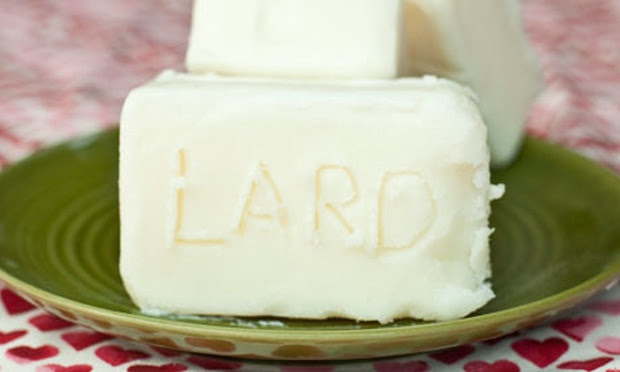
Thanks for getting this far. A headline like “Consider lard” will cause many readers to click away in horror, feeling arteries fur, strokes striking, the tempting of fat and fate at the sight of this four letter word. Lard ranks among the most reviled foods in the western world. As Roy Hattersley came to know its very name is a playground metonym for fat. Once, it was the great cooking fat of Europe, from Shetland to Gibraltar and east beyond the Caucasus, in China, Mexico, in South America.

In Ukraine they have a festival devoted to it. Polish immigrants caused a UK shortage in 2004. If your ancestors came from these islands they likely opened their lard-ers and ate bread, lard and salt for countless breakfasts. And not many of them died of obesity. For thousands of years there has been lard wherever there were pigs, and there were pigs, broadly speaking, wherever there weren’t Muslims.

It’s a supremely versatile fat. Because it smokes so little when it’s hot it’s perfect for bringing a golden shatter to a chip or a fritter – only dripping, lard’s bovine equivalent, does a better job. (A specific kind of lard is also called dripping, but let’s not muddle things.) Its large crystals of fat make lard unsurpassable in baking: a pastry crust made with lard – or half-lard, half-butter, as Delia recommends – offers a stunning flaky shortness, that gently encompassing roundedness that wine buffs horribly call mouthfeel.

Before the second world war Britons ate lard without guilt or fear. Its disappearance from our kitchens parallels a surge in the national waistline and an upswing in the cosseted maladies of fat. It’s worth remembering that the very people who so trumpeted the benefits of factory margarine – which we now know caused considerably more harm than good – were the same who lambasted lard and denied its natural glories.

By any estimation, lard is a healthier fat than butter. Gram for gram, it contains 20% less saturated fat, and it’s higher in the monounsaturated fats which seem to lower LDL cholesterol (the “bad” kind) and raise HDL (the “good”). It’s one of nature’s best sources of vitamin D. Unlike shortening it contains no trans fats, probably the most dangerous fats of all. Of course it has more saturated fat than olive oil, but in her splendid book Fat: An Appreciation of a Misunderstood Ingredient, Jennifer McLagan points out that even its saturated fat is believed to have a neutral effect on blood cholesterol. And would you want a pie crust made with extra virgin?


Leaf lard, the highest-quality, surrounds a pig’s loin and kidneys. (Roast pork loin, incidentally, gives the best crackling.) Next in value are the fat on the animal’s back, appropriately called fatback, and the the soft fat from around the internal organs, which has a more pronounced porky flavour. There are two main methods to make or “render” lard: wet and dry. In wet rendering you boil the fat in water. To dry render you simply melt it in a dry pan and skim off any crunchy bits of meat and skin. (Salted, these become the world’s best scratchings.) Wet-rendered lard has a clean, neutral flavour and a high smoke point, while dry-rendered is a nut-brown colour, smokes at a lower heat and tastes faintly of well-roasted pork. The industrial lard of the supermarkets may well have been bleached, deodorised, emulsified and otherwise fiddled with, but homemade or small-scale lard is likely to be be excellent. A kindly butcher might well give you a load of hard pig fat for free to take home and render (unto) yourself.

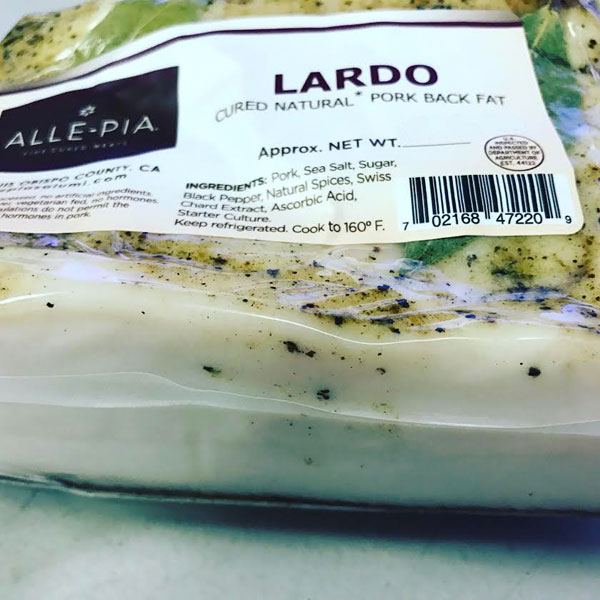
The best thing about lardy cake is its counterintuitive lightness – the fat brings the dough a refreshing, silky fluffiness. The cake originates in Wiltshire, which was always Britain’s best pig county. In central Europe they cut fatback into cubes and salt it for stews. The Italians cure lardo with rosemary and spices in the coffin-shaped basins of the Carrara marble mines. This lardo di Colonnata is a sublime antipasto, wrapped round prunes or figs, melted over grilled bread, or served with salt and honey. A melting smear of cured, flavoured lard is a wonder over a steak, and a lot of Mexican cuisine (don’t laugh) is unthinkable without lard.

Assaulted by food company propaganda and disillusioned by decades of conflicting advice, many people are returning to diets unsullied by fads and dogma. That lard is both “healthier” than butter and yet so despised shows the empty logic of the standard position. The fat amply qualifies as “real food”, that definition popularised by Michael Pollan as “the sort of food our great grandmothers would recognise as food”. Indeed, its history and heritage make it seem more valuable than ever when you consider what the lard hath given.

https://youtu.be/KddkyZ1UG5g


Read the original post: http://www.theguardian.com/lifeandstyle/wordofmouth/2011/feb/15/consider-lard