
The Pork Obsessives: Inside The Secret Online Society Inspiring America’s Best Chefs

pigsociety3

Behind the James Beard Award and the burgeoning restaurant empire, Linton Hopkins is really just an obsessive pork nerd. The Atlanta-based chef founded the Fellowship of Country Ham Slicers, which celebrates the craft of hand-slicing aged legs of swine, and created a collector’s edition Country Hams of the South placemat (read: treasure map) for the Atlanta Food & Wine Festival. The website for Holeman and Finch, his casual outpost in Atlanta, has a very scientific-looking photo on its homepage that claims ham can cure virtually any malady.

Hopkins’ devotion to swine is borderline religious, so it’s fair to ask: Where would a person like him find spiritual kinship with people who worship pork as much as he does?

The answer is The Salt Cured Pig—a private, invite-only group that can be found on the Facebook super highway somewhere between Bronies Unite Mid-Atlantic and Nuke the Whales.


“You can trust that The Salt Cured Pig is a community of people who actually care about how we procure, practice, and preserve our craft, “ said Hopkins.
pattersonuseThe Salt Cured Pig founder John Patterson has seen the group grow to over 8,000 members. 

I. A Global Network of Swine Fanatics

The Salt Cured Pig was founded in 2010 by Michigan native John Patterson, who has since watched his cultish community of swine enthusiasts grow to more than 8,000 members. An average of 100 new people are invited into the group every week by friends already on the inside.

This is a place where rockstar butchers and unadulterated porknography take precedence over the media’s breathless rediscovery of edible plant life, and Patterson loves it. And why wouldn’t he? America’s most knowledgeable farmers, meat processors, butchers, charcutiers, chefs, and educators have essentially open-sourced their collective wisdom in his forum.

America’s most knowledgeable farmers, meat processors, butchers, charcutiers, chefs, and educators have open-sourced their collective wisdom in the forum. It’s like getting private batting lessons from George Brett, the Kansas City Royals Hall of Famer


“This was a selfish venture in the beginning,” said Patterson. “I bankrupted myself buying cured meats at Zingerman’s one day and decided, if people have been doing this for thousands of years, I should just do it myself.”

The first leg of The Salt Cured Pig journey is all about Patterson’s original vision of setting out on one’s own into the wide world of DIY curing. Certainly that was my experience when I joined shortly after the group’s inception. For the better part of that first year of membership, my 900-square-foot abode in Washington, D.C. was filled with various meat-curing experiments. Pancetta strung up in the kitchen window and pork jowl hanging from an old planter hook in the corner. Every time I had a question or near meltdown, I went to the group.

Answers would come from people like Josh and Jessica Applestone, the forebears of nouveau butchery at Fleisher’s Pasture-Raised Meats, or Kate Hill, an American expat living in Gascony who runs a pork-centric cooking school, Kitchen at Camont, with a family of French master pig farmers and butchers named the Chapolards. It was like getting private batting lessons from George Brett, the Kansas City Royals Hall of Famer who was my childhood hero. I achieved delicious successes and a few spectacular failures (amazingly, my wife still agreed to marry me that year). More than once or twice, I considered training to become a butcher and opening a shop.


“Where else can charcuterie enthusiasts around the world get access to an incredible network like this 24 hours a day?” asked Hill, a group administrator. “When I’m having a morning café au lait in France, someone in Tucson is tending his smoker, a charcutier in Bangkok is talking to a pig farmer in Australia, and a Korean chef is sharing his wares with us all.”

II. Chefs Find Inspiration

A search of the group brings up some culinary star-power, including Craig Deihl, Jonathan Waxman, Nate Anda, Paul Kahan, David Varley, Ryan Farr, Lee Anne Wong, Tom Mylan, and Celina Tio. Peter Kaminsky, whose 2005 book Pig Perfect introduced the world to Chuck Talbott’s pioneering research on heritage pig breeds and flavor, is also a member (as is Talbott). Despite their high-profile status, some still look to The Salt Cured Pig as a place for continuous learning and experimentation.
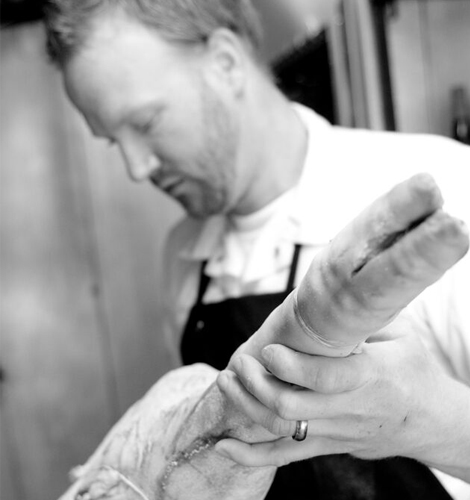
craigdiehljohnsmoakChefs like Rick McKee (pictured above) and Craig Deihl credit the group with inspiring dishes that appear on his menu. (Photo: John Smoak)


“What’s really important to me is the way people are open and post photos about failure, which is so important to getting better,” said Deihl, whose charcuterie work at Cypress and Artisan Meat Share in Charleston is second to none in the U.S. right now. “Watching people share non-pork ideas, like salmon belly nduja and shrimp sausage and swordfish bacon, has also made me think about what new things I can do in the restaurants.”

VIPs like Deihl have undoubtedly had an impact in The Salt Cured Pig forum, but the lesser-known professionals represent the group’s real value. These are the workaday evangelists who are carrying forward the movement for responsible pig husbandry and curing.

“I think it is a really valuable resource for anyone in the restaurant business,” said Justin Brunson, owner and executive chef at Old Major, the Denver Bacon Company, and a constellation of other meat-driven establishments in the Mile High City. “I get tips on chili pastes, peppers, and salts for sausage and curing in the group all the time, and the members gave me a ton of help on specs when I built my first curing chamber.”


Brunson is known among pork nerds, and he and others like him are the most active in the group’s conversation strings, offering hard-won wisdom to less-seasoned members and doing their best to keep the group focused on safety, tradition, and quality. Others include Cathy Barrow, the writer behind MrsWheelBarrow.com; Adam Danforth, the James Beard Award-winning author and butcher; Carl Blake, who runs Rustik Rooster Farms in Iowa; Brady Lowe, the founder of Cochon 555; Bob Perry, Chef in Residence at the University of Kentucky College of Agriculture; and Bob Del Grosso, a micropaleontologist by training who has taught for decades at the Culinary Institute of America and other institutions.

“Before the advent of groups like this, the likelihood that someone like Carl Blake would be sharing hog-farming tips with people in Michigan and Austria was almost nil,” said Del Grosso. “During my tenure as a Salt Cured Pig administrator I’ve seen countless examples of people who, inspired by something they read there, pick up knives and saws to butcher their food, pick up stakes and move to farms. That is significant.”

“I look at the group every day to see what people are doing,” said Brandon Johns, chef-owner of Grange Kitchen & Bar, an Ann Arbor restaurant that counts other members among its regular patrons. “It’s great to see them using old-school technique, like hand-cutting sausage, that you can’t find anywhere anymore, and I’m always getting inspiration to try new things.”

There’s the issue of the pesky vegetarians who have regularly infiltrated the group, calling ironically for Patterson’s slaughter.


With all the collective wisdom and shared support, is the forum having a wider impact? Anecdotally, those of us who have been in the group since early on have seen growth in the number of heritage-pig farms, professional curing operations, and restaurants doing in-house charcuterie. According to a three-year study by the Livestock Conservancy, an organization that works on genetic conservation and promotion of heritage-breed animals, the numbers of heritage-breed pigs overall have been growing in recent years. Just a couple days ago, member Stephen Prochaska announced the opening of his new Cedar Rapids, Iowa sausage shop, The Sausage Foundry, and thanked the group for insights and input.

“A goal in the beginning was to make sure that these things wouldn’t just be fads,” said Patterson. “I hope we are helping secure a better future for meat in America.”

III. The Swine Schism, Militant Vegetarians, and the Power of Community

That remains to be seen, but we wouldn’t even be having this conversation without the committed core constituency in The Salt Cured Pig. Whether the center can hold is another question, because Patterson’s ride hasn’t all been pillowy white fatback and silky sausage gravy. The group has, at times, been greased by drama.

Firstly, there’s the issue of the pesky vegetarians who have infiltrated the group regularly, calling (ironically) for Patterson’s slaughter and, on more than one occasion, getting him thrown off of Facebook (he maintains aliases including Bobby Berkshire, named after the famous breed of curing hogs). One woman was so aggressive that Patterson did a little research and cornered her with Google Maps evidence of a charcoal grill in her backyard. She backed off and the veg hackers have been quiet recently.

Patterson’s ride hasn’t all been pillowy white fatback and silky sausage gravy. The group, like so many young phenomena, has at times been greased by drama.


Then there was the infamous swine schism. In the early days, when The Salt Cured Pig was small, most of the members were in it to share advanced practices, but things changed as the numbers roared upwards. Some griped that bacon became too dominant a theme (is that possible?) and the comment strings got too heated and meme-heavy. The full administrative team tried to exert some quality control, but the divide had already calcified. A breakaway faction of accomplished home charcutiers, led by bloggers Scott Stegen and Jason Molinari, peeled off and formed Sausage Debauchery, a rival group with a less freewheeling and more pedantic bent. To date, Sausage Debauchery has more than 5,400 members.

“I think the two communities are alternate sides of the same coin: The Salt Cured Pig is great for people just getting into the curing and overcoming their fear, and Sausage Debauchery is like a watering hole for what I call the ‘meat mafia,’ those of us who live the craft every day,” said Hank Shaw, the James Beard Award-winning blogger and author of Hunt, Gather, Cook: Finding the Forgotten Feast and Duck, Duck, Goose.
paolo
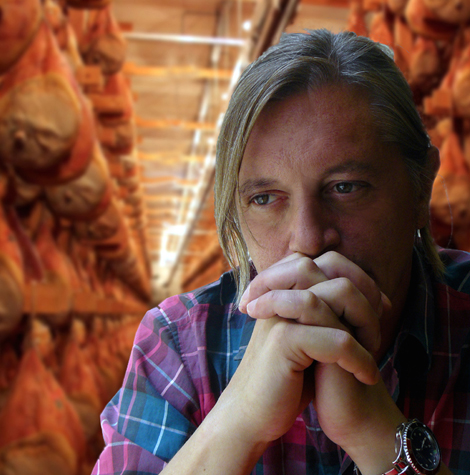
Paolo Sossai, a spiritual guide for pork forums like The Salt Cured Pig, embodied the restless pursuit of quality swine products.


Many people hold dual membership and foster friendships in both groups, and the kinship shows through more than any split—as the story of Paolo Sossai makes clear. Sossai, who died from cancer last month, may have been the pioneering digital community organizer for home charcutiers as the head of the Salumi Casalinghi Forum, an Italian listserv where he shared old-world techniques and facilitated discussion on the craft. He was a mentor to many in both The Salt Cured Pig and Sausage Debauchery, dropping in and out of discussions in both groups to offer patient, broken-English–infused explanations of things like the definition of porchetta di testa, and the regional difference between sopressa and sopressata. His death brought forth an outpouring of sympathy.


“Paolo’s legacy is the real sense of community in terms of passion for craft, willingness to help and a wonderful intolerance of showiness or lack of humility,” said John Gower, a member of both The Salt Cured Pig and Sausage Debauchery, who raises pigs on a sustainable farm in North Devon, England. “In life and death, he has only encouraged this sense all the more amongst many of us.”

Sossai, like Patterson, Stegen, and many others, was the bond that held the communities together and pushed them forward towards a vision of better, more sustainable farms and food. Which reminds me: I have a big batch of heritage pork shoulder in the freezer that needs my attention.


Read the original post: http://firstwefeast.com/eat/the-pork-obsessives/
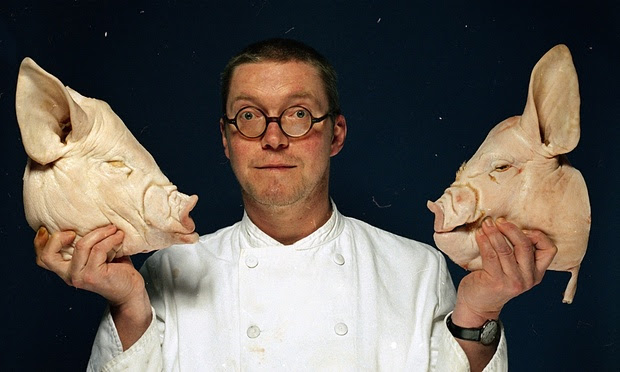
There are just so many imaginative ways to deal with a pig’s head

pigshead

St John’s Fergus Henderson. King of nose to tail eating. Photograph: Suki Dhanda for the Observer

Boning a pig’s head isn’t easy. My friend, the food historian Dr Annie Gray, tried it once. It took her and a friend five hours. She was following the 1846 instructions of Charles Elmé Francatelli, once chef to Queen Victoria, who was an old hand at the whole pig boning business. The key is to get a head severed at the second vertebrae, so that when you have tunnel-boned the skull, working the blade carefully about the jaw and skull, and then refilled it with the forcemeat, you have a flap of skin to be re-stitched at the back.

Before you can do that, you have to take the pig’s head, the eyes stitched closed, and smear it with six pounds of salt, handfuls of saltpetre, sugar, cloves, mace, garlic, thyme, marjoram and basil. It then needs to be submerged in a quart of port for two weeks and turned every day.

Next you stuff it with sausagemeat, and a mixture of tongue, fatty bacon, truffles and pistachio kernels. It now needs to be wrapped in butter-rubbed muslin and simmered in a stock full of cow’s feet and grouse carcasses for five hours, before being allowed to cool. Finally, decorate it with piped lard and separately baked pastry pieces. Queen Victoria had a head like this on her table at Christmas every year. Apparently the upper classes have long appreciated the ceremony that attends the boning of pig heads.

Preparing a pig’s head this way is tricky, of course, because you’re trying to keep it in one piece. If that’s not an issue you can cut off the pieces you want: the cheeks ears and snout. Pig cheeks braise beautifully. The ears have many uses. Fuchsia Dunlop has a great recipe in her Revolutionary Chinese Cookbook for an aromatic salad, which is all about chilli oil and sesame oil, and the thin slices of gelatinous skin sandwiching a crunch of cartilage.

Alternatively, April Bloomfield does a crispy pig’s ear salad, in which they become the biggest curve of pork scratching imaginable. The Pitt Cue boys recommend boiling them for a couple of hours and refrigerating overnight, before cutting into strips, deep frying them and serving with a habanero sauce. At Duck & Waffle, they dust crispy strips of ear with a sweet salty mix. They taste like Frazzles.

If this doesn’t appeal, you can always boil a head until the flesh falls away. Next, remove all the meat. There are now two ways to go. Spice it up the old English way with lots of mace and white pepper, and press it to make a classic brawn. Or (again, pace Pitt Cue) form it into a sausage bound in clingfilm. Once refrigerated and set, cut it into discs, bread crumb and deep fry to make pig’s head croquettes.

Alternatively, take the whole thing and, as they do at St John, slow roast it for hours until the meat falls from the bones, and the skin shatters beneath your teeth like savoury glass. Think of this as a self-boning pig’s head, which is a neat trick if you can pull it off. Of course, there may be other ways to go about boning a pig’s head.


Originally posted: http://www.theguardian.com/

Here’s Why You Should Be Cooking With Bones, Fat And Skin

IMG_5583
Bones from a variety of animals can be a key ingredient in stocks, which are essential in all types of cooking.

Food Republic’s column Ask Your Butcher seeks to answer FAQs in the world of butchery. Ethically minded butcher Bryan Mayer founded Philadelphia’s Kensington Quarters and helped develop a renowned butcher-training program at Brooklyn’s Fleisher’s. Today, he consults with farmers, chefs, butchers and anyone else who will listen. In each column, Mayer tackles a pressing issue facing both meat buyers and home cooks. Here, he explores three things that you probably aren’t cooking with now, but you should.

Peer over the counter at your local whole-animal butcher shop and you’re more than likely going to see a whole lot of bones, fat and — depending on the animal — skin. And while our more industrially focused brethren don’t have to take much of this into consideration (being that you can order up just about anything skinless, boneless, and pretty much denuded of any and all fat), we who preach whole-carcass utilization take this as a challenge!

Our detractors would say that the industrial model is nothing if not efficient when it comes to utilizing the whole carcass. And that’s somewhat true, if you exclude certain parts that are routinely discarded due to their lack of economic viability. While I’ve read more than my fair share of blog posts pointing out that we, the so-called whole-animal butchers who claim to use everything but the oink, often fall short of these claims, it does bear mentioning that we are severely limited in what we actually receive from our slaughterhouses.

The limitations of these by-products, both edible and inedible, are not totally based on legality, but rather on a significant revenue stream for slaughterhouses. And rightfully so. Up until very recently, very few people in the U.S. were looking to prepare a traditional Burns Supper, which, among other things, calls for stomach and lung, the latter being a by-product that is illegal in the U.S. But what of all those bones going into that bone broth, or, as I like to call it, stock? It’s as if they magically appeared, to cure all your ailments, from gut issues to hair loss to nonexistent love life.

In fact, the list of uses for animal by-products — again, both inedible and edible — is endless. Here’s a sample, courtesy of the U.S. Department of Agriculture:

Adhesives, ceramics, cosmetics, feed use, fertilizer, foam in fire extinguishers, insecticides, buttons and handles, capsules for medications, emulsions, gelatins, glues, hardening steel, candies, dairy products, ointments, paper, photographic films, refining sugar, textiles, candies, chewing gum, germicides, industrial oils, lubricants, soap, glycerin, shortenings, tires, athletic equipment, brushes, felt, insulation, rugs, upholstery.

Sorry, vegans.

I’m hoping now you can see why these things are hard to come by, and more importantly, why they have such value. To put it all into context for you, by-products account for roughly 30 percent of the live weight (weight before slaughter and evisceration) of hogs and roughly 44 percent of the live weight of cattle. To devalue these items would ultimately mean devaluing the work of our farmers. We don’t want to do that.

With the proliferation of whole-animal butcher shops, we are starting to see an increased interest in using more by-products, specifically bones, fat and skin. So here are a few cooking ideas:

Bones

IMG_2075
Stocks are about what tastes good to you! A basic beef stock can be exceedingly simple to prepare.

Auguste Escoffier once said, “Indeed, stock is everything in cooking. Without it, nothing can be done.” And since my grandma used it as a cure-all, I’m not one to disagree. Stocks contain minerals in a form that the body can absorb easily — not just trace minerals, but sulfur, magnesium and calcium. Add to that the stuff in cartilage, like chondroitin and glucosamine, and you’re liable to put GNC out of business. And while it’s easy to poke fun of your local dispensary, pouring cups of $9 broth from stainless steel urns, there clearly is some merit to this craze — certainly more so than kale!

Feel free to use any types of bones you’d like: neck, knuckle (the ends of long bones) and marrow all work great. Go ahead and experiment. Step outside the comfort zones of beef and chicken! Try lamb, goat and pork, and add any spices you wish. After all, it’s about what tastes good to you. For my simple beef stock, I add a bit of salt, ginger, clove and turmeric. You can simply simmer bones and water, or go ahead and make a full-on stock by adding your standard mirepoix. Or, in my case, suppengruen, to honor my German side.

Basic Beef Stock

Ingredients
Roughly 4 pounds of neck, knuckle, and/or marrow bones
4 quarts water (or enough to cover bones)
3 each celery, carrots and onions, if desired

Directions:

  1. The basic rule here is that it should be easy, or you won’t do it. So if you want to roast your bones, go for it. It’ll result in a darker, richer-tasting stock, but it’s not necessary.
  2. If you want to add things like onion, celery, carrots, vinegar and whatever other spices, go for it. Just add enough water to cover your bones while leaving some room at the top for expansion.
  3. You’ll want to bring to a boil and then simmer for as long as you can; 12 hours is preferable, but if you’ve only got four, then so be it. Some people like to skim the fat off the top; I don’t. But if you’ve got the time, go for it. That’s all there is to it.
  4. Let it cool and refrigerate up to four days or freeze. Season however you’d like.

Skin

IMG_1926
Behold the beauty of the chicharrón: pork belly fried in its own fat.

It’s one of largest organs, if not the largest. You could say it’s one of the most important. It keeps the body safe from the extremes of temperatures, sunlight and chemicals. And if you’re a hog or a chicken, it also happens to be delicious. Roast a whole chicken in my house and someone’s picking off the crispy skin. Braise a picnic ham for pernil and that crispy skin is a great counterbalance to the tender meat. Skin alone, especially from pigs, has many uses. Aside from all the inedible examples mentioned above, it’s great to add skin to stocks. All that gelatin that it contains is a great thickener. It can make great noodles, and, of course, there’s the ol’ standby, chicharrónes.

Preparing pig skin for noodles is a bit of a process and removes something very dear to me and hopefully to you: pork fat. What you’re left with is something reminiscent of pasta, but with an obvious porkiness that is an excellent addition to any ramen. You’ll want to denude the skin of any fat and hair, add some salt and allow it to cure for a couple of hours. You can prepare a marinade, which is something that will help break down the skin over a 24-hour period. Once that’s done, you’ll want to cook for a couple more hours, cool for another 12 and you’re ready to add to your ramen. Yeah, that’s a lot of work.

Let’s stick to a chicharrón. I like my chicharrónes the way my mother-in-law does them: not the puffed, airy kind, but something with a bit more substance — some meat and some fat. The seasoning isn’t necessarily the important part here, but the process is, as you’ll want to follow it closely in order to get a crispy, crunchy chicharrón.

You’re still going to have to put in some time with this one, but you can make a few batches to sit up on your shelf (it’s right next to the granola on mine). I like to use pork belly for this as it has the best ratios of skin, meat and fat. I’ll use a little baking soda with my salt, as I cure the belly overnight. This will help with dehydration, which is important in order to achieve that crunchy skin. After your 24-hour cure, you’re ready to cook. Grab a large skillet and add some water for the wet-rendering method. This is much more forgiving than the dry method and the water will also help to braise the bit of meat and slowly render the fat over 3 to 4 hours. You’ll know when all the water has evaporated and you’re left with just rendered fat when you cease to see any bubbles rising. You’re all set to crank the heat to high and fry away, which should take about three to five minutes. Transfer to a paper towel–lined plate to cool a bit and then add some vinegar, preferably some Sukang Maanghang.

Chicharrón Baboy (Filipino Pork Rind Cracklings)

Ingredients
1 pound pork belly
2 teaspoons baking soda
1 teaspoon salt
Water to cover
Vinegar

Directions:

  1. Rub the surface of the skin with the baking soda and salt, making sure to distribute evenly. Place on a dish and into your fridge for 12 hours.
  2. Rinse off the belly, pat dry and cut into one-inch cubes. Place into your deep-sided skillet and cover with water.
  3. Using low heat, slowly render and braise for 3-4 hours. Remember to turn the pieces of belly every so often to evenly cook. Once the bubbles stop rising, your water has evaporated and you’ve got rendered fat.
  4. Turn the heat up to high and watch as they fry in their own rendered fat. This should take no more than five minutes. Transfer to a paper towel, add some vinegar and perhaps some salt and pepper to taste!

Fat

IMG_8249
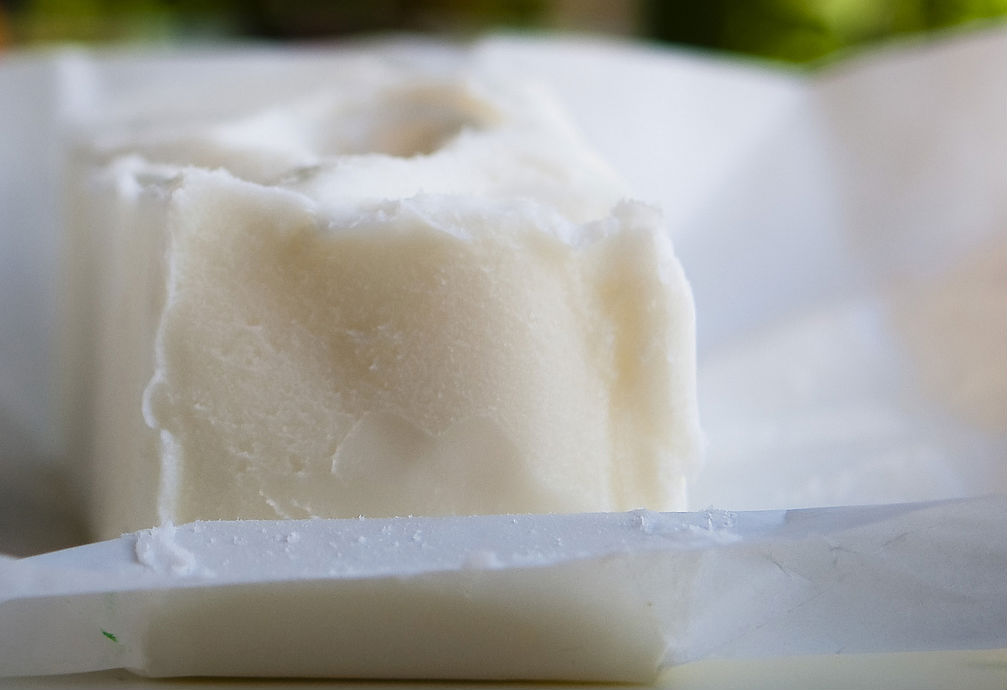
There are many culinary uses for rendered fat (pork lard is pictured here).

Since we briefly mentioned fat above, why don’t we really talk about it for a moment here? Fat has been vilified for far too long. Whether it was Sinclair’s fictional account of the horrors of rendering plants, Procter and Gamble’s marketing campaign for Crisco and the newly invented process of hydrogenation in the early 20th century, or scientists in the 1950s all but singling out animal fat as the cause of heart disease, it seemed we had good reason to avoid animal fats at any cost.

Well, that cost is our health. Fats from animals — consumed in moderation, of course — provide a concentrated source of energy in our diet, a source that cannot be supplemented. They are the building blocks for cell membranes and hormones. As if that weren’t enough, they are also the carriers for the extremely important, fat-soluble vitamins A, D, E and K. Fat doesn’t only taste good — it is now recognized as the sixth taste — but it does good for you! And not just animal fats. We’re talking oils: extra-virgin olive oil, unrefined flaxseed oil, and coconut oil, for example. Keep on using all that butter, which is hopefully from grass-fed, fully pastured cows!

Good oils and butter are fairly easy to come by these days. As for rendered animal fat, that’s a bit tricky. Your whole-animal butcher shop should have some already rendered for you. If not, you can always purchase a hunk of fat from them and render it yourself. Pork fat is the best, as it’s the most neutral of fats, but feel free to use beef, chicken or whatever you’d like. You’ll need a skillet, some water and a little bit of time — that’s all. You’ll want to cube the fat or, if possible, coarsely grind it to speed the process up a bit. I like the wet-rendering method, as you’re less likely to scorch the fat. While scorching won’t necessarily ruin the fat, it will definitely bring out the flavors a bit more in your lard, which is something that you may not want in a flaky pie crust. A low flame, and once the bubbles stop rising, you’ve got pure fat ready to fry potatoes or make some chicharrónes.

Rendered Fat

This can be as easy as removing some of the visceral fat from the chicken you’re about to roast or going to your local whole-animal butcher to order some pasture-raised animal fats.

Directions:

  1. Choose an animal fat — beef, pork or chicken. Dice, or coarsely ground, for beef and pork to speed the process.
  2. Set your flame to low in a deep-sided skillet or pot, and allow the fat to slowly melt. Again, your fat is fully rendered and all the water has evaporated when bubbles stop rising.
  3. All that’s left to do is strain out any impurities and you’ve got plenty of healthy animal fats to last for at least a few days. There are lots of opinions on how to store rendered fat. I’ll let you pick the method that you feel safest with. For me it’s about three months in the fridge and up to a year in my freezer.

Read the original post: http://www.foodrepublic.com/

Putting the Feet Before the Belly: How Pork Trotters Became Such a Thing

trotters_560x373

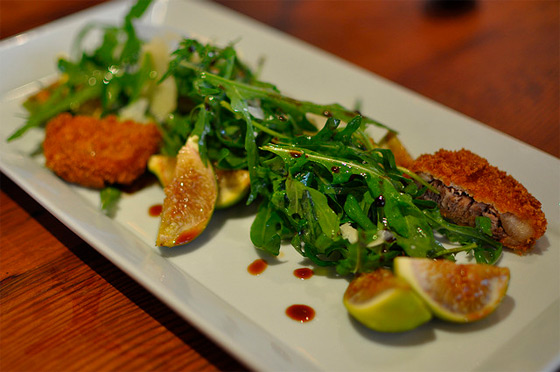
Crispy pork trotters with Mission figs at Flour + Water, ca. July 2009.

Some of the most welcome offal to come out of the trend of head-to-tail cuisine are pork trotters, a.k.a. pigs’ feet, and we’re now seeing more of this humble pork product pop up on respectable menus in New York, L.A. and San Francisco. More often than not, the meat is braised, deboned, and formed into a crab cake-like portion, browned on both sides, and served with any number of sauces likely to win over even picky eaters — as they were last spring on the menu at the critically adored Frances, with a sauce gribiche. Semi-rustic preparations of trotters have made appearances in New York over the last few years at places like Craft and Baba, and last winter Northern Spy did a trotter cake with mustard greens — a play on collard greens and ham hocks — that caught the attention of the Times and became the lede for their review. (“Slice into it and the pork spills out, outrageously tender. There is nothing to tip off the squeamish that we’ve entered hoof territory.”)

But how did pigs’ feet — which many of us probably associate with the pale, puckered, and all-too-anatomically-intact versions we saw pickled in jars in the ethnic foods section of grocery stores as kids — become the stuff of haute cuisine?

San Francisco food writer Marcia Gagliardi (The Tablehopper) points back to the first wave of chefs embracing offal here in the last few years. “It started with the whole-animal guys — like Nate Appleman when he was at A16, Chris Cosentino at Incanto, and Mark Denham when he was at Laiola,” she says. “What you’re seeing now in S.F. is a second wave of restaurants doing rustic European dishes (Flour + Water, Frances, Contigo), and diners perhaps being a bit more adventurous.”

Below, a rough timeline of the trotters’ recent rise to prominence:

1999: Thomas Keller features Pig’s Feet with French Green Lentils in The French Laundry Cookbook.

2001: Tom Colicchio opens Craft in New York, later begins featuring pork trotters among his mix-and-match menu offerings.

2002: Chris Cosentino comes on board as executive chef at Incanto, bringing with him a passion for head-to-tail cooking, and using trotters in his pork ragu. Later launches the website OffalGood.com.

2004: The Bouchon Cookbook features pieds de cochon with a sauce gribiche.

2007: Fergus Henderson publishes Beyond Nose to Tail, which contains the recipe for Trotter Gear.

2007-2008: Trotters make their appearance on Nate Appleman’s menus at A16 and SPQR in San Francisco. He later wins the James Beard Award for Rising Star Chef, as well as a Food & Wine Best New Chef nod. They continue to make appearances on both menus under new chefs Liza Shaw and Matt Accarrino, in ragus, terrinas, and Shaw’s pork trotter zampone, which are deboned foreshanks stuffed with either sausage or a meatball mixture, then braised and finished off in a wood-fired oven.

Early 2008: Hakata Tonton opens in New York, with 33 of its 39 dishes containing pigs’ feet. The UK Telegraph declares them ‘the new superfood.’

June 2008: Animal opens in Los Angeles, and chefs Vinny Dotolo and Jon Shook garner loads of attention for their bold use of offal, and they frequently work trotters into their menu.

June 2009: Bouchon opens in Beverly Hills, features trotters.

July 2009: Flour + Water opens to loads of press early in the year, and that summer begins featuring trotters breaded and fried and served with Mission figs and mustard greens.

December 2009: Josef Centeno’s Lazy Ox Canteen opens in L.A., and receives a bunch of attention for, among other things, pigs’ feet.

February 2010: The Times writes up Northern Spy and their trotter dish.

Spring 2010:
Trotters appear on the menu at Frances, braised and seared in cakes, served with a sauce gribiche and pickled vegetables. Frances is nominated for a Beard Award for Best New Restaurant.

April 2010: Saveur spotlights the very rustic crispy pata (fried pigs’ feet) at Patio Filipino in San Bruno.

June 2010: Prospect opens in San Francisco, from the team behind the uber-successful Boulevard, featuring a dish that combines pork trotters with lobster. Critic Jonathan Kauffman later calls out the dish as a point where chef Ravi Kapur “hits a sweet spot” of edginess.

October 2010: Lowcountry opens in New York, offering “trotter tots” as a starter; Coi chef Daniel Patterson opens a casual offshoot in Oakland called Plum, featuring a pork trotter burger.


Original post: http://sanfrancisco.grubstreet.com

10 Reasons You Should Be Cooking With Lard

The Huffington Post  |  By Julie R. Thomson

lard

In a not so distant past (about a century ago) and in a not so foreign land (like, in America), lard was the fat that people cooked with. It wasn’t butter. Nor canola oil. And definitely not extra virgin olive oil.

Lard — rendered pig fat — was what people used when they needed to make pastry; when dinner needed frying; and even as a quick breakfast, eaten smeared on a piece of bread. So much has changed in our recent history. Lard is not only out of favor, it’s even considered a derogatory word.

We’re not going to get into how or why this happened — though Crisco and Upton Sinclair have gotten most of the blame — we’d just like to focus on bringing this glorious cooking (and baking) fat back into people’s kitchens. It’s time to let go of the lard stigma and enjoy great pie crust again. Let us make our case:

  1. Lard makes the best fried chicken. Crisp like a spring morning.
  2. It’s an extremely versatile fat. It doesn’t smoke at high temperatures so it’s perfect for frying. It does wonders while roasting. And its large fat crystals mean it makes the flakiest of pastries.
  3. Mexican tamales just wouldn’t be the same without it. Word.
  4. It has less saturated fat than butter. (Though not the same glorious flavor.) We’re not going to make any health claims about lard — because what do we Taste editors know about health? — but we can report what we’ve learned: lard has 20 percent less saturated fat than butter; it’s higher in monounsaturated fats which are said to lower LDL cholesterol; and it has none of the trans fat that shortening does. Chew on that.
  5. It makes for the flakiest of pie crusts. And one that’s pliable and easy to form.
  6. Despite what you may think, it does not impart a pork flavor. This is not bacon grease here, but rendered lard — preferably leaf lard which surrounds the loin and kidneys. It makes everything cripsy without leaving a trace of flavor behind.
  7. Vegetables roasted in lard come out crisper than you thought possible. As much as we love olive oil roasted veggies, sometimes they’re just too greasy and, well, a little soggy too.
  8. It’s sustainable. Cooking with lard is one way of guaranteeing you use every part of the hog. Some of the best restaurants, like Husk, are focused on that aim and bringing lard into fine dining.
  9. Biscuits. A southern lard biscuit recipe will make you wonder why you mess with anything else.
  10. Lard is even good on a piece of bread, in place of butter. Try it.


Read the original story: www.huffingtonpost.com

The One-Percenter’s Guide to Pork: The Best Pork, Ham, and Bacon in the World

by Kerry Acker | www.epicurious.com | February, 2014

6a00d83451cb0369e201a73d79fd9a970d-800wi

Not all pork products are created equal. Just imagine for a moment that money was no object, that no supernal slice of lavishly marbled ham or haute hunk of succulent pork was too high-end or high-falutin’ for your budget. Here, our mini guide to some of the finest, most exclusive, pork, ham, and bacon in the world.

Jamon Iberico de Bellota

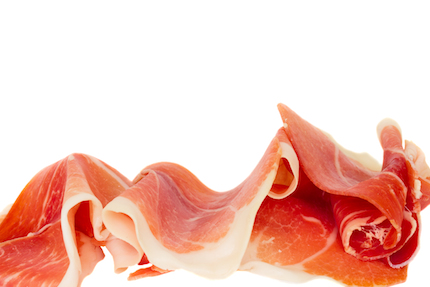
Celebrated El Bulli chef Ferran Adria once said of this traditionally cured Spanish ham, “Iberian pork meat is extraordinary. There’s nothing like it elsewhere in the world. There’s a great difference between a superior ham and all the rest.”

Raised along the Spain/Portugal border, the pata negra (black-hooved) pig roams free-range through old-growth oak forests, dining on herbs, grass, and, most significantly, acorns (bellota means “acorn”), resulting in an intensely flavored, distinctly nutty, and richly marbled meat unparalleled in the ham universe.

Get It: A 14.5-pound bone-in whole Jamon Iberico de Bellota ham from elite Spanish brand Cinco Jotas retails for $1,290 at La Tienda. But, wait, you’ll need to properly slice it, too, so consider investing in the Cinco Jotas Cortador kit–including a 13-pound bone-in Bellota ham, a black ham holder, two carving knives, serving pincers, and a protective chain-mail glove–which will set you back $2,450.

6a00d83451cb0369e201a5116f22ad970c-800wi

Culatello di Zibello

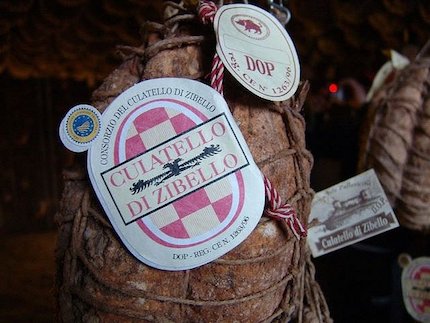
Among the rarest, most highly esteemed charcuterie in Italy, culatello is a boneless ham with a velvety texture and a robust, slightly sweet flavor. Produced in the foggy Po Valley, outside of Parma, culatello (“little backside”) is made from the muscle in the rear leg of the pig, and is related to prosciutto, but pig purists consider the version labeled with the D.O.P. “Culatello di Zibello” superior to its cousin. Because it takes a whole ham to make the culatello, and producers must adhere to strict D.O.P. regulations–including using only pigs born and raised in Lombardia or Emilia-Romagna, and a slow aging (without refrigeration) of 12 to 20 months–Culatello di Zibello is pretty hard to find. (Approximately 20,000 pieces of culatello are produced annually.)

Get It: Head to Italy’s lovely Antica Corte Pallavicina, a hotel/restaurant situated in Polesine Parmense and run by Chef Massimo Spigaroli, chairman of the Consortium of the Culatello di Zibello since its inception and widely considered one of the best producers of the exclusive ham. You can visit the on-site cellars, where the ham is aged to meltingly tender perfection, then sample it afterward at the Michelin-starred restaurant.

6a00d83451cb0369e201a73d7847bf970d-800wi

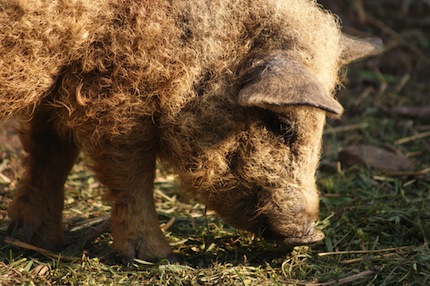
A Mangalitsa pig

Mangalitsa Pork, Bacon, and Lard

This rare breed of pig, the result of a 19th-century Austro-Hungarian experiment cross-breeding a wild boar with a pig raised for lard, is pretty darn funny-looking: Its distinct “fleece” coat gives it the look of a sheep-pig–which is why the Mangalitsa is also known as a “woolly pig”–and the pigs can weigh over 300 pounds. The animal was near extinction until the 1990s, when a Hungarian breeder revived it, and in recent years a handful of American farmers have started raising Mangalitsas. Though the woolly pigs are more expensive to produce than other heritage breeds, the buttery meat has been enjoying considerable popularity among chefs: Mangalitsa pork has been served on menus at the likes of the French Laundry, Le Cirque, and Blue Hill Stone Barns, and it’s also increasingly available as cured ham, bacon, and other products.

Get It: D’Artagnan sells a bone-in 12- to 16-pound Mangalitsa ham–dry-cured in Spain–for $400, Murray’s offers bacon ($17/12 oz.) from New Jersey-raised Mangalitsa pigs, and Florida-based Pasture Prime sells ground Mangalitsa pork, lard, and custom pork.

Edwards’ Surryano Ham

When it comes to dry-cured American ham, Surry, Virginia’s Edwards’ Surryano is a fabulous bet. Produced from Berkshire hogs and other heritage breeds–who dine on peanuts, grass, corn, and soy, according to Food Republic’s interview with Sam Edwards–the meat is dry-cured, smoked over hickory wood for seven days, then aged for 400 days. The ham that results is rich, smoky, and silky, and beloved by such chefs as David Chang, who serves it at Momofuku Ssam Bar.

Get It: A 15- to 17-pound bone-in Surryano will set you back $215, while $39 will get you 3.4 ounces of sliced Surryano heaven.

Benton’s Bacon

North Madisonville, Tennessee’s Benton’s Country Hams, famous for its world-class traditional dry-cured ham and (also dry-cured) bacon, is another American company that just makes us proud. New York Times writer John T. Edge said it best: “Allen Benton is the rock star of American bacon. There’s just something very primal about his bacon. It’s like barbecue and is so distinctive.” Chef devotees of Benton’s intensely, beautifully smoky bacon are many, and include David Chang, Sean Brock, and Hugh Acheson, to name just a few.

Get It: Four 1-pound packs of Benton’s famous hickory-smoked bacon cost just $26 via Benton’s website, but bear in mind that there may be a 5-week delay in delivery–which you will totally understand once you taste this extraordinary bacon, which would satisfy even the pickiest one-percenter.


Originally posted: 2/18/2014 : http://www.epicurious.com

Iberico, Serrano, Mangalica, Oh My! The 411 on Spanish Hams

Jaume Guerra looks at me with a blank stare when I ask how he became interested in the world of Spanish hams. “Ham is a part of life in Spain,” he says, as if it was inevitable that he would become a master carver of piernas. I’m meeting with Guerra for a tutorial in Spanish jamónes, which, like any food or drink, become increasingly complex and fascinating the more you learn about them. As a greater variety of hams from Spain becomes available at U.S. grocery stores and from specialty purveyors, including Despaña and D’Artagnan, jamón aficionados may find themselves suddenly bewildered by the proliferation of choices in the meat department.

Jamón serrano, the Spanish ham almost every meat eater knows, has been available in the U.S. for about 17 years, Guerra explains, but it has recently been joined by the ibérico hams, the cebo and bellota varieties, and the lesser known (and considerably more expensive) mangalica. What are the differences among these three? And aside from asking for a sample and letting your taste buds make the decision for you, what should you know when you go to buy a Spanish ham?

Guerra gave TLK a crash course on the subject, explaining everything from how and what the pigs are fed and how long the hams are cured, to the characteristics you should look for in an exceptional Spanish ham, the carving instructions you should offer at the meat counter when you’re placing your order, and how you should serve and eat your ham at home.

Next, a look at the most famous Spanish hams…


Jamón Serrano

Jamón serrano is a working-class ham, the variety you keep on hand for day-to-day consumption,  cooking (say, for croquetas and simple bocadillos), and for kids, according to Guerra. While your local meat counter is likely to have a wide selection of serranos, Guerra cautions that few of the brands sold in the U.S. are of high quality. “Large, corporate producers can afford to enter the export market,” he explains, “and the result is an abundance of mediocre hams.” Because they are exported in greater quantities and are cheaper than other Spanish hams, serranos, which are dry-aged for about a year, are often the victims of shortcuts in that aging process, which is what endows all Spanish hams with their rich flavor.

In Guerra’s opinion, the best jamón serrano available in the U.S. is by Jamónes Segovia. Don’t make the mistake of thinking that a ham marketed as having a denominación de orígen, or D.O., assures its quality. “Treat ham the same way you treat wine,” Guerra advises. “A wine with a D.O. from Rioja only means it’s from Rioja and was made under certain conditions; the D.O. itself doesn’t assure that you’re drinking a great wine.”

Jamón Ibérico

Jamón ibérico is a step—a big one—above serrano, because most of the pigs that yield the cebo and bellota varieties of ibérico are free-range and their aging processes are longer. Bellota is better known in the U.S. than cebo, primarily because the acorn-fed pigs have achieved near mythical status here, thanks to media outlets that have portrayed the pigs as coddled darlings. According to Ignacio Saez de Ibarra, general manager of Pata Negra and Imperial Chorizo in New York, a farmer can only have so many pigs, since a single bellota hog needs two full acres of acorn trees to achieve its harvesting weight.

In both cases, though, the fact that the pigs get to wander freely means that they’re exercising more than pigs being raised and fattened in commercial pens, and that, in turn, means they’re developing more intramuscular fat. The result? A richer flavor than the serranos. Ibéricos are also aged longer: cebos for 18-36 months, and bellotas for a minimum of 36 months.

“The Ibéricos are meant to be savored,” says Guerra, “to be part of an experience, to open the appetite. They’re a rich ham, ideal for degustaciónes or tastings.”

Jeffrey Weiss, author of the excellent and comprehensive guide to Spanish charcuterie, Charcutería, the Soul of Spain, offers tips for bringing the ibéricos to your table. Serve these with a fino sherry, he recommends; “It’ll knock your socks off!”  At his restaurant, jeninni kitchen + wine bar, he likes to pair jamones with grilled bread and seasonal curtidos, “little pickled goodies that we make at the restaurant.” You can get his recipe for sweet and sour pickled garlic here.

Next, one of Spain’s most expensive exports…

Jamón Mangalica

Jamón mangalica reigns supreme among the Spanish hams, despite the fact that the heritage pigs from which it is sourced aren’t raised in Spain at all but in Hungary. The mangalica pigs are uniquely suited for the cold climate where they live, having developed a thick coat, and—most important to those who want to eat it–thick layers of intramuscular fat.

The mangalica pigs are open-pasture foragers that eat barley, corn, grass, soybeans, sunflowers, and wheat in small, free-range groups. Once they’re fattened and ready for aging, they head to Spain, where master jamoneros begin the long process of curing. It’s this ham that takes the longest amount of time to age to perfection, usually three years. “It’s the slow curing that gives mangalica its flavor,” Guerra explains, and its deep, rich, glossiness is best suited for degustación rather than piling onto a piece of crusty bread.

How to Get the Best Ham

Few butchers in the United States are experts when it comes to Spanish hams, says Guerra, and it’s helpful if you approach the meat counter with a bit of your own knowledge to ensure you’re buying the best quality and getting good cuts. Here are Guerra’s pro tips for buying Spanish jamónes:

• Look for evidence of tirosina. “Many people make the mistake of thinking that the white, crystalline flecks or threads on Spanish ham are undesirable, when the opposite is actually the case,” says Guerra. Tirosina (or tyrosine, in English) is an amino acid, and those white crystals are evidence that the ham has been aged slowly and adequately. You won’t see them in a ham whose aging process has been accelerated.
• Ask the butcher not to trim la corteza, the yellow layer of fat encasing the pierna. Even though  it’s not edible, it protects the meat, serving a similar function as a rind on a hard cheese.
• Ask the butcher to slice the ham thin. Thick cuts of Spanish hams will obscure the richness and complexity of their flavors.

Pata Negra’s Saez de Ibarra adds that packaging doesn’t necessarily advertise the differences among the hams, especially between the cebos and bellotas. If in doubt, he says, “ask for longer curation periods, always closer to 18 months, at least.”

Where to Buy Spanish Hams

In New York City, Guerra recommends Despaña, which is the only retailer where the hams are sliced by hand. As for supermarkets, Fairway carries the hams mentioned here. Finally, Guerra himself can supply you with a pierna if you hire his master carving services for a party or private event. His price includes not only his expert slicing skills, but the pierna at cost.

Outside New York, all three hams, including the mangalica, can be ordered online or by phone from D’Artagnan.


Original post: http://thelatinkitchen.com

Raised with Respect

Chefs and restaurants are becoming proponents of sourcing humanely raised animals, because it’s better for the planet and the palate.

raised-respect

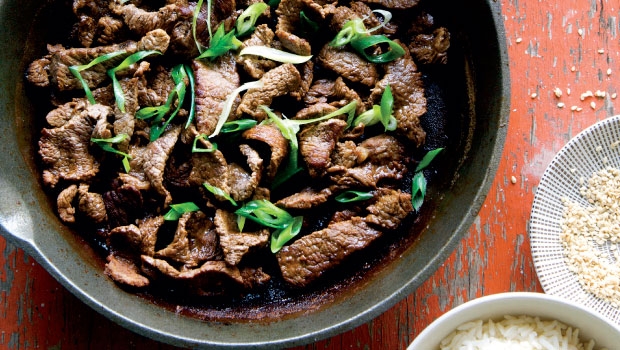
Beef Bulgogi Meat & Livestock Australia

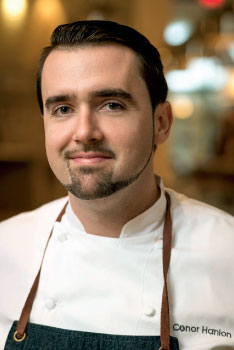
In his formative years as a chef, Conor Hanlon didn’t think too much beyond the kitchen.

“I was much more concerned about keeping my head above water than about where we were sourcing ingredients,” Chef Hanlon acknowledges.

But now, as executive chef of the W Hotels in Miami and chef de cuisine at its upscale eatery, The Dutch, sourcing is no longer an ignored topic.

Chef Hanlon’s broadened enlightenment began seven years ago when he read about the Mangalitsa pig, a little-known Hungarian breed characterized by its fatty, marbled meat. Fascinated, he spent four months trying to find the pig, often called the Kobe beef of pork. When he finally secured the animal and cooked it, the experience proved transformative.

“That’s when the light bulb went off in me,” Chef Hanlon says. “Whenever something is being raised, there’s someone behind it—and the way [that person] is raising the animal translates into its taste.”

In subsequent years, Chef Hanlon became increasingly more engrossed in the issue of animal welfare and how animal care translates to both the plate and the dining experience.

“Because I love what I do, I want humanely raised products,” he says.

A multi-layered issue touching hot-button topics such as animal rights, environmental stewardship, and social justice, animal welfare has become a frequently discussed subject in the restaurant industry, one propelled by consumers and chefs alike.

“This is everybody’s issue,” says Jason Gronlund, vice president of culinary for Smokey Bones, a 65-unit casual-dining chain based in Orlando. “Just because we have to feed the population doesn’t mean we can take shortcuts in the care of animals.”

Though animal welfare is a subjective term with shifting meaning among chefs, farmers, producers, and consumers, Meat & Livestock Australia business development manager Catherine Golding says the principal elements of animal welfare remain evenhanded and clear: Animals should be treated with respect and care according to best practices in animal husbandry throughout their lives.

That extends “from the paddocks they were born and raised in to when they are transported for sale and at the processing plant,” says Golding, whose organization works with industry and government in Australia to promote fact-based best practices in animal husbandry.

All Creatures Great and Small

From cattle and dairy to pork and poultry—and even farm-raised fish—animal welfare continues to weave into the public’s consciousness. Cage-free and pasture-raised are no longer fringe terms, but pepper grocery store aisles and restaurant menus.

dg_0

Dan Gibson has witnessed the transformation firsthand.

After experiencing 9/11 in New York City, Gibson traded fast-paced Manhattan for life on the farm. In 2002, he built a grass-fed herd at Grazin’ Angus Acres in Ghent, New York, and began selling in New York’s green market system in 2006. Even among the most conscientious chefs, Gibson says many struggled to understand the advantages of his meats compared with those arriving from a concentrated animal feeding operation (CAFO). Over time, he says, that has changed.

“There’s a significant and growing amount of the population that cares about this issue and is voting with their pocketbook every day,” Gibson says.

The burgeoning movement inspired Gibson to open Grazin’, a diner serving only Animal Welfare Approved (AWA) products, in 2011. AWA is a labeling program for meat and dairy goods that ensures animals were raised to the highest welfare and environmental standards.

Located in Hudson, New York, Grazin’ is a hit among the locals and frequently serves guests who have made the 120-mile trip from New York City specifically to visit his eatery. In 2014, sales jumped nearly 50 percent over the previous year. Those results and swelling interest have motivated Gibson to locate a Grazin’ outpost in New York City later this year.

“And we’re not going to stop there,” Gibson says.

Today’s consumers, many contend, are more sophisticated and interested in food than ever, accessing millions of resources to explore all aspects of food, from nutrition’s impact on the body to ethical sourcing.

“Food is in the consumers’ sight all the time now … and as demands change, you have to abide by that,” Smokey Bones’ Gronlund says, specifically noting the rise of organic goods and paleolithic diets.

According to AWA, raising animals intensively, either indoors or confined on dirt feedlots, harms animal welfare and, ultimately, human health and the greater environment. The organization, which is based in Arlington, Virginia, charges that headline-grabbing news about the rise of antibiotic-resistant bacteria, environmental pollution, and animal-welfare abuses spotlight the broken nature of the nation’s food system. Furthermore, AWA contends that the nutritional quality of meat, milk, and eggs is intrinsically linked to the welfare of animals and the impact of farming systems on the environment.

“Shouldn’t we all want to make sure that animals’ needs and wants are met?” AWA program director Andrew Gunther asks.

For many, the answer is a definitive yes, which has heightened calls for the elimination of cages and crates, and driven awareness around the ethical sourcing of animal products as well as restaurants’ roles and responsibilities.

Gunther calls animal welfare a “market pressure that’s coming,” and one that is only going to grow given Gen Y’s interest in social and environmental issues.

“All chefs should have this on their horizon because it’s vital to their business, especially given how much the market has shifted towards people wanting to know the background of their food,” Gunther says. “It’s better to get ahead of the game and secure your place in the market rather than sit on your hands.”

A more conscientious and questioning populace, meanwhile, has urged restaurants to define their brands by deeply vetting sources and pushing humanely raised goods as a marketplace differentiator. As Smokey Bones’ Gronlund notes, no restaurant wants negative press.

Increasingly, serving the greater good extends from the flavor on the plate to all the practices and processes involved in food preparation.

“Though it costs more to serve free-range chicken, it’s a product you can stand behind and be proud to serve,” Chef Hanlon says.

Looming beyond the ethical concerns and marketplace movement, however, there’s the critically important issue of taste. Beef, lamb, and other animal products raised according to best practices in animal husbandry simply taste better, many argue.

“It is a more tender, juicy, and, overall, just better-tasting meat,” Golding contends.

By returning to the original practices of animal husbandry, a counter to the mass commercialization of food, Chef Hanlon believes animals enjoy richer diets that result in more robust flavor profiles on the plate. He says the pasture-raised cattle of Australia avoid the sweet, starchy taste of their corn-fed domestic counterparts.

“When you put cattle in a lot and feed them the same product day after day, there’s no diversity,” Chef Hanlon says. “When the cattle are in a pasture, however, eating different grasses and grains each day, those flavors come through.”

Put more succinctly, he says: “Why take an animal that never ate corn and make it eat corn? It doesn’t make sense.”

ef

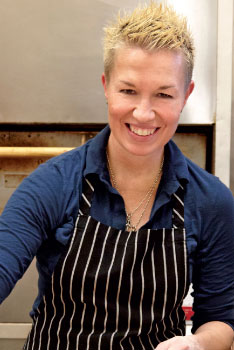
Celebrity chef Elizabeth Falkner, a James Beard Award nominee, believes a comparative taste test would deliver clear results.

“If more people tasted an animal that had been cared for and one that had been neglected, they would come to the same conclusion,” Chef Falkner says. “You can just taste the difference.

“And if nothing else,” she continues, “at least there has to be better karma in sourcing products from animals that have been treated the right way.”

Clarifying the Cause

While many can be sold on the rationale of sourcing goods from humanely raised animals, actually bringing those goods into the restaurant is a process that presents its own hurdles.

Rising consumer interest in food sourcing has created a litany of packaging terms that spark more confusion than clarity. According to AWA’s guide, Food Labels Exposed, terms such as fresh and all-natural have little meaning. Fresh, for instance, simply means that the internal temperature of the meat never dropped below 26 degrees Fahrenheit.

Similarly, all-natural has nothing to do with animal welfare, but rather signals that the meat contains no artificial ingredients or added colors, and that it was minimally processed. Even the term humane is employed loosely on packaging.

“Humane claims are now widely used to convince consumers the food manufacturer is making a special effort in the way animals are raised. However, there is no legal definition or minimum welfare standard for the term humane,” AWA reports.

This uncontrolled Wild West image of labeling has given defined third-party credentials—such as AWA or Certified Humane, two organizations that both perform birth-to-slaughter audits—added credence in the marketplace.

“These third-party agencies give credibility and also brand protection,” Gunther says, adding that leaning on a third-party helps a restaurant counter arguments between animal rights groups and producers.

Cattle and sheep products sourced from Australia, Golding adds, are also raised according to strict animal-welfare regulations. “The standards are legislated by law and enforced by state governments across the country,” she says.

At Smokey Bones, Gronlund says his team leans on its Australian-based vendor, JBS, to ensure the animal goods that Smokey Bones’ procures are humanely harvested and meet the restaurant chain’s defined specifications.

“We’re 100 percent clear in our expectations,” Gronlund says.

Then, of course, there’s the issue of price, a supremely important matter in an industry known for tight margins and intense competition. According to the AWA’s Gunther, the markup on some humanely raised products is significant. AWA-approved chicken, for instance, can be twice as expensive as other options in the marketplace.

Gibson, who is also a supplier to restaurants, says it takes much longer to finish cattle on grass, about three times as long as the 12–15 months needed at a CAFO. That investment of time is reflected in his prices. Ground meat goes for $10 per pound while filet runs $40 per pound. To some operators, absorbing higher prices is simply the cost of doing business in an evolving, more curious, and conscientious society.

At Grazin’, his own restaurant, Gibson simply charges what he needs to and explains the deeper value inherent in his products.

“There are lots of people who don’t think about livestock, but they’re not my customer,” Gibson says. “If you’re mindful about how an animal is raised, taken, and processed—and that’s important to you—then you’re going to seek me out. It’s that simple.”

Others, however, understand the need to be more flexible, nimble, and strategic in their sourcing. Competing in the casual-dining category, Gronlund says Smokey Bones must balance sourcing and pricing to stay cost-efficient and competitive. He says that process begins by looking at the restaurants’ target consumers and determining their hot-button issues.

“You have to know what matters to your customers,” he says.

To test that, Falkner says restaurants might ease into sourcing humanely raised products, perhaps investing in items it can first spotlight as specials before committing to regular menu items. “Then, track the success of those products and see if there’s a correlation,” Falkner says.

To further combat the higher costs, Gunther says some chefs decrease the portion size and take care to explain their sourcing efforts, which positions the restaurant to earn guest loyalty.

Falkner suggests restaurant leaders educate their service staff on where products come from and, in the case of animals, how they are treated. Front-of-the house staff can then relay this information to diners to build a more compelling story.

In addition, Falkner says restaurants might buy cuts that are not prime and use such products strategically, such as using the humanely raised product to complement the main entrée.

ch

It’s a theory Chef Hanlon subscribes to at The Dutch. In November, for instance, Chef Hanlon topped a dish of roasted baby root vegetables with lamb shoulder braised with red wine. He then pulled apart the lamb and served it as a rich sauce over the vegetables.

“It’s about finding a happy medium,” Chef Hanlon says.

As informed by the past as he is in tune with the future, Chef Hanlon acknowledges he needs to selectively pick his battles concerning animal welfare and sourcing. His team at the W Hotels uses up to 1,000 eggs each day, an immense volume that makes obtaining free-range eggs cost-prohibitive. Still, he remains mindful and committed to other ways he can source humanely raised goods.

“No one opens a restaurant to close the restaurant,” Chef Hanlon says. “I have to pick the things that are important to me and run with that in a smart way. It’s about being realistic and pragmatic. We can’t do it all, but we can do some things that make a difference.”


Original post: http://www.fsrmagazine.com | Daniel P. Smith | Sustainability | February 2015

This Spanish Pig-Slaughtering Tradition Is Rooted In Sustainability

Armando

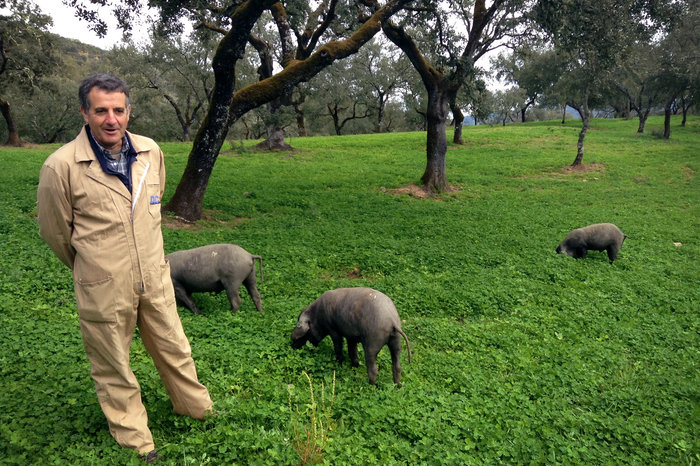
Pig farmer Armando Escaño stands with his Iberian pigs on his farm on western Spain’s dehesa. Escaño raises pigs for jamón ibérico, Spain’s most prized ham. | Lauren Frayer for NPR


In Spain, an age-old way of surviving the winter is getting some new attention from foodies worldwide. It’s called la matanza — literally, the killing of a pig. It’s an ancient ritual in danger of dying out, amid an influx of commercial abattoirs and modern supermarkets. But Spain’s matanza is now getting renewed interest from farm-to-table food enthusiasts.

Armando Escaño calls out to his fat black pigs as they chomp on acorns under cork trees. Escaño comes from a centuries-long line of pig farmers on western Spain’s dehesa, a UNESCO-protected landscape where this country’s most prized ham — jamón ibérico — is produced.

“You can see the future in the past. It’s lasted thousands of years and is therefore sustainable.”

– Chef Dan Barber

Lured by that delicacy, tourists are now making these empty green hills a new foodie destination. They’re coming to see how Armando’s pigs live — and how they die.

“Matar means ‘to kill’ in Spanish — but the word ‘matanza’ actually refers to the whole process that takes two to three days, which starts with the actual slaughtering, but involves the seasonings of the meats and charcuteries,” says Miguel Ullibarri, a tour guide and jamón expert who organizes culinary tours of the dehesa region. “There’s lots of cooking involved — quite a lot of drinking as well!”

Ullibarri’s company, A Taste of Spain, brings visitors to learn about the farm-to-table, free-range, organic eating that’s been the norm here for centuries. Tourists typically spend a few days in Spain’s dehesa, a landscape of rolling hills dotted with cork oaks and fat black pigs. They learn about the relationship between wildlife and landscape conservation: Each Iberian pig requires nearly 5 acres of grazing land, on average. They also learn about the pigs’ relationship to cork — some 80 percent of global cork exports come from this border region of Spain and Portugal.

“These age-old practices carry with them a very complicated ecological understanding, and an intimate engagement with the environment, because technology has not penetrated the agricultural landscape like it has in America,” says Dan Barber, the chef and co-owner of Blue Hill and Blue Hill at Stone Barns, who has toured western Spain with Ullibarri. “You can see the future in the past. It’s lasted thousands of years and is therefore sustainable.”

Barber writes about his discovery of Spanish food traditions in his latest book, The Third Plate.

Like Barber, Ullibarri’s guests tour jamón-curing facilities, and they sometimes attend a matanza — the pig slaughter.


“It’s important to know where your food comes from — even if the experience is unpleasant.”

– Juan Miguel Ramos, mayor of Linares, Spain


“They simply pick the animal up, and lay him on a table — all the while, they’re all stroking him and trying to keep him calm,” recalls Bob Hancock, a Kentucky native who went on one of Ullibarri’s tours a few years ago. “They simply just cut the artery, and the pig is bled out. They don’t do what they do here in the States, [where] they either stun or shoot the animal to knock the animal out. The pig was simply calm until his life was gone.”

The pig is massaged to calm him, and to prevent the flow of adrenaline into his muscles — which can change the flavor of the meat.

Hancock was so impressed with what he witnessed in the matanza that he decided to raise pigs at home in Kentucky. “It was a completely different experience! You could really feel the respect they gave to the animals,” he says.

Iberian black pigs can weigh 500 pounds, having doubled their weight in the two-month acorn season, right before the slaughter. Outside the acorn, or bellota, season, the pigs eat grass, other plants, corn feed — even insects. The matanza has always been an intimate community affair. Tour operators must get to know local officials personally and persuade them to allow foreigners to attend in small groups.

“The matanza is such a core part of the culture, in the sense that it’s how people fought to stay alive — it provided the food for the year. So for them, it’s not a hobby that’s taken lightly — it’s not roasting your ribs on the weekend,” says Ryan Opaz, a Minnesota native who now lives in Portugal and runs a food and wine tour company, Catavino.

Opaz has received increasing numbers of requests for tours that include the matanza and hopes to add them to his company’s itineraries next year — but he says it must be done carefully.

“It’s not a pretty sight for some people. So there’s a bit of voyeurism here. What the tourists are looking for is that full visceral experience,” says Opaz, a former butcher himself. “If it’s done respectfully, it’s truly like stepping back a century — which is great.”

Ullibarri says his company was reluctant at first to include the matanza in its tours. Guides spend days explaining the historical and cultural context of the matanza before guests watch the killing. They want to be careful to respect the wishes of local officials, who don’t want their age-old practices to appear backward to foreigners.


matanza-2-99e1e3d977a68484735418563abafad583b5fcc1-s400-c85

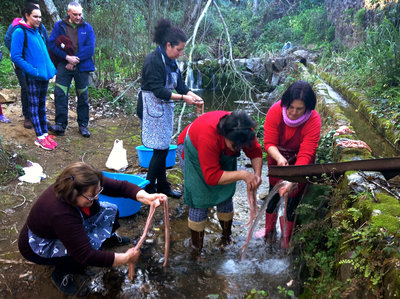
Women wash pig’s intestines in the local river near the village of Linares, Spain. After the matanza, or pig slaughter, every part of the animal is used, nose to tail. The intestines — cleaned with water, lemon and vinegar — will be used as sausage casings.

Lauren Frayer for NPR

NPR was invited to attend a matanza in the Spanish mountain village of Linares, population 300.

“It’s a rural tradition we want to preserve,” says Linares’ mayor, Juan Miguel Ramos. “It’s important to know where your food comes from — even if the experience is unpleasant.”

In Linares, the matanza is done in a farmyard not far from the town square. Villagers drag the pig onto a wooden table that looks like an altar — they use the Spanish word sacrificar, to sacrifice, rather than to kill. Grown men coo and pet the pig, to keep it calm. A man wields a sharp knife, and women rush forward with buckets for the blood.

¡Está muerto! ¡Sangre! — It’s dead! Blood!” a man screams. The whole process takes less than 15 seconds.

“The rest is women’s work,” says Carmen Ramos, chuckling, her arm elbow-deep in a bucket of hot blood, which she stirs vigorously to keep from coagulating. The blood will be mixed with rice, oats and spices to make morcilla, a type of Spanish blood sausage.

The pig’s heavy carcass is carefully lifted onto a wooden cart and hauled into the town square for butchering. And a festival begins. Flamenco music blasts from speakers affixed to the town hall; children dance on cobblestones.

The women take the pig’s intestines down to the river, where they wash them in a cold stream with lemon and vinegar. The intestines will be used as sausage casings. Every part of the pig is used — nose to tail, and down to the hooves, which are boiled for gelatin.

“We came out to the countryside to show our little girls the old tradition,” says Isabel Romero, a Spanish tourist from the city of Malaga, who brought her daughters, ages 11 and 6. “It’s the first time they’ve seen that pork doesn’t always come from the supermarket.”

After his matanza tour, Bob Hancock went home to Kentucky and installed a Spanish wood oven in the bakery he owns — and started raising pigs himself.

“There’s a huge wave of people getting into a nose-to-tail style of eating. They’re not just going to the three-star Michelin restaurants. They’re doing exactly what I did,” he says. “And slowly but surely, the way we are looking at our food here is changing — for the better.”

matanza-3_custom-2779d1967888378b0110776fd1522a492dba4ba8-s400-c85

Village women chop herbs for use in sausage at a matanza festival in the village of Linares, population 300, in the Sierra Aracena, in southwestern Spain. | Lauren Frayer for NPR


March 18, 2015 | by Lauren Frayer | NPR | Read original post: http://www.npr.org/

Best Burger? Of course it’s pork!

The Best Burgers in the Country, According to Chefs

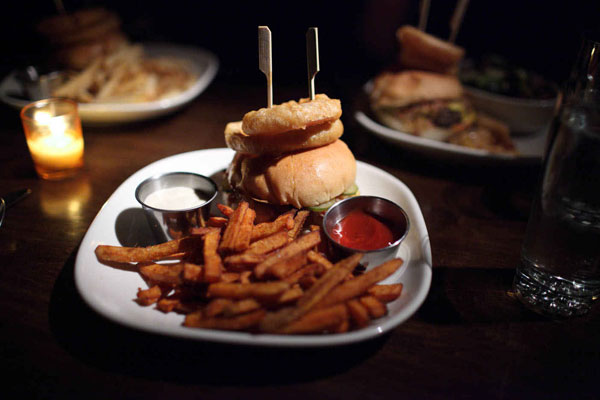
Double Bacon Mangalitsa Pork Burger

Burger & Barrel
New York, NY
Recommended by: Cliff Crooks, chef at BLT Steak, BLT Prime, and The Wayfarer (New York, NY)
“Any one of the burgers at my friend Josh Capon’s place Burger & Barrel. If forced to pick, I’d say the Double Bacon Mangalitsa Pork Burger. He had me at Mangalitsa, which is a type of pig — so delicious!”

ChefsBest