(Bruce posted this story on his Substack on Aug 25)
I was 16 (in 1970) when I decided to go to hard hat dive school, and had just turned 17 when our class started. Oakland was cold that winter, and the roof of our apartment froze a big puddle solid. We went up and played on the ice.
The Coastal School of Deep Sea Diving was right on San Francisco Bay, so we could go practice ocean dives with currents and typical ocean hazards. Most of our training was in a big tank, maybe fifteen feet deep. It was cold because the metal building it was in was cold, and the owner of the school put black ink in the water so it was always zero visibility . Cold, dark, and yes, kinda representative of my life diving over the next 40 years, but I am getting ahead of myself.
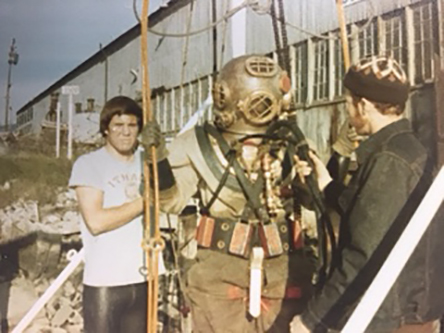
We trained in Navy Mark-5 gear. We divided into teams of five or six men, with each person putting on the suit and performing some underwater task, like tying knots, rigging, connecting and disconnecting the air hose of another diver etc. I messed up some things, and that was the point. Try, learn, fail, try again, remember not to die. Each team member rotated between tending the diver and his hose, or putting on the suit and diving. There were about four people tending the diver and one guy diving. There were other teams and, from memory, I think at least four divers and maybe five were in the tank diving at any one time. So our class was 20-25 divers in training.
I screwed up the connecting air hose task and rebreathed my own CO2 in the helmet until I saw a three dimensional purple cloud floating before me in the darkness. I had one hand on a ladder and pulled myself out of the water. I was supposed to hose-signal some 3 -2 pulls (no air) and I didn’t. The tenders waited quite a while as I was asphyxiating myself. Ha ha, no harm done, but when you are in a fix, try to use a hose signal to the tender somewhere up there holding your hose. I say hopefully, and that is because hose signals don’t always work: thick kelp, a hose wrapped in the rocks, tender sleeping, whatever. You can hope a hose signal gets through, but you’d better have a backup plan, like one hand on the ladder, or ditching the lead, which is near impossible in heavy gear.
Claustrophobia is a word invented to describe climbing into a Mark 5 and descending a ladder into a tank of jet black water. One of our team members had claustrophobia and, for what ever reason, decided commercial hard hat school was a good way to overcome his fear. He also was the only team member gainfully employed, with a wife and kids waiting each day for his return. He sat through classes with us and dutifully suited up and went down the ladder; he spent many days holding onto the ladder, some days with only part of his head underwater. But he suited up and got in and eventually went down to the bottom, where he waited and didn’t really get the task of the day done. His bubbles came up from the same spot; he didn’t move beyond the bottom of the ladder. But every diver on the team got in every day, and we on deck tending him watched the bubbles each day until one day they moved. Our team, no the whole room, erupted in applause . He never went on to be a diver making a living on risk, but he did overcome claustrophobia on the most difficult of terms. Hats off from everyone who watched.
Very few of us who trained in hard hat gear back in 1971 went on to dive professionally in a Mark 5 because the technology had already moved on to wetsuits and band masks rather than canvas suits and brass helmets. Kirby-Morgan, Aquadyne, Radcliffe’s Rat Hat and loads of other dive technology were coming out of Santa Barbara. I dove commercially (for sea urchins) for forty years after dive school and never wore a Mark 5 again. I dove out of Santa Barbara most of those years and never needed anything but hooka, which was just the second stage of a scuba setup and a 300’ hose attached to a compressor mounted on the deck of a boat. We called it light gear because you didn’t need much lead; it allowed divers to swim. In heavy gear you needed lead boots and walked on the bottom. In hooka gear you swim, miles a day.
I have pictures of the other guys on our team of divers in training, but the only name I can remember is Mickey, the other diver down with me on the air-hose connecting fiasco. We had communication lines and the tenders could talk to the divers, but it was school and your communication always seemed to disappear when you wanted to know what was going on up on deck, or vice versa. I never had communication lines again in my dive career, the only hose signals we used were one pull “stop pulling” or three pulls meaning “pull me in”. If the tender started pulling you in, a one pull from the diver meant stop and give me some slack so I can untangle myself from the kelp, or something like that. Three pulls meant start pulling again. Otherwise the diver and his tender on the deck were incommunicado for hours and hours of every day. The tender had to listen to the compressor running, and the diver didn’t ever hear much but his own bubbles and maybe the clicking of pistol shrimp.
In hard hat gear the diver really is dependent on the deck crew and a good hose tender. He can’t get out of his weight belt very easily, and if he loses air, he has until he sees the purple cloud float by. In light gear we didn’t want or need to talk to the hose tender. If things got really bad, you just dropped your weight belt and swam for the surface. When the air went out you didn’t usually even get another breath, so no hallucinations but sometimes a crazy free ascent – that is no air, nothing in your lungs because you breathed out before you realized you were on your own, and the air was gone with 60 or 70 feet of water still remaining between you and your next breath.
We got paid for risk. Well not really, I was paid for the sea urchins or abalone that I brought in from the islands. Risk was just part of it, and the fifty miles of open water we crossed each day on our boats often was more dangerous than sharks or running out of air on the bottom of the ocean.
It was damn fun !
(That’s me in hardhat gear.)