by Diane Pleschner | Aug 26, 2026 | Bruce's Substack
(Bruce posted this story on his Substack on Aug 25)
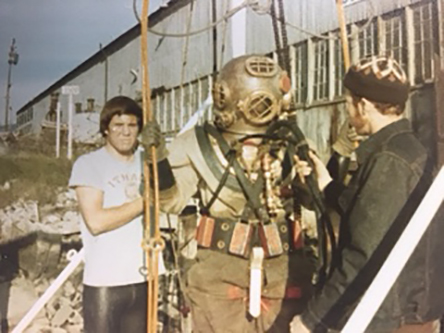
I was 16 (in 1970) when I decided to go to hard hat dive school, and had just turned 17 when our class started. Oakland was cold that winter, and the roof of our apartment froze a big puddle solid. We went up and played on the ice.
The Coastal School of Deep Sea Diving was right on San Francisco Bay, so we could go practice ocean dives with currents and typical ocean hazards. Most of our training was in a big tank, maybe fifteen feet deep. It was cold because the metal building it was in was cold, and the owner of the school put black ink in the water so it was always zero visibility . Cold, dark, and yes, kinda representative of my life diving over the next 40 years, but I am getting ahead of myself.
We trained in Navy Mark-5 gear. We divided into teams of five or six men, with each person putting on the suit and performing some underwater task, like tying knots, rigging, connecting and disconnecting the air hose of another diver etc. I messed up some things, and that was the point. Try, learn, fail, try again, remember not to die. Each team member rotated between tending the diver and his hose, or putting on the suit and diving. There were about four people tending the diver and one guy diving. There were other teams and, from memory, I think at least four divers and maybe five were in the tank diving at any one time. So our class was 20-25 divers in training.
I screwed up the connecting air hose task and rebreathed my own CO2 in the helmet until I saw a three dimensional purple cloud floating before me in the darkness. I had one hand on a ladder and pulled myself out of the water. I was supposed to hose-signal some 3 -2 pulls (no air) and I didn’t. The tenders waited quite a while as I was asphyxiating myself. Ha ha, no harm done, but when you are in a fix, try to use a hose signal to the tender somewhere up there holding your hose. I say hopefully, and that is because hose signals don’t always work: thick kelp, a hose wrapped in the rocks, tender sleeping, whatever. You can hope a hose signal gets through, but you’d better have a backup plan, like one hand on the ladder, or ditching the lead, which is near impossible in heavy gear.
Claustrophobia is a word invented to describe climbing into a Mark 5 and descending a ladder into a tank of jet black water. One of our team members had claustrophobia and, for what ever reason, decided commercial hard hat school was a good way to overcome his fear. He also was the only team member gainfully employed, with a wife and kids waiting each day for his return. He sat through classes with us and dutifully suited up and went down the ladder; he spent many days holding onto the ladder, some days with only part of his head underwater. But he suited up and got in and eventually went down to the bottom, where he waited and didn’t really get the task of the day done. His bubbles came up from the same spot; he didn’t move beyond the bottom of the ladder. But every diver on the team got in every day, and we on deck tending him watched the bubbles each day until one day they moved. Our team, no the whole room, erupted in applause . He never went on to be a diver making a living on risk, but he did overcome claustrophobia on the most difficult of terms. Hats off from everyone who watched.
Very few of us who trained in hard hat gear back in 1971 went on to dive professionally in a Mark 5 because the technology had already moved on to wetsuits and band masks rather than canvas suits and brass helmets. Kirby-Morgan, Aquadyne, Radcliffe’s Rat Hat and loads of other dive technology were coming out of Santa Barbara. I dove commercially (for sea urchins) for forty years after dive school and never wore a Mark 5 again. I dove out of Santa Barbara most of those years and never needed anything but hooka, which was just the second stage of a scuba setup and a 300’ hose attached to a compressor mounted on the deck of a boat. We called it light gear because you didn’t need much lead; it allowed divers to swim. In heavy gear you needed lead boots and walked on the bottom. In hooka gear you swim, miles a day.
I have pictures of the other guys on our team of divers in training, but the only name I can remember is Mickey, the other diver down with me on the air-hose connecting fiasco. We had communication lines and the tenders could talk to the divers, but it was school and your communication always seemed to disappear when you wanted to know what was going on up on deck, or vice versa. I never had communication lines again in my dive career, the only hose signals we used were one pull “stop pulling” or three pulls meaning “pull me in”. If the tender started pulling you in, a one pull from the diver meant stop and give me some slack so I can untangle myself from the kelp, or something like that. Three pulls meant start pulling again. Otherwise the diver and his tender on the deck were incommunicado for hours and hours of every day. The tender had to listen to the compressor running, and the diver didn’t ever hear much but his own bubbles and maybe the clicking of pistol shrimp.
In hard hat gear the diver really is dependent on the deck crew and a good hose tender. He can’t get out of his weight belt very easily, and if he loses air, he has until he sees the purple cloud float by. In light gear we didn’t want or need to talk to the hose tender. If things got really bad, you just dropped your weight belt and swam for the surface. When the air went out you didn’t usually even get another breath, so no hallucinations but sometimes a crazy free ascent – that is no air, nothing in your lungs because you breathed out before you realized you were on your own, and the air was gone with 60 or 70 feet of water still remaining between you and your next breath.
We got paid for risk. Well not really, I was paid for the sea urchins or abalone that I brought in from the islands. Risk was just part of it, and the fifty miles of open water we crossed each day on our boats often was more dangerous than sharks or running out of air on the bottom of the ocean.
It was damn fun !
(That’s me in hardhat gear.)
by Diane Pleschner | May 11, 2026 | Bruce's Substack
Bruce wrote and posted this article in his Substack on May 11, 2026 —
Farming or gardening at scale takes energy to control weeds and prepare a seedbed for planting. It does not require as much energy as we put into it, but energy has been almost free for long enough that we take it for granted that we will always deep plow, disc, till, furrow, rip, use plastic mulch, and dump liberal volumes of NPK to maintain our production of cheap food. To experiment with very low or zero fossil fuels inputs isn’t a question agricultural colleges entertain.
The government isn’t interested and very few farmers would ever try farming without fuel.
“No till” has been used as a way to describe farm techniques that attempt to reduce tillage, but the method commonly in use depends on GMO crops and millions of gallons of roundup and fertilizer. Current “no till” techniques do help address soil loss from wind and water erosion. No till also saves fuel that would otherwise be spent on tillage and cultivation. How soil responds to roundup and massive NPK additions isn’t the same as how it would respond to organic no till and composting systems, not even close. So the term no till has been bastardized, like organic, regenerative, renewable, and every other term initially intended to define earth-friendly agriculture.
No till, in its simplest form, is farming or gardening with a hoe. One man, one hoe . When combined with a heathy composting system, no till can help rejuvenate soils and help maintain fertility. There are other tools like a wheel hoe that, like the grub hoe, can be effectively used to avoid tillage. Most gardeners who take up no till do so, I believe, to improve their soil. Not using fuel isn’t their primary motive, and neither is it a goal of organics operations. No fuel farming, or zero input agriculture, is technique as much as anything, and when attempting to transition you are mostly on your own.
So I use a grub hoe, a wheel hoe, and an electric wheel hoe. The electric wheel hoe is very fast but limited to cutting weeds as they first germinate. It is so fast and easy, and fun, that it can prepare more seedbed than you can keep maintained as the vegetable crops, and weed pressure, mature. Weeds that sink their roots too deeply can be hoed out with the grub hoe, and the wheel hoe serves intermediate needs like getting between rows of vegetables that the electric wheel hoe no longer fits between.
To start a garden requires using the grub hoe to break ground . A hundred square feet a day is reasonable progress. Once open, leveled and with a nice top dressing of compost, the wheel hoe or electric wheel hoe can maintain control of the weeds. Although 100 sq ft per day is reasonable progress with a grub hoe, the electric wheel hoe can knock back 2,000 sq ft in minutes. The manual wheel hoe stands somewhere between the two, and using it is a physical workout just like the grub hoe. Electrics are so nice to use and their potential is great, but again, farmers are not pursuing zero fossil fuel use. Without some effort to adapt small electrics, they will remain the tools of subsistence scale production, which farmers aren’t interested in pursuing because subsistence and profit are different motives.
Solar electrics and small battery-powered gardening tools can provide a method to change the typical ratio of 10 fossil fuel calories to produce one calorie of food. Even when accounting for the embodied energy in their production, small electrics can produce food calories in excess of the energy required to produce the tools and solar panels that power them. Fossil fuel agriculture simply can’t do anything like producing food calories in excess of the energy it costs to build and fuel the tractors and heavy steel equipment required to grow crops.
Small electrics are available for very little money. My electric wheel hoe utilizes a Greenworks minibike that cost $1,000, a Hoss wheel hoe costs $325, and the grub hoe costs $50. With those three tools one man can produce two million food calories or more annually. My Greenworks mini bike is working well into its third year of cultivation chores, and the annual calories produced can feed a small family. Subsistence isn’t some hippy fantasy, it’s a working option. Someone better at number crunching could figure out the embodied energy used to make the tools and the solar panels. Proving that the EROEI (energy return on energy invested) is positive requires keeping track of food calories produced over time, and the longer the tools perform, the better the EROEI numbers will be. I don’t know if ten food calories for every one calorie of fossil fuel energy is a reasonable goal, but it certainly would be an improvement over our current systems of food production. Scaling these tools to feed cities isn’t my motivation, subsistence is. When the last of the fossil fuel is left in the ground because it costs more energy to produce than the energy produced on recovery, it will mean that far more humans will be forced to feed themselves without fuel.
Renewables that produce far more energy than the energy required in their production offer many possibilities in energy production. What if solar + small electrics can produce seed oil crops to fuel some transportation costs via biodiesel, and do so without any fossil fuel costs or emissions? Can small electric tools be used to create wind machines that scale to small farm uses like lifting water? What are the possibilities in utilizing small electrics to build out wind mills, water pumps or passive thermal concentrators? Can we leverage small electric renewables to utilize other forms of energy? I think the answer is yes, I think it is already working, but you probably either doubt my conclusions or my sanity. Such is the price of progress. Wish me well.
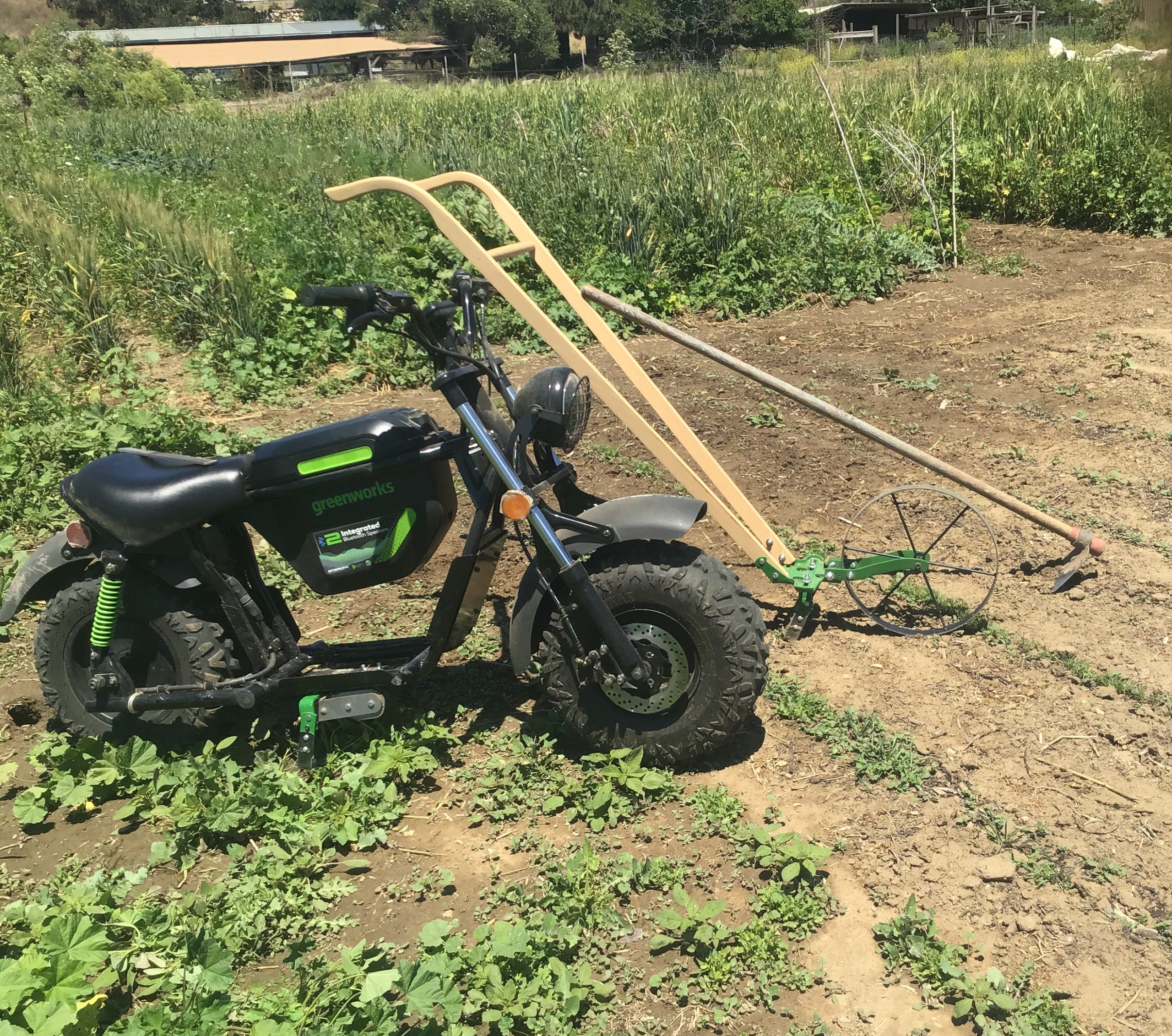 Subsistence farming tools
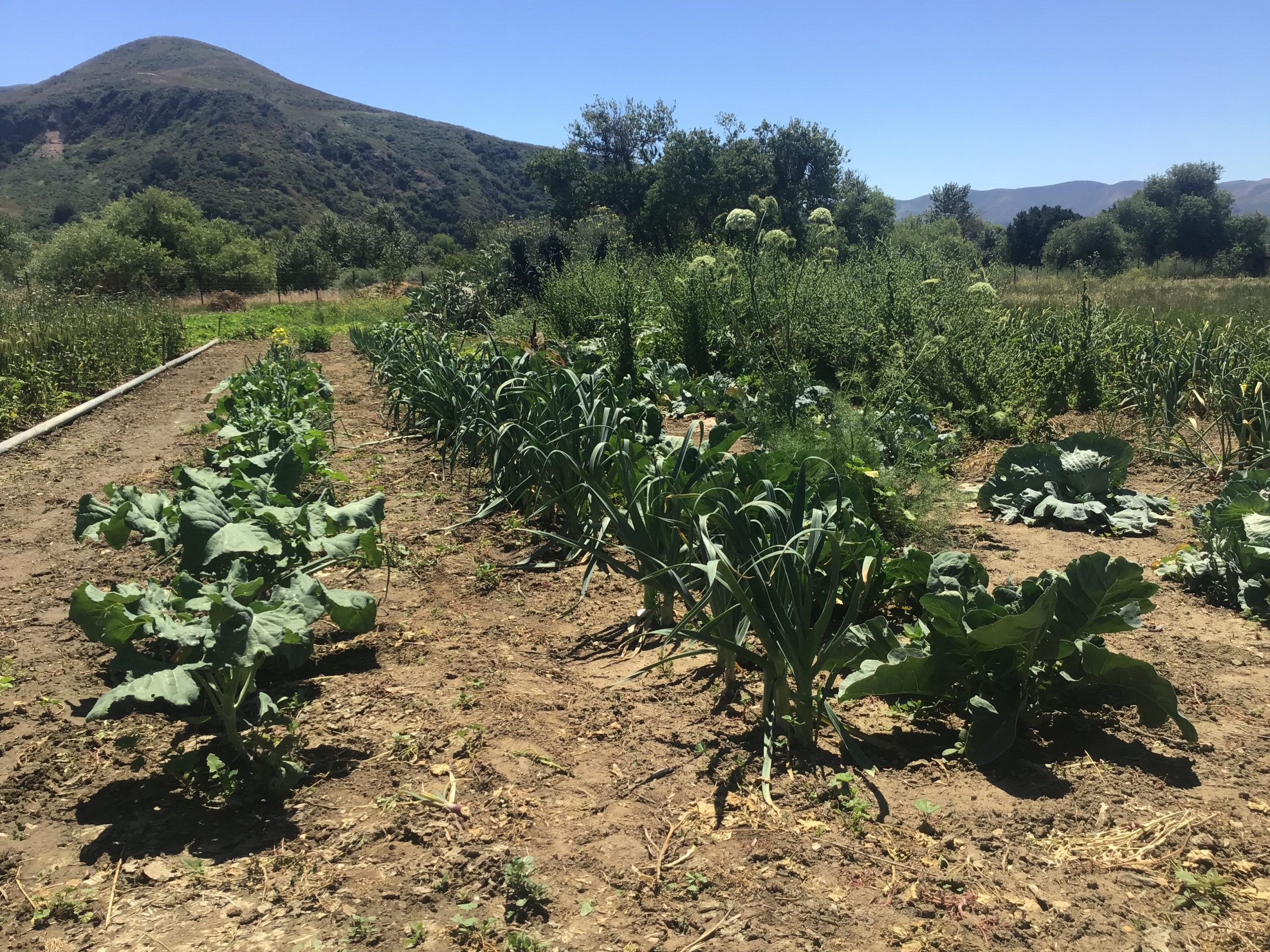 Part of Bruce’s garden May 11, 2026
by Diane Pleschner | Feb 16, 2026 | Farming
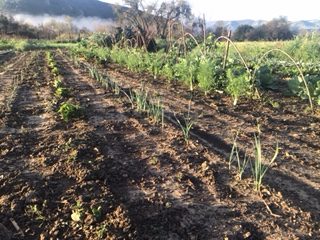
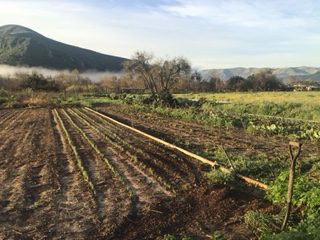
Fog floating down the river. Winter garden going into spring. Bruce has been pulling back the corn and weeds from last year’s garden and top dressing the soil. No rototiller, tractor, or tillage. Farmed with a hoe and an electric e-bike cultivator that he invented. Garden area 60’x60’ currently planted — with about three times that area in last year’s overgrown mess still to pull into shape.
So oak leaf mulch mixed with rabbit manure for fertility and zero fossil fuels for tillage, or anything else. Durum and spring white wheat germinating, leeks, yellow onions, white onions, shallots, garlic, snap peas, little gem lettuce, escarole, fennel, and beets all coming along. Last years kale, artichokes and Brussel sprouts stand in the background.
Very abnormally warm so far this year — corn volunteering for Valentines Day. Not right !
Spring garden at Winfield Farm
by Diane Pleschner | Feb 5, 2026 | Farming
Farm-to-table restaurant Pico Los Alamos features upscale comfort food made with local ingredients, sourced from farmers committed to organic, regenerative and humane practices. Pico owners Kali and Will are passionate about local! Each month Pico features one of their suppliers in their Know Thy Farmer lunch events. Honor beyond honors, Winfield Farm is being feted at the Know Thy Farmer event on February 7.
The Pico promotion for the event announced: WINFIELD FARM –
Mangalitsa Pigs & subsistence farming – Bruce does it all! Join us in the Pico garden for a three-course, wine-paired lunch featuring heritage Mangalitsa pigs from our friends Bruce and Diane Steele at Winfield Farm. The menu will showcase their dedication to solar energy and human powered farming.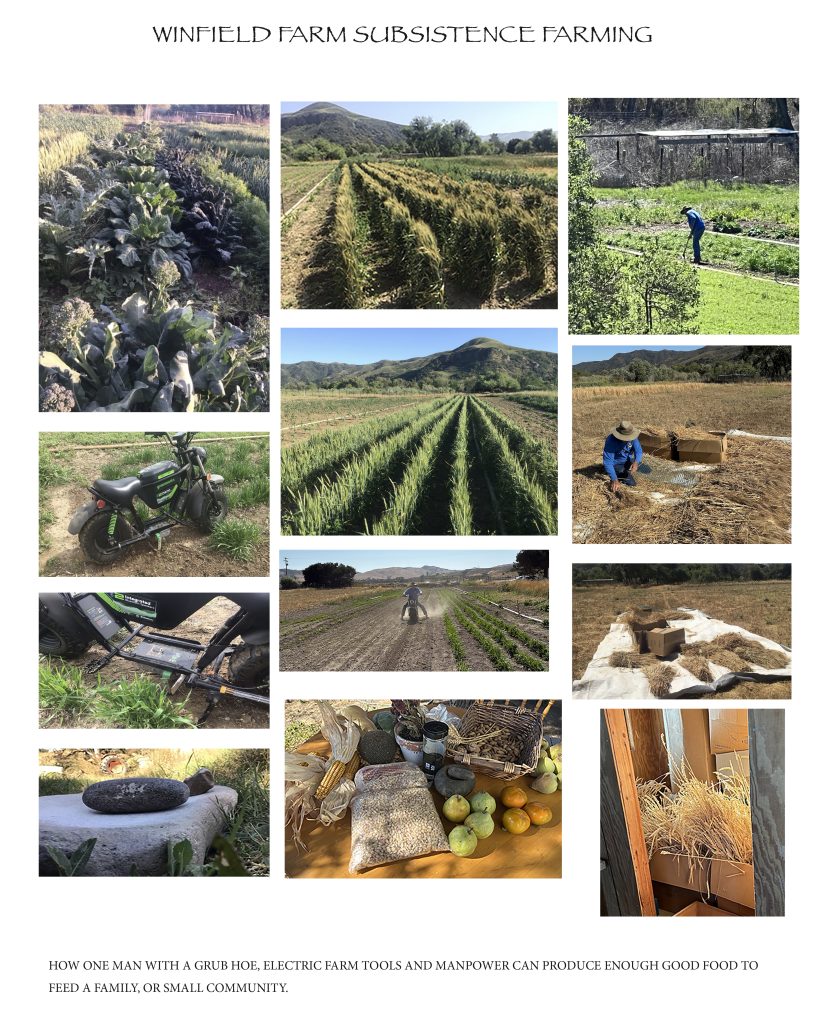
Bruce is excited about this event “It’s great to have a restaurant that has helped support Winfield Farm for a decade,” Bruce says. “It’s nice to have friends willing to try acorns and to have an excuse to showcase the culinary potential of a primitive/minimalist experimental garden.” The lunch menu highlights foods grown at Winfield Farm.
For sure, the menu that Bruce and Kali are planning is unique — 1st course: Durum/buckwheat cold soba noodles paired with 3 kinds of acorn starch “dotorimuk” with little gem lettuce and dipping sauce. 2nd course: cassoulet of tarbias beans, Mangalitsa ham hocks and kale. 3rd course: grandma’s cookbook ‘pumpkin’ pie made from butternut squash and persimmons.
Bruce demonstrates what’s possible for one man to produce with only electric tools and manpower — using no fossil fuel. “Everything but the ham hocks was produced on our farm without fossil fuels,” he says. “The pigs have a carbon footprint.”
He continues, “[this event] gave me an excuse to make three different kinds of dotorimuk, which is likely a first for any restaurant to serve in the US, or anywhere.” The three types of dotorimuk have different colors: pink dotorimuk is from coastal live oak, a favorite of local indigenous Chumash; blond dotorimuk is from tan oak, preferred by Pomo Indians in Northern California; and the brown dotorimuk is from holm oak, the type favored by Iberico pigs on the Spanish dehesa. (Interestingly, Bruce forages for holm oak acorns nearby; Holm oaks have been planted as ornamental trees in many areas of California.)
Bruce plans to set up a table with his metate, nutcracker and samples of various types of grains and their flour for a “show and tell” on Pico’s patio, greeting the sold-out party before lunch begins.
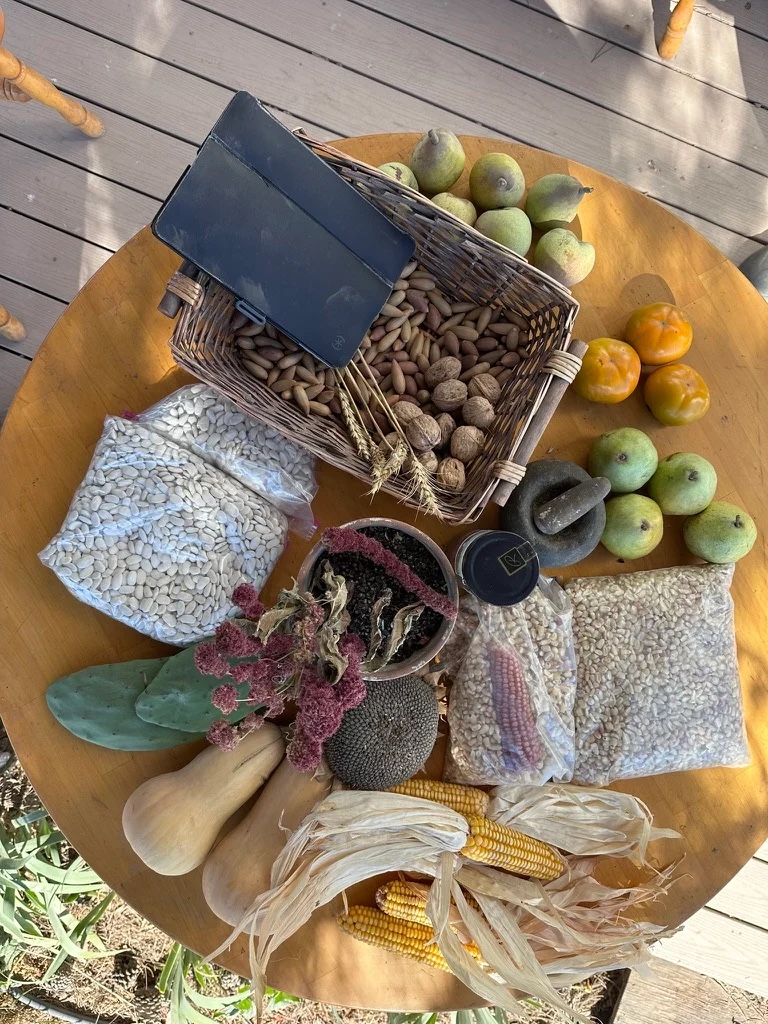
Winfield Farm’s subsistence bounty | Credit: Matt Kettmann
by Diane Pleschner | Jan 9, 2026 | WF News
Full Belly Files Newsletter, January 9 2026, by Matt Kettman
Full Belly Files serves up multiple courses of food & drink coverage every Friday, going off-menu from our regularly published content to deliver tasty nuggets of restaurant, recipe, and refreshment wisdom to your inbox.
New Year’s Resolution: Know, and Support, Thy Farmer
Put your money where your mouth is this year, starting with Pico’s lunch series; plus, stories you may have missed.
Though its popularity is no longer peaking, the winemaker dinner developed a tried-and-true format for hosting a meal that is both indulgent and educational.
The basic formula — for those who haven’t managed to attend one over the past three decades or so — is that the winemaker introduces each course by explaining the chosen wine for that dish, often with the chef also chiming in on the cuisine. Diners leave full of both food and information, often leading to lasting relationships with the wineries and restaurants involved.
(If that piques your interest, check out this “Soul & Soil” dinner at Finch & Fork on January 29 with Chef John Vasquez and winemaker Jessica Gasca from Story of Soil.)
An auxiliary benefit of that format — which still works well for winemakers, by the way, so long as there are enough paying customers in attendance — is that restaurants are applying a similar approach to the farmers, ranchers, and fishermen who fuel their menus. In this age of ever-curious, sustainably minded eating, why not let these frontline food producers share some of the limelight and tell us more?
I’ve advocated for this myself over the years in this column. One call-to-action in my piece about the last farmers’ market in the old location even led to this Lotusland benefit dinner last year, when I was able to ask questions of the highly engaging Jacob Grant of Roots Organic Farm.
It’s great to see more “farmer dinners” — for lack of a better name — pop up around our community. Doing them best right now must be Pico in Los Alamos, which launched their Know Thy Farmer lunch series in February 2022 with Motley Crew Ranch and Sea Smoke Wines.
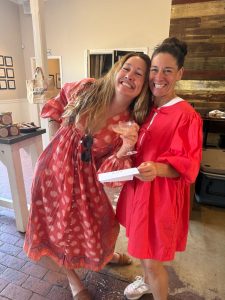
Kali Kopley (right) with Carla Malloy at last year’s Elder Flat Farm Know Thy Farmer lunch.
Know Thy Farmer is driven by Pico co-owner Kali Kopley, who develops the connections and crafts the menus for these monthly events. She keeps them intimate, with a max of 40 people seated at two long tables, and affordable, at $50 for three courses, dessert, and pairings from Lumen Wine, which are made by Will Henry, Kopley’s partner in business and life.
“The inspiration for Know Thy Farmer was to create a gathering where guests could meet a local farmer and learn about their passion, story, practices, and about daily life on the farm,” she said. “These lunches are my vision to meet your neighbor and learn where your food comes from.”
Last year, we previewed last August’s Elder Flat Farm showcase and I mentioned December’s Luretik Olive Oil lunch, but the next two really caught my eye: Mighty Cap Mushrooms on January 18 and Winfield Farm on February 7.
Even casual readers of Full Belly Files must recognize my growing fascination with mushrooms, and Mighty Cap out of Paso Robles is the Central Coast’s most prominent commercial grower of edible fungi. (I’m long overdue for a story on Solvang’s Wolfe Family Farm, so maybe I’ll finally get on that this year.)
For their event next Saturday, Kopley plans to make a consomme of maitake — which is Mighty Cap owner Chris Battle’s favorite mushroom, she said — as well as a mushroom and bacon salad. She may also make a mushroom cassoulet with Lompoc beans or a lion’s mane fritter. “My head is full of tasty mushroom ideas,” she admitted.
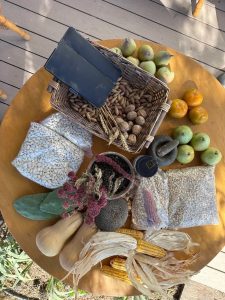
Winfield Farm’s subsistence bounty | Credit: Matt Kettmann
The menu is even more adventurous for the Winfield Farm lunch on February 7. You may remember Winfield Farm from this newsletter I wrote about Bruce and Diane Steele moving from gourmet pigs to subsistence crops in November 2024, which was slightly expanded into this January 2025 cover story. The Pico lunch will highlight both eras of Winfield, including the succulent heirloom pork that Bruce pioneered and the hardy grains that he’s now championing.
“I was going to make cold soba noodles with my hand-harvested durum wheat and have Kali roll it out in her pasta roller,” said Bruce, who serves them with a dipping sauce. Added Kopley, “Bruce is going to teach me how to make durum wheat pasta, and I will teach him how to roll out pasta on a fancy Italian pasta machine. Mostly Bruce will be teaching me!”
For the main course, they are thinking about a sausage dish, either with polenta made from the hand-ground purple maize that Bruce grew or a black caviar lentil from Rancho Gordo. For dessert, Bruce may make a batch of Korean-style acorn starch jelly called dotori-muk to create a dark chocolate pudding that can fill with profiteroles produced from a mix of homegrown and store-bought flours.
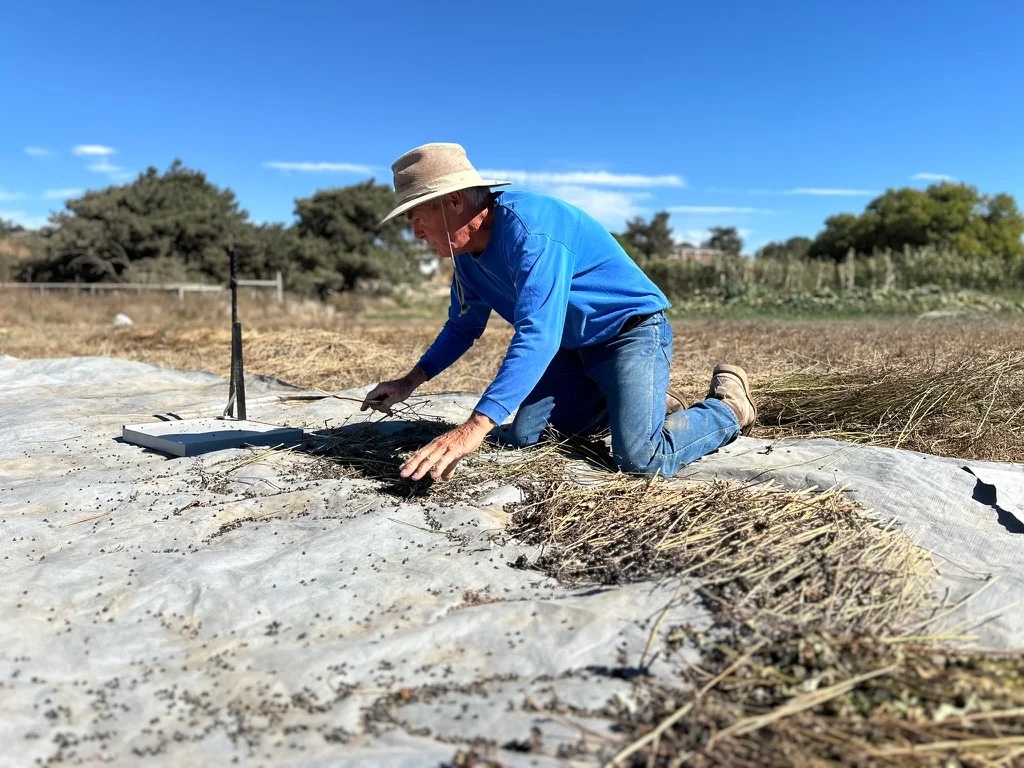
Bruce Steele threshes buckwheat in the middle of Winfield Farm. | Credit: Matt Kettmann
As guests enjoy the food and Lumen pours, Kopley and the Steeles will discuss Winfield Farm’s subsistence farming techniques and how they utilize native grains. She is fired up, exclaiming, “I think this lunch is going to be the best ever!”
For more tickets to Pico’s Know Thy Farmer events — including Mighty Cap on January 18, Winfield Farm on February 7, and Figueroa Mountain Olive Oil on March 28 — click here. If you’re interested in learning about future Know Thy Farmer events — or about Pico’s 10-year anniversary party next month — sign up for their monthly newsletter at the bottom of this page. For more info on Pico, see losalamosgeneralstore.com.