
Blog & News
How To Prepare and Cook Mangalitsa Tri-Tip -The Kobe Beef of Pork
A video from UKULELE JAY BBQ.
Hope you enjoy and please SUBSCRIBE and make sure to follow more UKULELE JAY BBQ on INSTAGRAM @ukulelejaybbq. Another one for the SCINTILLATION STATE!
A culinary culture collision: Porchetta, a Hungarian pig and a South Korean Chef
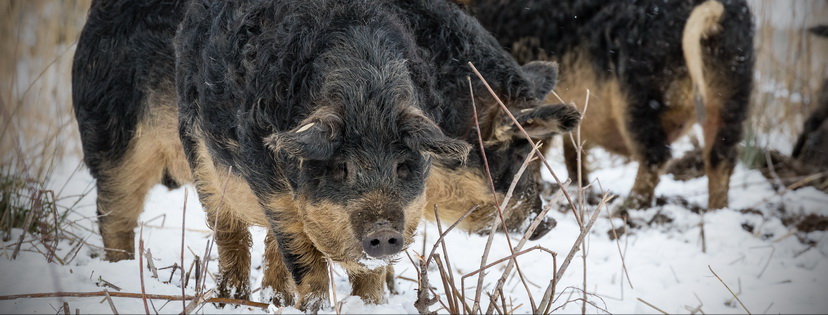
It sounds like the opening of a joke – A Hungarian pig, an Italian recipe and a South Korean Chef meet in a bar – but the pig roast at BIGA in San Diego was nothing to laugh at. There were however plenty of grins as Chef/Owner, Tae Dickey demonstrated his take on an Italian classic Porchetta Roll. Then the afternoon unfolded into a foodies dream. Six acclaimed chefs incorporated pork into eight tasting courses. Delicious ciders from Bivouac and Duck Foot Brewing’s gluten-free beers were on tap. Regal Wines poured Italian vintages. While culinary culture took a turn away from tradition, satisfaction was definitely served.
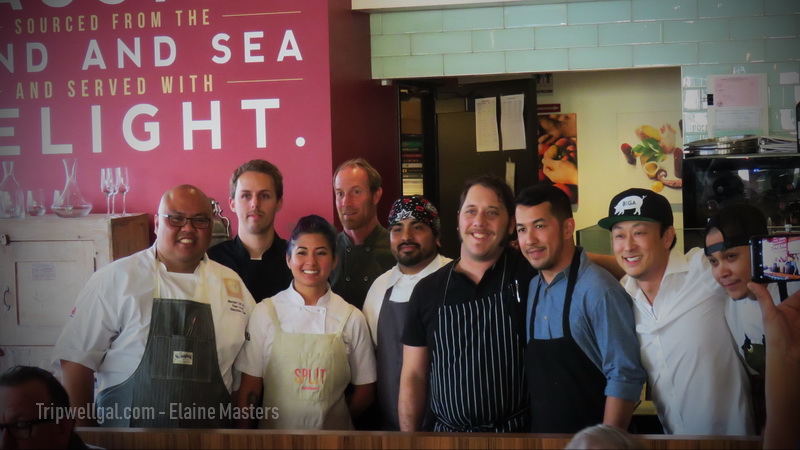 BIGA Anniversary Chef Collaboration
This was the third BIGA pig roast and there was no doubt the event would be memorable given the chefs in attendance. There was Davin Waite from Wrench and Rodent. Whenever he shows up get ready for inspired bites. Willy Eick of Mission Bar and Grill has mastered the art of blending traditions deliciously. Carlos Rodriguez, chef de cuisine at BIGA, stirs his Texan roots and Puerto Rican influences in uniquely apt ways.
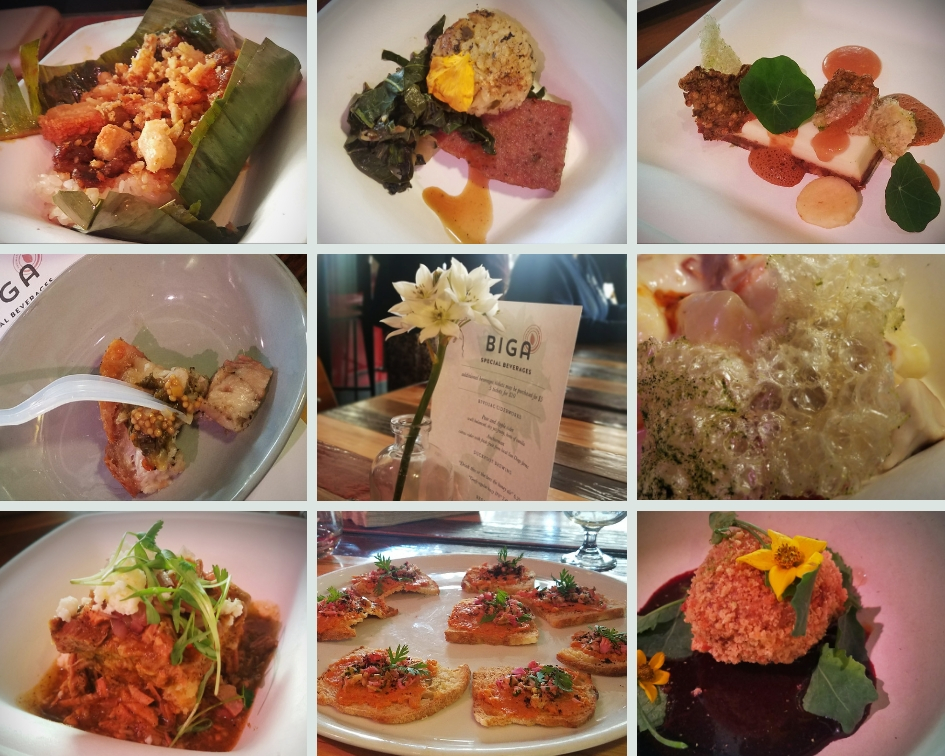
Evan Cruz of Arterra flavors his creations with a Filipino twist. Johnny Dolan of The Lion’s Share was instrumental in bringing it all together. Pastry Innovator, Kristianna Zabala of Split Bake House presented a plateful of tasty textures in a petite dessert flan laced with lard. But the star performance was Tae Dickey’s Porchetta Roll and the demonstration of his signature dish. You’ll find it on the menu every Saturday at BIGA.
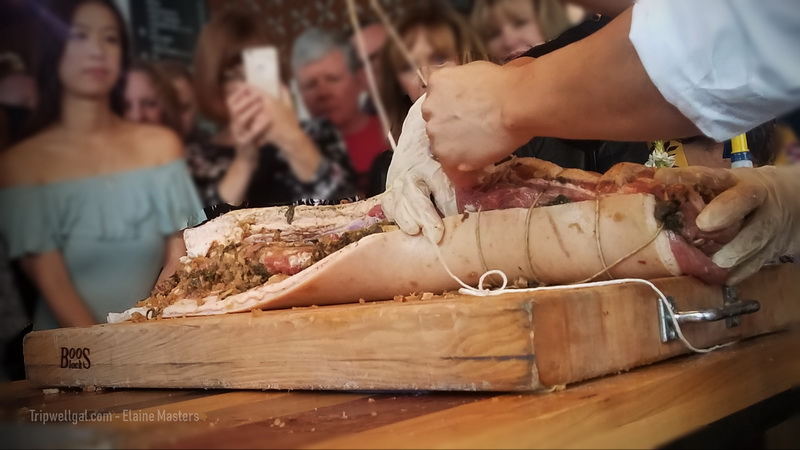 Chef Dickey assembling his Porchetta Roll at BIGA
Chef Dickey is no stranger to culinary culture clashes. He was born in South Korea but moved to Italy with his family as a teenager. He attended the Culinary Institute in Hyde Park, New York before opening BIGA three years ago. Those Italian years branded his cooking sensibilities but he’s not reverent about sticking with tradition. Before the anniversary meal progressed he summoned the crowd to a table near the entry windows. A large tray held a side of pork nest to a row of porcine steaks and a bowl of savory greens. Slapping the smooth pork side, Dickey confessed that “Italians tell you to beat the hell out of that skin” but he doesn’t. His secret is sprinkling baking soda over the surface lightly. “As we learned in chemistry class, baking soda is a natural tenderizer,” then he cautioned that after a few hours it’s important to wipe the soda off. Porchetta is traditionally done with pork loin but Chef Dickey favors a Heritage Breed, the Mangalista Pig.
Watch my video about the Mangalista Pigs and Chef Dickey’s Porchetta:
These pigs are nothing to laugh at either. They grow large and wooly and were originally bred in Hungary, becoming one of the fattest pigs in the world. The rush to Communism almost led to their extinction as meatier breeds became popular. Luckily with recent trends towards all things bacon, demand for the pigs has crossed culinary culture borders. Of course, American farmers were curious and a few are raising these porcine wonders. Near Buellton, California at the Winfield Farm big, curly Mangalitsa Pigs have taken over.
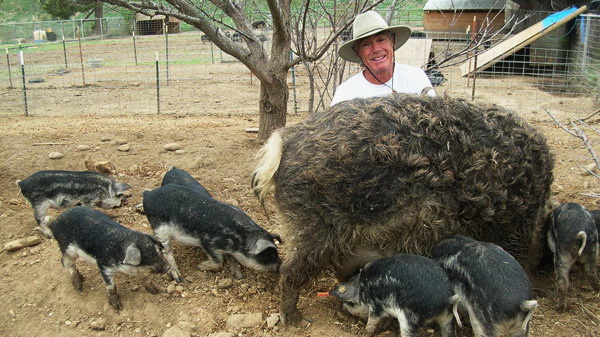 Bruce Steel and one of his prized Mangalista Mommas at Winfield Farm
Owners Bruce and Diane Steele were growing organic vegetables when they decided to add a few pigs. The idea was to feed them with their unmarketable castoffs and past date veggies. They scooped up the acorns growing on their acres of ranchland to finish off the pigs’ diet before going to market. It worked too well as the pigs flourished and then drought conditions hampered their farming. Today they create a range of products including Leaf Lard, which is the highest grade and lower in saturated fat than other animals. It’s also higher in heart-healthy monounsaturated fat. If that’s hard to swallow remember that that’s the same kind of fat that gives olive oil its healthy reputation.
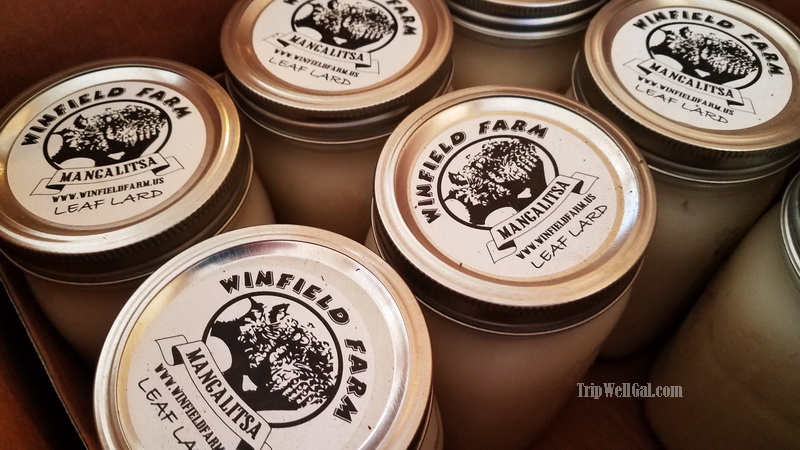 Leaf Lard by the quart from Winfield Farm.
Visit the Mangalica Pig Festival
 Hungarian Parliament in springtime
Original post: https://www.tripwellgal.com/culinary-culture-collision-italian-porchetta-hungarian-pig-south-korean-chef/
SPRING ’19 SPECIAL
Life is good at Winfield Farm this spring! In celebration, we’re pleased to offer this SPRING ’19 SPECIAL on some very special Mangalitsa products.
Mangalitsa Finocchiona salami is now available through our online Mangalitsa Market, cured by Alle Pia Fine Cured Meats. (USDA approved, Alle Pia also cures our Mangalitsa Lardo. You can order Mangalitsa lardo directly from Alle Pia.
http://www.allepiasalumi.com/products/lardo )
Finocchiona salami gets its flavor from traditional Chianti wine from Italy, crushed fennel seeds and black pepper. Finocchiona is one of the most loved among Tuscan pork products. Its name derives from “finnocchio”, or fennel, with the crushed seeds added for enriched taste and aroma.
7 ounces of pure deliciousness!!
$16 each
We also asked Alle Pia to cure Mangalitsa guanciale, traditional pork jowl, for us – an absolute must for creating authentic dishes like carbonara or Amatriciana. The higher fat content melts like magic over pastas and sautees. Slice thin or dice and add to any dish. Eat it plain, put thin slices over warm bread as an appetizer, sauté in pan with onions, add to spinach or any other dish for amazing flavor.
$25 per pound (vacuum sealed packages average approx. 2+ pounds)
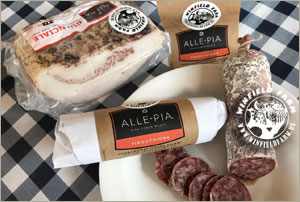
This spring, we also have on hand a bountiful supply of:
Mangalitsa large link sausage –
Flavors: Sweet Italian and Sheboygan Bratwurst
$12 per pound (packs contain 3 links, approx. 1 pound)
Mangalitsa Babyback Ribs
$12 per pound (racks average 1+ pound)
Full rack spare ribs
$10 per pound (racks average 1.5 – 2 pounds+)
Mangalitsa bone-in sirloin chops
$15 per pound (chops average .5 to .75 pounds each)
If you haven’t tried Mangalitsa, you REALLY should –– and taste the Magic for yourself. To entice you, here’s a
SPRING ’19 SPECIAL – 10 percent discount on the products listed above.
To order please email us directly at:
bruce@winfieldfarm.us and indicate
“Spring 19 Special” in the subject line.
(Please make sure to include your shipping address and telephone number in your order.)
We will invoice you via PayPal and you can pay with credit card online.
(Please note: Offer is good while supplies last, or until May 31, 2019)
This special offer is NOT posted on our online Mangalitsa Market.
(Note: Special offer excludes shipping/handling cost.
Winfield Farm ships via Golden State Overnight to western states only — WA, OR, CA, NV, ID, UT, AZ, NM.)
The Feast of Apicius — Sat. Oct. 20, 2018
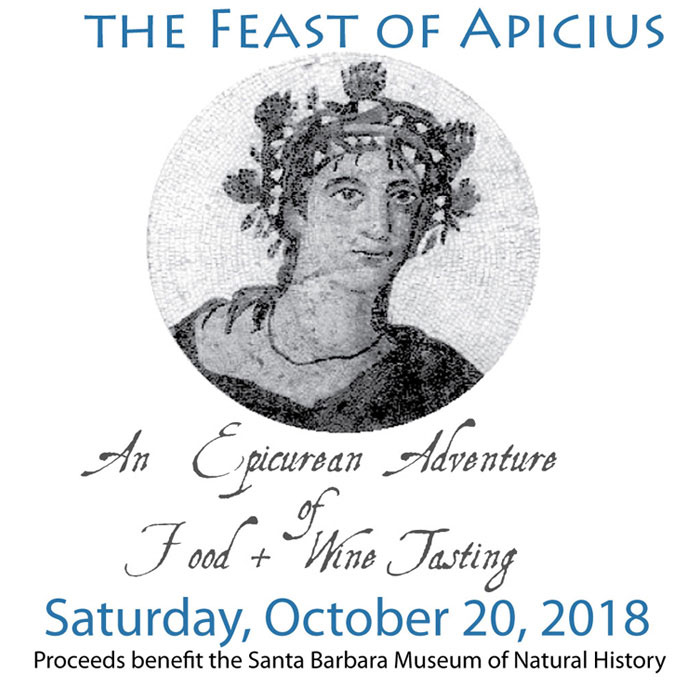
Join Winfield Farm and Grimm’s Bluff winery at the “Feast of Apicius” on October 20, 2018 from 2-5 pm in Fleischmann Auditorium at the Santa Barbara Natural History Museum. This delicious wine + food pairing event is the first of its kind in Santa Barbara as it honors the epicure Apicius renown for his hedonistic pursuit of the finest cuisine. Apicius inspired the world’s first cookbook, written in 1st century Rome.
Bruce will be serving Asian Mangalitsa Meatballs with Ginger Honey sauce, infused with Grimm’s Bluff Sauvignon Blanc wine.
The Feast of Apicius
Saturday, October 20, 2-5 pm
Fleischmann Auditorium, Santa Barbara Museum of Natural History
Price: $50.00 /per person. Proceeds benefit the Museum
Tickets must be purchased in advance: Apicius2018
The Neglected Harvest: Acorns
With 41 million Americans facing hunger currently, the search for solutions is constant – all but a scarce few are overlooking the abundant yet neglected harvest many communities fail to see outside their doorsteps despite their very real hunger. America’s acorns could be feeding millions – directly and indirectly. Acorns have long been eaten by people and animals all over the northern hemisphere – there’s nothing to stop us from eating them again or using them to raise animals. For example, some of the finest prosciutto comes from acorn-fed free-roaming Iberico pigs in Spain. Instead of acorns being a landscaping nuisance, we need to embrace them for what they are: hyper-local, nutrient-dense, gluten-free, perennial, wild-foraged food!
The Miracle Acorn
Acorns don’t come every year: instead they form masts, massive yields that occur in intervals every two to a dozen years. You might have a nut tree in your yard like a pistachio that alternates the years it fruits. This large yield allows for an easy harvest and processing, which requires only drying and leaching of the tannins. It is rare, but sometimes an oak tree grows acorns that has no tannins – it is a sweet acorn! We all can gather our own acorns, process them, and eat them or feed them to our animals. You don’t need to be an expert on acorns to gather enough acorns for an entire year within a few hours with a rake and dustpan. It truly is a natural abundance during those mast years!
Imagine gathering all your flour needs for the year in one afternoon. It’s similar to the way hunters take home one or two deer in a few weekends of hunting and save on buying meat from the store the entire winter or even next year. Natural abundance has that kind of ability – it’s what gave early humans the free time to imagine, reflect, and invent new ways of thinking and being. We could be leveraging natural abundances that are already in place to fight hunger and free ourselves from annual grains by embracing the perennial foods already in place.
Living on Acorns
For several seasons now, Winfield Farm’s Bruce Steele has been only eating food grown and raised on his farm as part of a challenge that he and a friend took upon themselves. He relies on acorns in his diet, and he’s planning on scaling up even more by growing oak trees to raise acorns to feed his Mangalitsa pigs which he sells for meat and uses their lard for biodiesel to run his farm in tandem with solar power.
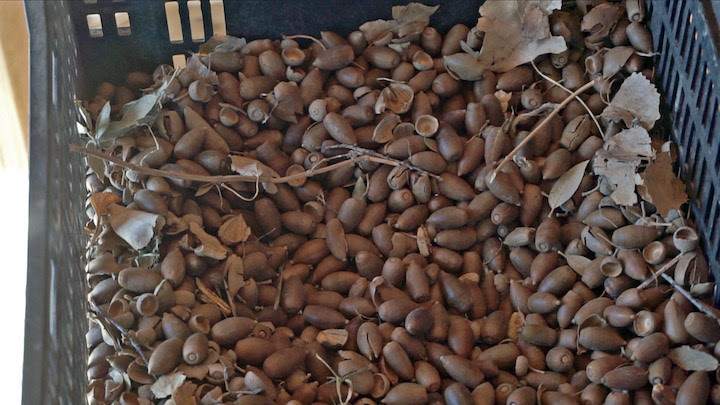
Bruce Steele shares his insights here on drying, leaching, processing, researching, and using acorns:
After collecting acorns you need to spread them out and dry them. This process takes a couple months. Acorns that are cracked or acorns that try to germinate will spoil and need to be thrown away. Sun drying is ideal, but acorns need to be moved indoors if rain or fog threaten. Acorns that fall early in autumn have better drying conditions than acorns that fall later during rain season. Acorns that have dried will separate from the shell and facilitate ease of use with the Davebuilt nutcracker. The nutmeat needs to be separated from the shells, a somewhat time consuming part of processing acorns, but it is during this process that you need to sort out any spoiled or moldy nuts.
The next step is rehydrating the nutmeat overnight with some water in a refrigerator. They can then be a put into a blender (one cup meats and two cups water) and blended into a wet cornmeal consistency. The nutmeat and water are then transferred into one quart mason jars and put back into the refrigerator. Once a day, pour off the liquid but be careful to not pour out the white layer of starch that floats above the blended nutmeat – you can use a natural fiber cheesecloth to do this. After you’ve drained off the tannin-rich liquid, add fresh water. Repeat this process until when you hold a bit of the acorn mush in your mouth, it isn’t bitter at all. This can take 3 – 10 days depending on your acorn type. This is called cold water leaching.
Different acorns require different amounts of time for leaching. Holm oak needs fewer days of leaching than native California oaks. If you can locate Holm oaks, I would suggest using them. There are many different types of oak trees and acorns – you need to experiment with each type to determine how long they take to remove the bitter tannins. This step is critical to making acorn flour for human consumption. If you have access to California black oaks that live at above 3,500 feet in the Sierra then you should try to collect and process them because they were favored by Native American tribes.
I have processed California Live Oak, valley oaks, cork oaks, holm oaks, and Gambel oaks from Arizona. Black oaks are a good species to target. In Arizona there is a species of sweet oak with very low tannins called Emory oaks. All of these western oak species can be processed into acorn flour, but some take more leaching time than others, and some just taste better when you are done.
Once you have finished the leaching process, pass the water, white starch, and nut meat through a strainer, and keep the water: it will have the white starch in it. You can wait till the starch settles and decant the water. This is the part of acorns that the Koreans use for Dotorimuk (Korean acorn jelly). It is very useful as a thickener and can be utilized much like cornstarch. The strained nutmeat can be spread thinly onto a cookie sheet and sun dried. Once dry, a flour mill will turn the dried nutmeat into acorn flour.
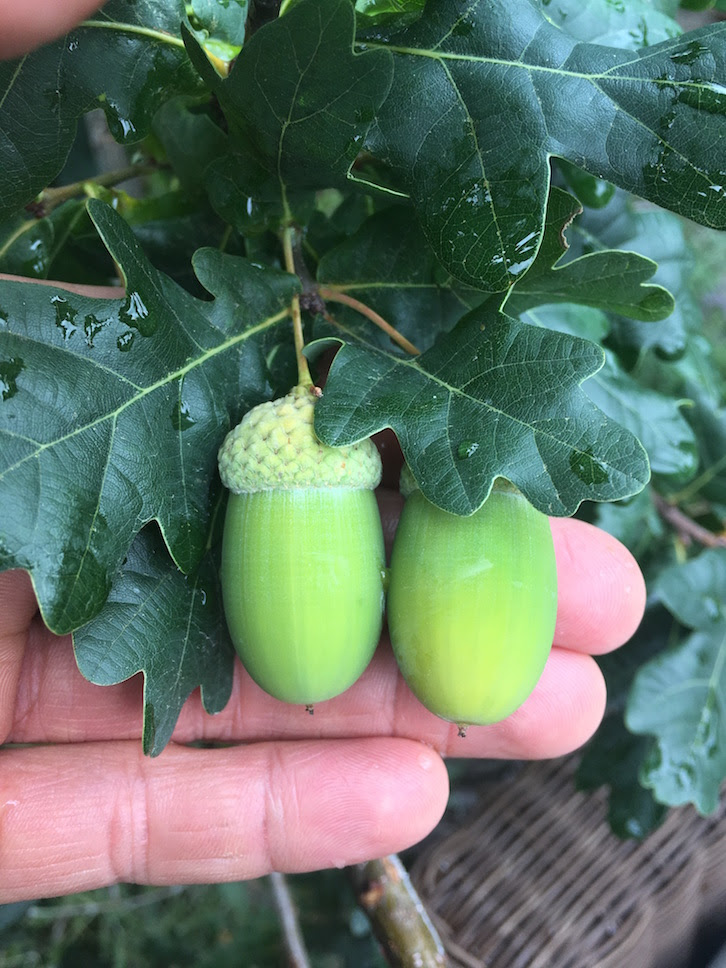
Bruce’s methods are just one way to process acorns for food purposes – there are several other ways to do it: you can even leave the acorns in a net bag in a stream for 3-7 days to let the tannins flow out that way! Learning to use your acorn products requires some experimentation in various recipes. Acorn flour has no glutens and will not rise like wheat flour. Some people mix it with wheat flour for cakes or cookies, but if you are using it as a gluten-free flour, then you need to experiment with using beaten egg whites to lighten cookie, cake, or pancake recipes. If you don’t want to use eggs, you could use any other binder you choose. Mark Salter, acorn aficionado, has tried and likes tapioca starch, arrowroot starch, and even cattail starch!
The Oaken Future
While you may not have an oak tree in your yard, your area likely has some, and if not, there’s likely an indigenous edible equivalent in your area that is being similarly neglected. The native oak savanna is an assembly of interrelated species, not just the acorn-bearing canopy tree. As we embrace the cornerstone of an ecosystem and food system that worked in concert, we will see the return of other beneficial species for medicine, fiber, and food. By supporting the oak savanna and native biodiversity, we support so much of what the oaken savanna generated and protected.
When you crack open an acorn, you are participating in a long tradition that spans the northern hemisphere, and one that can open the door to end hunger, break off our reliance upon industrialized agriculture, and embrace an abundant world of wild foods and foraging abundance!
Here’s the article as a PDF, as seen in Issue 09 of Permaculture Magazine.
Lardo is latest darling of animal-fat movement
The Italian fatback finds its way onto salumi plates, burgers and tacos across the US
Fatphobes had better fasten their seatbelts: lardo has landed.
Not to be confused with conventional lard, lardo is indeed fatback, but it’s fatback of a sublime nature. A national treasure in Italy, Lardo di Colonnata is a designated heritage food that’s made from cosseted hogs fed a diet of forest nuts, then cured for months with herbs and spices in special containers made of Carrara marble. After curing, it makes its tissue-thin and toothsome appearance on salumi plates around that country.
It’s not surprising, perhaps, to find it at home, at high-end restaurants here like Rare Steak and Seafood in Washington, D.C., where it’s part of the Pork Tasting appetizer, alongside paté and chicharrón. It’s another thing altogether to see it as a hamburger topper, as has been the case at Farm Burger in Atlanta.
Unctuous in texture and mild in flavor, it plays well with other ingredients. At Cultivar in Boston, the Heritage Headcheese is served with smoked peaches and lemon verbena-whipped lardo. At Seattle’s Staple & Fancy, it made an unexpected appearance in the Baby Beets and Watermelon Salad with lardo and pistachio. It has also made the menu at Le Farfalle in Charleston, S.C., where the special Stringozzi alla Spoletina pasta entrée was finished with lardo and tomato sauce.
It has found a niche in bread baskets, too. Belcampo Meat Co., a restaurant-cum-butchery with seven locations in California, offers bread service with lardo butter, while trendy RPM Italian in Washington, D.C., serves rosemary focaccia with whipped lardo. In a similarly starchy vein, at Speedy Romeo, a next-gen pizza emporium in New York City, whipped lardo tops coal-baked potatoes on the special Triple Crown catering menu.
Lardo has also turned up in some unexpected places, like B.S. Taqueria, which boasts “authentically inauthentic fare” in Los Angeles, of which the Clam and Lardo Tacos is a good example. The sophisticated Lardo-Wrapped Langoustine with white asparagus at Oriole, Chicago’s fine-dining mecca, is another. And somewhere in between is the Little Piggy Muffin from New York’s Dominique Ansel Bakery that’s served with a thin slice of lardo melted over the top.
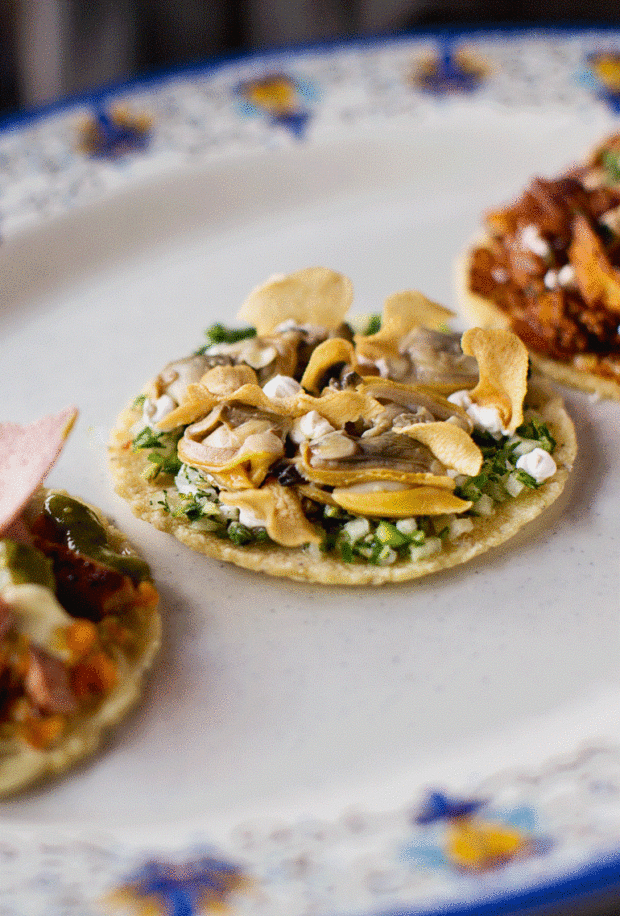
BS Tacqueria’s clam and lardo tacos
The interest in lardo has an all-American cognate, as lard has come back into vogue in restaurant kitchens as well. For many chefs and bakers, of course, it never went out of fashion. Pastry chefs consider it a pie-crust prerequisite, many Southern cooks add a dollop to make their biscuits extra flaky, and it’s SOP at Mexican restaurants, where manteca, or lard, adds depth of flavor and mouthfeel to standards like refried beans and tortillas.
A new generation of operators has succumbed to its fatty charms, like popular, two-unit Bang Bang Pie & Biscuits in Chicago, which boasts that the “leaf lard for our signature pastry crust is rendered specifically for us by our friends at Smoking Goose.” Leaf lard is the highest grade of lard, taken from inside the loin, and it has an especially mild flavor. At nearby Big Jones, the menu pays homage to the people, places and history of the South with dishes like the award-winning fried chicken that is cooked in a combination of leaf lard, ham drippings and clarified butter.
Speaking of homages, Lardo, an OG of the Portland, Ore., food-cart scene, boasts that “it worships at the altar of swine and proudly celebrates its excesses.” The resulting swine-heavy sandwich list has included a Double Burger with lardo alongside the Pork Meatball Banh Mi and Korean Pork Shoulder Sandwich, all of which can be enjoyed with a side of Crispy Pigs Ears with fennel salt or Lardo Fries fried in rendered fatback.
Considering that animal fats have been well and truly stigmatized for the past 50 years, it’s ironic that lard, along with beef tallow, duck fat and chicken schmaltz, is currently climbing the charts on hipster menus around the country. It happens that it is the beneficiary of a unique confluence of factors, including the dramatic fall from grace of trans fats; the rise of the nose-to-tail movement, which has embraced previously discarded pig parts; and, especially, the rediscovery of animal fats by Millennials, especially Millennial parents, who prize their clean, additive-free labels.
There’s a kind of back-to-the-future vibe that would make their great-grandmothers proud.
Original post: http://www.restaurant-hospitality.com/food-trends/lardo-latest-darling-animal-fat-movement
COCHON 555 — MARCH 11, 2018
COCHON 555 RETURNS TO LA
MARCH 11 AT THE VICEROY HOTEL, SANTA MONICA

LOS ANGELES (February 13, 2018) —
If you love a good cause and want to attend one of the country’s most talked about culinary events, then clear your weekend calendar when Cochon555 returns to Los Angeles on March 11, 2018 at the incredible Viceroy Santa Monica. Imagine an elaborate 30-course, stand-up, super sustainable dinner featuring amazing beverages where you get to help pick the best bite from some of the best local chefs.
This year’s all-star cast of chefs – who specialize in whole animal cooking and are paired with farmers responsibly raising delicious heritage breed pigs – include Sammy Monsour of Preux & Proper, Brian Redzikowski of Kettner Exchange, Thomas Bille of Otium, Lord Maynard Llera of Mason and Hugo Bolanos of Wolfgang Puck at Hotel Bel-Air. Butcher Michael Puglisi of Electric City Butcher rounds out a stellar lineup.
We at Winfield Farm are delighted to partner this year with Executive Chef Hugo Bolanos (@hugoalejandrobolanos) of Wolfgang Puck at Hotel Bel Air. On March 1 we will deliver a 200-pound heritage Mangalitsa from which Chef Hugo will make 6 magical dishes.
To win the friendly competition for a cause, a chef’s menu must woo twenty celebrity judges with their “Judge’s Plate” scored on utilization; technique; and overall flavor and be voted “best bite of the day” by guests. The winning “Prince or Princess of Pork” in Los Angeles will advance to the national finale, Grand Cochon, a head-to-tail, winner-takes-all showdown for the crown in Chicago on September 30th.
The ultimate aim of Cochon555 is to provide education to chefs and consumers and create experiences that guests can sink their teeth into: honest food from real farmers. The goal is to raise the bar on building a sustainable and profitable relationship for brands and chefs participating in culinary festivals. For an in-depth look at the distinguished providers behind the Cochon555 movement, to view a video, and to purchase tickets, please visit http://cochon555.com/us-tour/2018-la/
Tickets for general admission start at $130; VIP tickets (early admission + exclusive access to cocktail competition and allocated wines and spirits) are $200.
Where: Viceroy Santa Monica – 1819 Ocean Ave, Santa Monica, CA 90401
When: Sunday, March 11
Time: 4 p.m. for VIP entry, 5 p.m. for General Admission
History of the Mangalitsa

Many names are used for the Mangalitsa, his races and crossbreds: Mangalitsa, wool haired pig, curly-haired pig, Baris and Ordas (crossbred) or Bogauner (Bakony ancestor of Mangalitsa). In different countries are different spellings for Mangaltiza:
Mangalica (Hungarian), Mangulica (Serbian), Mangalita (rum), Mangalitsa (AmE), Mangulac, Mangaliza, Mangalicza. The races of the Mangalitsa pigs (Hungarian Blonde Mangalitsa) in Hungarian Szöke, Fecskehasu (Hungarian Mangalitsa swallowbellied) and Voros called (Hungarian Red Mangalitsa).

The primary breeding in Kisjeno has pioneered this development. A document from 1833 shows involved the transportation of twelve Schumadinka (Sumadija, Sumadia) fat pigs (2/10) as bred in Topscider, Belgrade, the Serbian Prince Milos Obrenovic, the Palatine of Hungary, Joseph Anton Johann of Austria in its Dömäne Kisjeno. This “Milos–pigs” were paired with Szalontai and Bakony–pigs. Their descendants became the basis for subsequent fat pig breeding. The “blood–Kisjeno” spread all over the numerous breeding flocks in Hungary.

Mangalitza as the leading lard type breed, the products of this pig fueled mainly the population of the Austro-Hungarian Empire. The reason of his popularity was the fat. After a long time runner, the pigs were fattened up to 250 to 300 kg,. 20 to 25cm backfat not uncommon.
Before the introduction of the Danube Steam Navigation and construction of rail shipments of pig farms they had to bring the pigs to the Vienna slaughterhouses in weeklong walks by feed. 1871, 38.330 fat pigs from Gyor and Sopron were driven to the Vienna market.
In the 1890s in Budpest a pig market system and the pig slaughter house was built. Hungarian livestock census in 1895 showed a population of 6,447,143 pigs (MATLEKOVITS 1900; Tormay 1896). 94% of them belonged to the lard type pig.
Hungary with 407 pigs per 1000 inhabitants, the country with the most pigs in Europe. 1894 73% to Central and Western Europe were exported.
This first golden age of Hungarian fat pig breeding ended in 1895 introduced from America, swine plague, export restrictions and rival, foreign pig meat breeds. The stock recovered only in 1911, but was again decimated in the war years.

From the 50s of the 20th Century, the demand for pork products changed radically and pig breeds with lean meat quality supplanted the Mangalitsa pig. During the late seventies industrial pig established with imported pig meat breeds and standardized health conditions in warehouses, the Mangalitsa pig was maintained only in zoos or occasionally by small farmers for their own use.
In 1973, the Mangalitsa in Hungary was placed under protection and introduced a subsidized gene reserve breed. Until 1980 within 10 farms it was possible to rebuilt a breeding line of the three race options: Blonde, Red and swallowbellied
Only an export agreement with Spain for the production of Serrano ham (Jamón Serrano) from 1990 caused an economic boom of Mangalitzas.
Originally posted: https://www.mangalitzainternational.org/
Mangalitsa Pork: Where to Buy and Try the Prized Meat
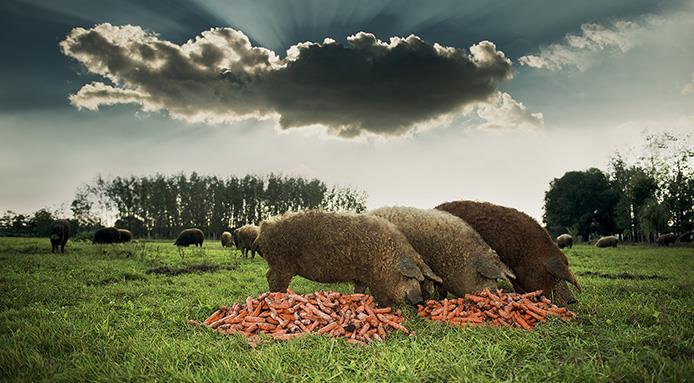
Known as Mangalica, Mangalitsa or Mangalitza, this is the pig prized for its high fat marbled meat that has been hailed as the Kobe beef of pork and attracted critical acclaim from chefs around the world.
As delicious as it is, tracking down this curly haired rare breed hog is still somewhat of a challenge, despite its growing popularity.
In response to the huge Facebook interest we had from our initial article introducing the delights of the succulent meat, we’ve decided to put together a list of some of the farms, shops and restaurants where you can get your hands on this tasty find.
From a rural farm in Wales to a three Michelin-starred restaurant in New York find out where you can try this tasty delicacy and you’ll be hooked.
Meanwhile, those wanting to go the whole hog should mark the annual Mangalica Festival Budapest in their diary for three days of celebrations from 10 to 12 February 2017 (TBC) and anything and everything related to Mangalitsa.
Watch the video from the Mangalica Festival 2012 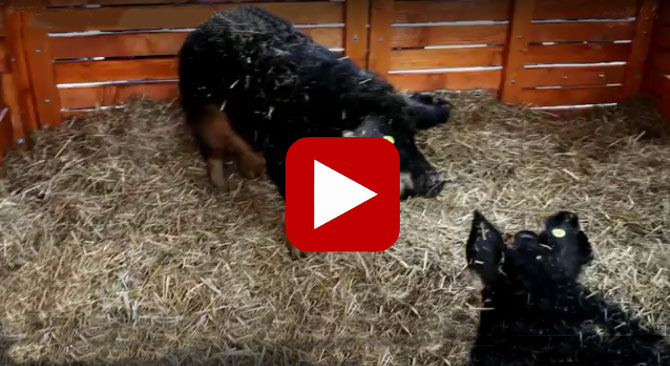
Originally published: https://www.finedininglovers.com/blog/culinary-stops/mangalista-pork/
Inside the Secret World of Super-Premium Spanish Jamon Iberico
Preface — Mangalitsa pigs (like the rare Hungarian breed raised at Winfield Farm) are the only other pigs besides Iberico that can officially be labeled “pata negra”. In fact, Spanish charcutiers rediscovered Mangalitsas in Hungary in the early 1990s while looking for new sources of premium quality lard hogs and found Mangalitsa, and their interest saved the breed from extinction. Mangalitsas also are descended from European boar lines.
[Photographs: Max Falkowitz]
It’s a misty Wednesday afternoon and the pigs are hard at work. So is their porquero Juan Carlo, who’s busy guiding them across this 1,700 acre farm to the land’s choicest acorns. At sunrise, Juan Carlo rouses about 340 pigs from their farmhouse and sets them to work. At sundown he corrals them back to the ranch. This year marks his 25th on the job.
In a few weeks the pigs’ work will be done: they’ll be sufficiently fattened up from their grazing to be slaughtered, butchered, and turned into some of the most expensive ham in the world—at my local source, $220 for a hand-sliced pound. Why so much? Because it’ll be jamon Iberico puro de bellota, acorn-fed pure breed Iberico ham, and sold under the Cinco Jotas (5J) brand, one of the oldest and most well-respected in Spain.
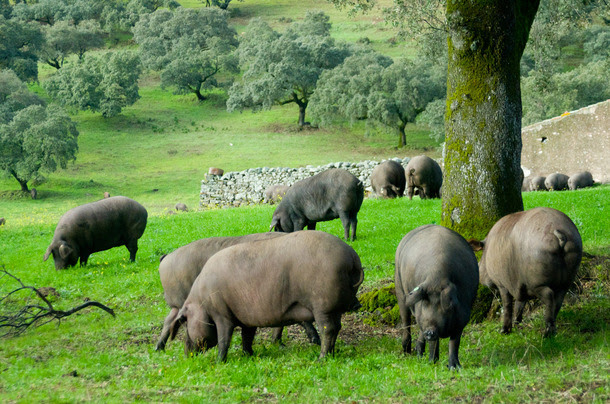
It’s a misty Wednesday afternoon and the pigs are hard at work. So is their porquero Juan Carlo, who’s busy guiding them across this 1,700 acre farm to the land’s choicest acorns. At sunrise, Juan Carlo rouses about 340 pigs from their farmhouse and sets them to work. At sundown he corrals them back to the ranch. This year marks his 25th on the job.
In a few weeks the pigs’ work will be done: they’ll be sufficiently fattened up from their grazing to be slaughtered, butchered, and turned into some of the most expensive ham in the world—at my local source, $220 for a hand-sliced pound. Why so much? Because it’ll be jamon Iberico puro de bellota, acorn-fed pure breed Iberico ham, and sold under the Cinco Jotas (5J) brand, one of the oldest and most well-respected in Spain.
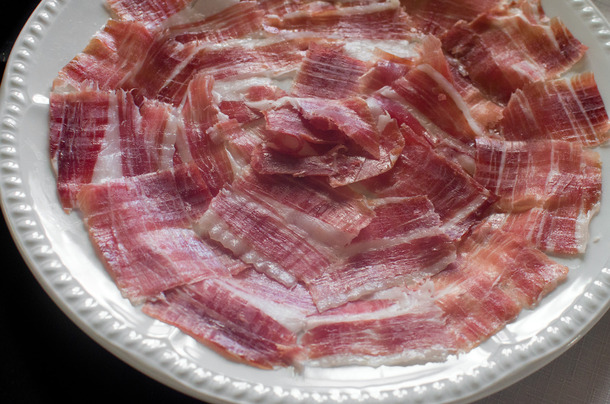
Acorn-fed jamon Iberico is intensely sweet. It’s floral, earthy, and nutty like good Parmesan, with fat so soft it melts right in your mouth. For many ham lovers it’s as good as good gets, and it never comes cheap.
This storybook-green plot of land, dotted with knobby trees and cooled by the breezy Iberian climate, is one of many across Spain and Portugal that raises pigs for Sanchez Romero Carvajal, the company that produces 5J ham. But all those pigs eventually make their way to a small town called Jabugo where hams cure in a 130-year-old cellar designed for the task. From start to finish, the ham-making process is simple: grant good pigs the freedom to be good pigs, let them feast on the land, then cure their flesh with little more than salt and air.
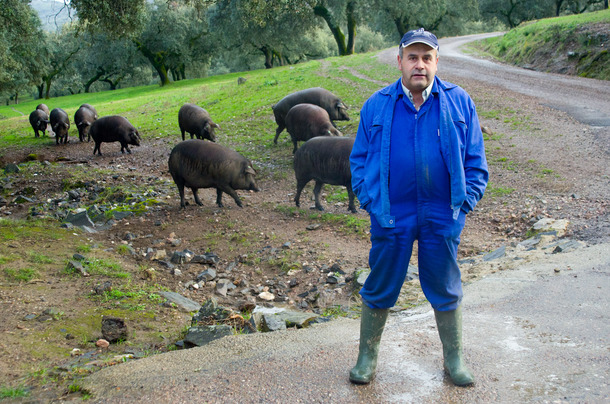
For most eaters, that’s where the story begins and ends. But there’s more to it—a process that blends unwavering tradition and modern technology to produce this sought-after ham. To share what work that involves, Carvajal invited me to tour their farms and ham curing facility. Though the visit wasn’t all-access—there wasn’t time to see the pigs’ nurseries or the actual slaughter facilities, for instance—no questions were off-limits. Here’s how it all happens.
Behind the Label
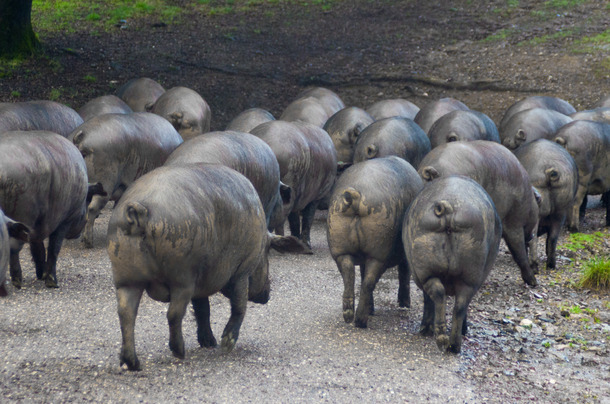
In the world of Spanish ham, there are two premium classifications: Iberico pigs and acorn-fed pigs. Unlike white pig breeds like Serrano, black-skinned Iberico pigs are descendants of the Mediterranean wild boar, and are colloquially called pata negra (“black foot”) for the hoof that accompanies each ham. They’re athletic animals, runners and rooters, and thanks to the structure of their intramuscular fat, their meat is more flavorful, juicy, and distinctive.
Iberico pigs are expensive. They have smaller litters, yield less meat per head, and take time to mature, which is why many ham producers around Spain cross-bred them with other varieties. Up until recently, ham made from pigs that were as little as half-Iberico could be sold as jamon Iberico, but new legislation now requires Iberico ham to be labeled according to the percentage of the pigs’ Iberian ancestry. 5J is one of the few brands to exclusively use pure Iberico pigs.
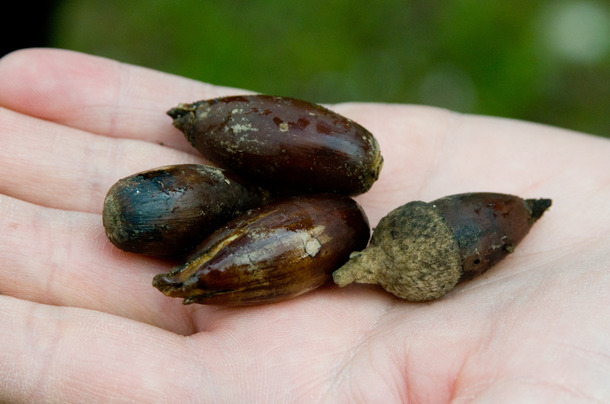
Then there’s the acorns, the bellota, which fall from oak and cork trees from early October to early March on the farms where the pigs are raised. They’re high in fat, a large percentage of which is unsaturated oleic fatty acid, and eating them is what makes the pigs’ fat so soft and creamy, on the verge of melting at room temperature. Acorns also contribute to the ham’s nutty flavor and aroma, as essential to the product as the meat itself. Of all commercially raised Iberico pigs, only 5% are both pure breed and acorn-fed.
From Piglets to Porkers
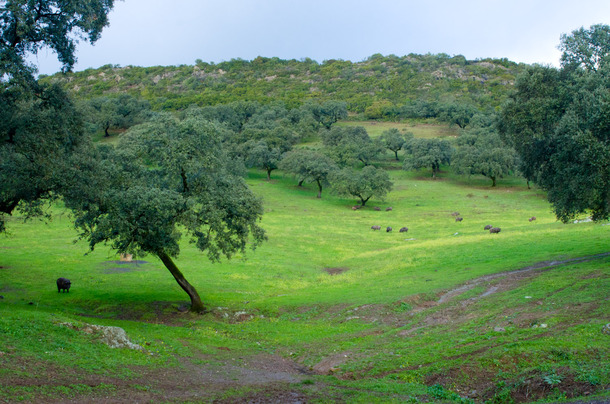
Spanish ham culture has a vocabulary all its own. There are porqueros, not shepherds; pigs are “sacrificed,” not slaughtered; and the farms where they’re raised are called dehesas.
The dehesas are a national treasure: each one to two thousand acres of forest partially converted to pasture, often hundreds of years old, with rolling grassy hills amidst crops of acorn-producing oak and cork trees. Just as acorns are an essential ingredient to the ham, so too are the dehesas. These pigs need to run around all day, over the hills and through the woods, for their muscles to develop and for the ham to taste the way it does.
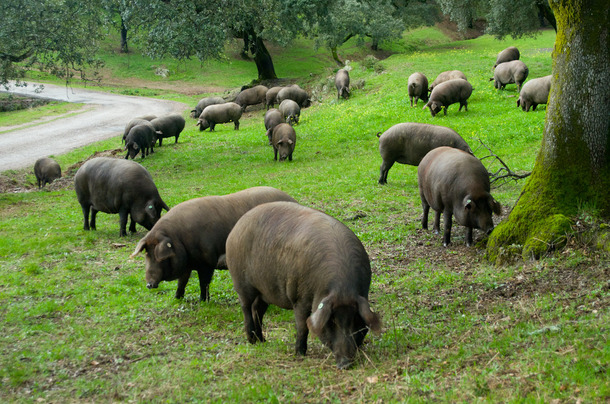
Over 18 to 24 months, the pigs will root around the dehesa, grazing on grass, mushrooms, bugs, herbs, whatever they can find. Come October all through March, the montanara, or acorn-dropping season begins, and the pigs march into action. Fatty acorns are the pigs’ favorite food, and with a mandated five acres of dehesa per pig, there’s plenty of room to look for them. By the pigs’ second montanara, they’ll have feasted enough to reach their kill weight, about 360 pounds.
Managing the pigs isn’t just left to nature. Carvajal inspectors pay anonymous visits every two to three weeks to check on their treatment and diet. They also sample the pigs’ fat to analyze its oleic acid content—too little and the pigs won’t meet quality standards, too much and they’ll be impossible to cure into ham.
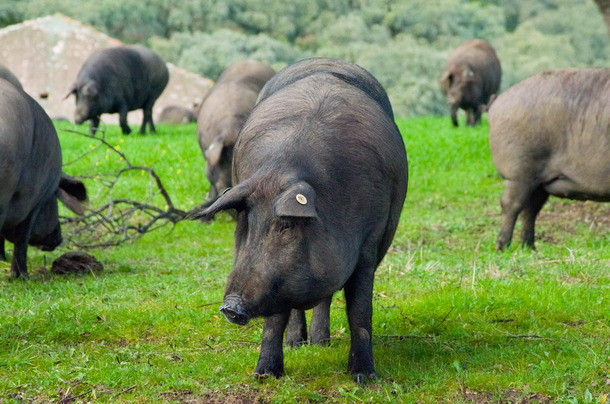
You may have heard that pigs are as smart or even smarter than dogs. On the dehesa they behave more like sheep dogs than sheep. Curious about newcomers, they’d inch closer and closer to me, some even posing nicely for the camera, before bolting away. Unlike livestock domesticated into complicity, these wild boar descendants stay smart.
The Long Cure
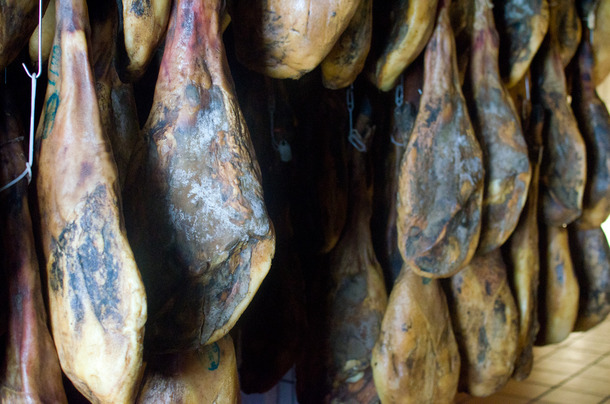
The curing facility in Jabugo is over 100 years old: part modern office space, part ancient farm house. In one courtyard you can still see hundreds of hooks on the ceiling from when ham was cured out in the open. These days they rest in a sprawling brick-walled cellar.
Before they get there, the pigs must be slaughtered. They’re knocked out with CO2, and once a pig is deemed unconscious by a vet, a worker slits the artery along its throat until it bleeds out. Legs, loins, and shoulders go toward making Carvajal products, and the remaining fresh meat is sold to Spanish restaurants. The ham-bound legs are then skinned, salted, rinsed, dried, and sent to the curing cellar, where they’ll remain for about a year and a half.
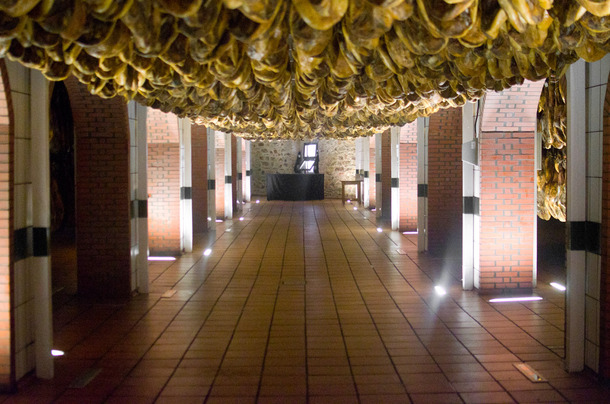
See those hanging bits at the top? All ham.
Carvajal’s 130-year-old cellar is an underground city of ham; step downstairs and you’re slapped with an aroma that’s something like rising bread, aged cheese, and your deli’s cured meat display—multiplied by the 40,000-odd hams inside. With little signage it’s a marvel anyone knows their way around. “Don’t worry,” an employee tells me, “I get lost in here all the time.”
Thick brick walls, a breezy, hilly climate, and a stable population of ham-friendly microorganisms are most of what the meat needs to finish its journey into ham. Skilled specialists monitor the cellars at all times, noting fluctuations in temperature and humidity, but their adjustments are amusingly low-tech. Need to change the temperature? Open or close a window. Air too dry? Spill some water on the floor.
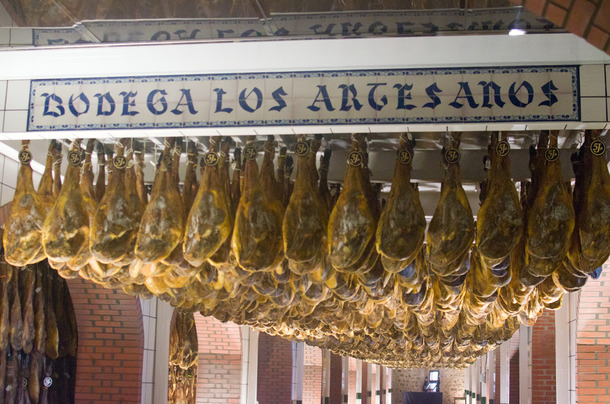
It’s more complicated than that, of course—hams too close to a window may get moved if they dry out too quickly, and the legs are regularly rubbed down with oil to prevent insects from taking up residence—but the most vital and final measurement Carvajal takes is very much a human one.
Before any ham leaves the cellar, it gets a sniff test. A trained nose can purportedly detect 100 aromas from a premium ham, some sweet, some meaty, some nutty. Different regions of Spain have their own hammy terroir, and even different cuts of the same leg bear unique aromas.
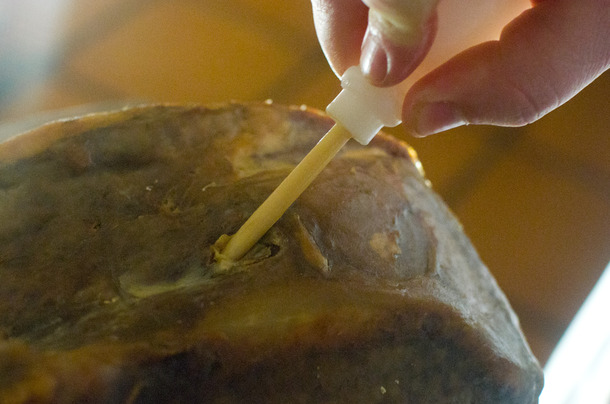
A mere eight noses are charged with inspecting all the hams. The job is so specialized that one ham sniffer, a third generation Carvajal employee, isn’t qualified to sniff cured loin (another 5J product) because the aromas are too different. (That’s his father’s job.)
With a short, stubby needle called a cala, the ham sniffer pokes down to the bone, quickly takes a whiff, and covers the breach with a smear of fat. There’s just a second or two to detect the balance of sweet, earthy, fermented, and floral aromas that signal a well-cured ham, and only a ham that passes the sniff test in four inspection sites makes its way out the door. If anything goes wrong, the nose knows.
Even for ham-loving Spaniards, 5J ham is a luxury good, which is why Carvajal also sells a more affordable ham under a Spanish-only brand called, eponymously, Sanchez Romero Carvajal. It’s made from the same pigs and cured in the same cellar, just not held to quite as stringent conditions. Only at the cellar do quality control experts decide which hams get the 5J label and which ones don’t.
To Market, to Market
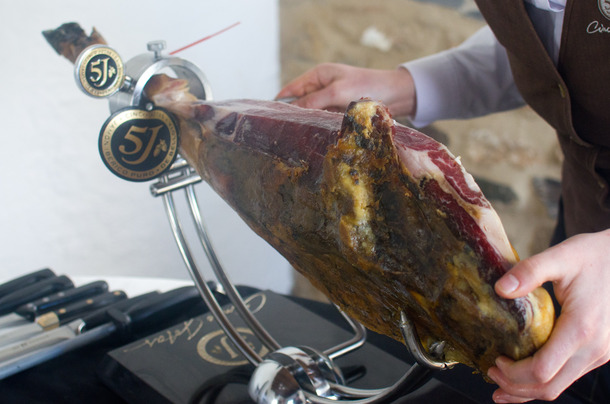
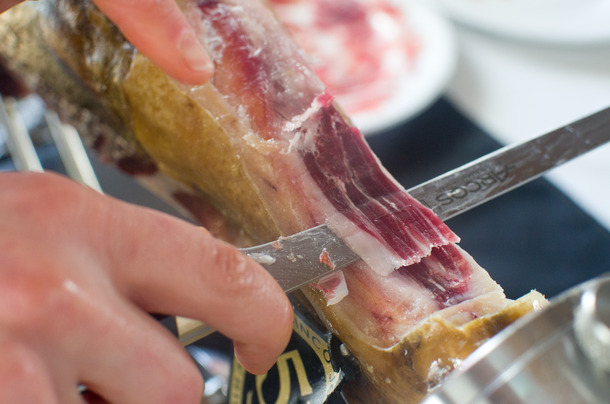
From there the ham moves on to a grateful world, though in truth many whole hams have already been spoken for by bars, restaurants, and large-scale clients that reserve them while they’re still aging. Jamon Iberico shouldn’t be sliced by machine—the soft fat would sheer out and the lean, bony legs make horizontal slicing difficult—so when Carvajal sells whole hams to a new restaurant or store client, they also provide training in how to slice the ham by hand. (You can see a good introductory video here.)
The company also employs 60-odd expert carvers who fabricate all of its pre-sliced packaged ham. Like cutting fish for sushi in Japan, carving Spanish ham is an artisan job of its own. The perfect slice is nearly see-through, small enough to eat in one bite, and carved at a level angle to get the most consistent and efficient slices from the ham as possible.
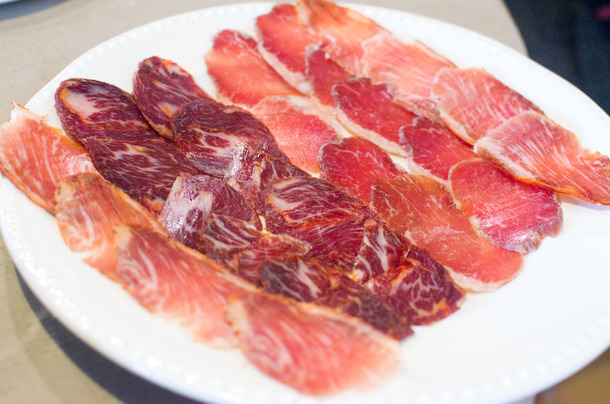
Remember how expert ham sniffers can detect four different aromas from the same ham? You may not be able to pick up on all the nuances, but it’s easy to see that different cuts of ham look and feel different, from the maza’s clean striations of fat to the ribeye-like marbling of punta—or the hard-to-reach “butcher’s cut” of the ham, the chewy, flavor-packed cana near the hoof. A skilled carver knows how to make the most of them all, mixing up a plate of ham with multiple cuts for contrast.
Which brings us back to where we started: why does good jamon Iberico cost so much? It’s more than the expensive pigs, spacious farmland, or acorn-rich diet. It’s more than the time and investment needed to prepare and cure hams properly, or the laboratory science and quality control behind the scenes.
Carvajal also sells cured loin and shoulder products.
At the end of the day the question comes down to scale—how much can you produce when every step along the way is so labor-intensive? What substitute is there for highly trained specialists who in some cases are born into the job?
Good pigs, living and dead, need time. And as with plenty of other luxury goods, there’s a choice to do something fast or to do it right. Fortunately for us (and the pigs), there are still some people more interested in the latter.