
Blog & News
COCHON 555 LA competition
Winfield Farm is delighted to partner with Chef Jason Neroni, from The Rose Cafe in Venice, in the COCHON 555 LA competition at the Viceroy in Santa Monica this Sunday, March 13. Chef Neroni is preparing magical dishes from a Winfield Farm Mangalitsa. Taste the magic on Sunday afternoon. Please come to the celebration and experience the magic yourself – tickets are still available and can be obtained here: http://events.cochon555.com/los_angeles_2016_industry

COCHON 555 Los Angeles, March 13

Experience this must-see culinary competition, five chefs cooking over 36 dishes prepared from whole locally-raised heritage breed pigs
[divider style=”shadow”]
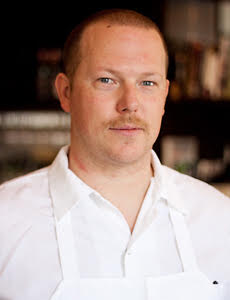
Winfield Farm is participating and our partner chef is Chef Jason Neroni at the Rose Cafe in Venice.
Created in 2008 in response to the lack of education around heritage breed pigs. The event series started from a thread of conversations where family farmers struggled to educate chefs, restaurants looked to source exceptional ingredients, and consumers sought out responsibly raised proteins. They all converged into one idea: the ultimate quest of flavor.
For more information visit: http://cochon555.com/2016-tour/los-angeles/
[divider style=”shadow”]
Jane Says: You Shouldn’t Be Afraid of Nitrites

(Photo: John Anthony Rizo/Getty Images)
To get a handle on nitrites, it helps to understand the role salting plays in curing meats. In On Food and Cooking, food scientist Harold McGee writes that salting, like drying, preserves meat by depriving bacteria and molds of water. “The addition of salt—sodium chloride—to meat creates such a high concentration of dissolved sodium and chloride ions outside the microbes that the water inside their cells is drawn out, salt is drawn in, and their cellular machinery is disrupted. The microbes either die or slow down drastically.” Chemistry is inherently operatic, when you think about it.
The use of nitrite remains an integral part of traditional curing methods for several reasons:
• It reacts in the meat to form nitric oxide, which binds to the iron atom in the red pigment myoglobin and prevents the iron from causing the fat to oxidize. That binding also produces the rosy pink-red color of cured meats—what we’ve been used to aesthetically since about the 10th century, when the Romans began adding saltpeter to meat to obtain that desired color.
• In terms of flavor, it contributes a characteristic sharpness that keeps evolving; a country ham aged for 18 months, for instance, has had time to develop a deep, resonant whang. And because nitrite is a powerful antioxidant, it helps keep the flavor of cured meats vibrant and free from off-flavors.
• Nitrite also squashes a variety of pathogens, including, most important, Clostridium botulinum, the bacterium that can cause rare but deadly botulism. Botulus is a Latin word for “sausage,” by the way, and the bacterium came by its name from its pathological association with Wurstvergiftung, or “sausage poisoning,” first investigated in the late 18th century in Germany.
But if you’re worried about consuming these preserving agents, let me break this to you as gently as I can: Even if you wouldn’t touch a ham sandwich, pepperoni pizza, or salumi plate with a 10-foot pole, you can no more avoid nitrate and nitrite than fly to the moon. According to sources such as “Human safety controversies surrounding nitrate and nitrite in the diet,” published in the journal Nitric Oxide: Biology and Chemistry, our saliva, surprisingly, “accounts for approximately 93.0% of the total daily ingestion of nitrite while foods account for a very small portion of the overall daily nitrite intake. This is due to the chemical reduction of salivary nitrate to nitrite by commensal bacteria in the oral cavity.” Forget cured meats; if you’re really concerned about nitrite, better stop swallowing.
Or, for that matter, eating vegetables, which contain the largest component (about 87 percent) of our dietary intake of nitrate. Those with the highest levels of nitrate are red beets, spinach, radishes, celery, lettuce, cabbage, fennel, broccoli, cucumbers, and leeks. If you’re interested in diving deeper, check out “Nitrate in vegetables,” a report by the Scientific Panel on Contaminants in the Food Chain of the European Food Safety Authority published in the EFSA Journal. I don’t imagine nitrate smoothies are going to be labeled as such at juice bars anytime soon, but optimizing the nitrate content in beet juice is of great interest to athletes and sports nutritionists.
While we’re on the subject of vegetables, let’s take a moment to contemplate “nitrite-free” bacon, hot dogs, etc. If you read the packages carefully, you’ll notice that what they actually say is “no nitrates or nitrites added.” Big difference in meaning there. What the producers use instead is celery powder or celery juice, both concentrated sources of nitrate, which is converted to nitrite by a bacterial culture.
So what makes nitrate and nitrite so controversial in the first place? In large enough amounts they are indeed toxic, the way anything is, even water. The main toxic effect is methemoglobinemia, a rare (and reversible) condition. Accidental poisonings aside, you would have to ingest thousands of hot dogs at a single sitting in order to overdose. The most eaten by Joey Chestnut, who won his eighth Nathan’s Hot Dog Eating Contest this year, is 61.
But cancer, of course, is everyone’s main concern. The potential of nitrate/nitrite to form carcinogenic N-nitrosamines in cured meats was first identified in 1971, according to the historical summary in the Nitric Oxide article mentioned above. “Their formation can take place only under special conditions where secondary amines are present, nitrite is available to react, near neutral pH is found, and product temperatures reach greater than 130°C, such as during the frying of bacon.”
The resulting shit show—er, groundswell of public concern—led to new regulations that lowered the amount of added nitrites, and new production practices were implemented. Among those practices was the addition of ascorbic acid (aka vitamin C, sodium ascorbate, erythorbic acid, sodium erythorbate), which inhibits the chemical reaction that can lead to the formation of nitrosamines. Additional limits exist for bacon: Nitrate is not permitted, so that actual concentrations of nitrite can be more precisely controlled; it’s also required to have either 550 parts per million added sodium erythorbate or sodium ascorbate, regardless of curing method, to inhibit the potential for nitrosamine formation during frying.
In a 2009 nationwide survey of cured meats and vegetables, it was “concluded that consistently lower levels of residual nitrate and nitrite than those from a survey reported by the National Academy of Sciences in 1981 existed.”
“Residual nitrite levels of 7 ppm in cooked sausages (hot dogs), 7 ppm in bacon, and 7 ppm in hams which have fallen from 10–31 ppm, 12–42 ppm, and 16–37 ppm, respectively, when compared to data reported in the NAS study,” the study continued. Overall, the survey found a nearly 80 percent reduction in nitrite levels in food products between 1975 and 2009. “Based on this data,” the authors write, “it can be concluded that cured meats provide minimal contributions to the human intake amounts of nitrate and nitrite.”
Interestingly, the Nitric Oxide piece also points out that in the 1990s, a new consumer product containing nitrate was introduced. “Toothpaste for sensitive teeth is now common and contains high levels (5% or 50,000 ppm (mg/kg)) of potassium nitrate. While under FDA regulatory purview, this newer source of human exposure has had no public controversy which is an interesting social question considering the debate concerning cured meats and the known salivary reduction of nitrate to nitrite.”
The advice to avoid cured meats because of possible risks related to cancer continues to resurface periodically. But since 1981, when the National Academy of Sciences first examined the scientific literature and concluded there was no link between nitrate/nitrite consumption and human cancers, there have been hundreds of studies that have examined the potential health risks. Aside from a few studies with demonstrably weak epidemiological data, the vast majority of studies have found no link.
Although research has failed to prove that nitrate or nitrite causes cancer, it has turned up a number of intriguing health benefits and possible pharmacological roles. The nitrites in our saliva, for example, seem to help protect us against foodborne pathogens and stomach ailments. And nitric oxide—the stuff that fixes the color in cured meats—has been found to be a signaling molecule, telling arteries when to expand (thus regulating blood pressure) and immune cells when to kill bacteria, and it helps brain cells communicate with one another. A lack of nitric oxide production in our bodies can lead to all sorts of unfortunate consequences, including hypertension, atherosclerosis, and thrombosis resulting in heart attack and stroke. The significance of this was of such paramount importance that the 1998 Nobel Prize in Physiology or Medicine was awarded to three American scientists for its discovery. I like to think they celebrated with a weenie roast.
Read the original post: http://www.takepart.com/
The Pork Obsessives: Inside The Secret Online Society Inspiring America’s Best Chefs

Behind the James Beard Award and the burgeoning restaurant empire, Linton Hopkins is really just an obsessive pork nerd. The Atlanta-based chef founded the Fellowship of Country Ham Slicers, which celebrates the craft of hand-slicing aged legs of swine, and created a collector’s edition Country Hams of the South placemat (read: treasure map) for the Atlanta Food & Wine Festival. The website for Holeman and Finch, his casual outpost in Atlanta, has a very scientific-looking photo on its homepage that claims ham can cure virtually any malady.
Hopkins’ devotion to swine is borderline religious, so it’s fair to ask: Where would a person like him find spiritual kinship with people who worship pork as much as he does?
The answer is The Salt Cured Pig—a private, invite-only group that can be found on the Facebook super highway somewhere between Bronies Unite Mid-Atlantic and Nuke the Whales.
“You can trust that The Salt Cured Pig is a community of people who actually care about how we procure, practice, and preserve our craft, “ said Hopkins.
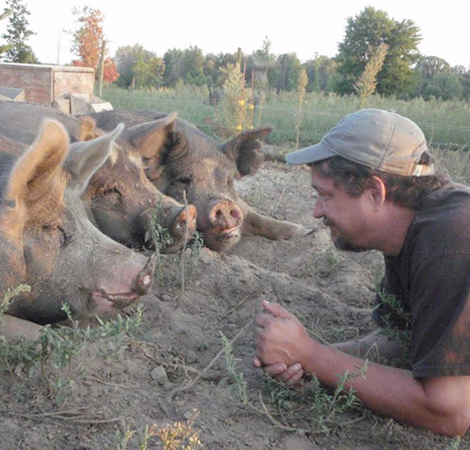 The Salt Cured Pig founder John Patterson has seen the group grow to over 8,000 members.
I. A Global Network of Swine Fanatics
The Salt Cured Pig was founded in 2010 by Michigan native John Patterson, who has since watched his cultish community of swine enthusiasts grow to more than 8,000 members. An average of 100 new people are invited into the group every week by friends already on the inside.
This is a place where rockstar butchers and unadulterated porknography take precedence over the media’s breathless rediscovery of edible plant life, and Patterson loves it. And why wouldn’t he? America’s most knowledgeable farmers, meat processors, butchers, charcutiers, chefs, and educators have essentially open-sourced their collective wisdom in his forum.
America’s most knowledgeable farmers, meat processors, butchers, charcutiers, chefs, and educators have open-sourced their collective wisdom in the forum. It’s like getting private batting lessons from George Brett, the Kansas City Royals Hall of Famer
“This was a selfish venture in the beginning,” said Patterson. “I bankrupted myself buying cured meats at Zingerman’s one day and decided, if people have been doing this for thousands of years, I should just do it myself.”
The first leg of The Salt Cured Pig journey is all about Patterson’s original vision of setting out on one’s own into the wide world of DIY curing. Certainly that was my experience when I joined shortly after the group’s inception. For the better part of that first year of membership, my 900-square-foot abode in Washington, D.C. was filled with various meat-curing experiments. Pancetta strung up in the kitchen window and pork jowl hanging from an old planter hook in the corner. Every time I had a question or near meltdown, I went to the group.
Answers would come from people like Josh and Jessica Applestone, the forebears of nouveau butchery at Fleisher’s Pasture-Raised Meats, or Kate Hill, an American expat living in Gascony who runs a pork-centric cooking school, Kitchen at Camont, with a family of French master pig farmers and butchers named the Chapolards. It was like getting private batting lessons from George Brett, the Kansas City Royals Hall of Famer who was my childhood hero. I achieved delicious successes and a few spectacular failures (amazingly, my wife still agreed to marry me that year). More than once or twice, I considered training to become a butcher and opening a shop.
“Where else can charcuterie enthusiasts around the world get access to an incredible network like this 24 hours a day?” asked Hill, a group administrator. “When I’m having a morning café au lait in France, someone in Tucson is tending his smoker, a charcutier in Bangkok is talking to a pig farmer in Australia, and a Korean chef is sharing his wares with us all.”
II. Chefs Find Inspiration
A search of the group brings up some culinary star-power, including Craig Deihl, Jonathan Waxman, Nate Anda, Paul Kahan, David Varley, Ryan Farr, Lee Anne Wong, Tom Mylan, and Celina Tio. Peter Kaminsky, whose 2005 book Pig Perfect introduced the world to Chuck Talbott’s pioneering research on heritage pig breeds and flavor, is also a member (as is Talbott). Despite their high-profile status, some still look to The Salt Cured Pig as a place for continuous learning and experimentation.
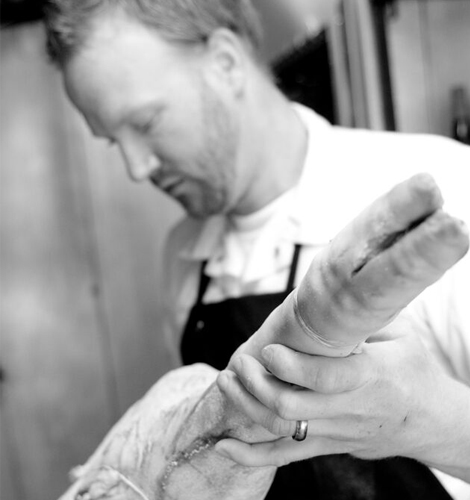 Chefs like Rick McKee (pictured above) and Craig Deihl credit the group with inspiring dishes that appear on his menu. (Photo: John Smoak)
“What’s really important to me is the way people are open and post photos about failure, which is so important to getting better,” said Deihl, whose charcuterie work at Cypress and Artisan Meat Share in Charleston is second to none in the U.S. right now. “Watching people share non-pork ideas, like salmon belly nduja and shrimp sausage and swordfish bacon, has also made me think about what new things I can do in the restaurants.”
VIPs like Deihl have undoubtedly had an impact in The Salt Cured Pig forum, but the lesser-known professionals represent the group’s real value. These are the workaday evangelists who are carrying forward the movement for responsible pig husbandry and curing.
“I think it is a really valuable resource for anyone in the restaurant business,” said Justin Brunson, owner and executive chef at Old Major, the Denver Bacon Company, and a constellation of other meat-driven establishments in the Mile High City. “I get tips on chili pastes, peppers, and salts for sausage and curing in the group all the time, and the members gave me a ton of help on specs when I built my first curing chamber.”
Brunson is known among pork nerds, and he and others like him are the most active in the group’s conversation strings, offering hard-won wisdom to less-seasoned members and doing their best to keep the group focused on safety, tradition, and quality. Others include Cathy Barrow, the writer behind MrsWheelBarrow.com; Adam Danforth, the James Beard Award-winning author and butcher; Carl Blake, who runs Rustik Rooster Farms in Iowa; Brady Lowe, the founder of Cochon 555; Bob Perry, Chef in Residence at the University of Kentucky College of Agriculture; and Bob Del Grosso, a micropaleontologist by training who has taught for decades at the Culinary Institute of America and other institutions.
“Before the advent of groups like this, the likelihood that someone like Carl Blake would be sharing hog-farming tips with people in Michigan and Austria was almost nil,” said Del Grosso. “During my tenure as a Salt Cured Pig administrator I’ve seen countless examples of people who, inspired by something they read there, pick up knives and saws to butcher their food, pick up stakes and move to farms. That is significant.”
“I look at the group every day to see what people are doing,” said Brandon Johns, chef-owner of Grange Kitchen & Bar, an Ann Arbor restaurant that counts other members among its regular patrons. “It’s great to see them using old-school technique, like hand-cutting sausage, that you can’t find anywhere anymore, and I’m always getting inspiration to try new things.”
There’s the issue of the pesky vegetarians who have regularly infiltrated the group, calling ironically for Patterson’s slaughter.
With all the collective wisdom and shared support, is the forum having a wider impact? Anecdotally, those of us who have been in the group since early on have seen growth in the number of heritage-pig farms, professional curing operations, and restaurants doing in-house charcuterie. According to a three-year study by the Livestock Conservancy, an organization that works on genetic conservation and promotion of heritage-breed animals, the numbers of heritage-breed pigs overall have been growing in recent years. Just a couple days ago, member Stephen Prochaska announced the opening of his new Cedar Rapids, Iowa sausage shop, The Sausage Foundry, and thanked the group for insights and input.
“A goal in the beginning was to make sure that these things wouldn’t just be fads,” said Patterson. “I hope we are helping secure a better future for meat in America.”
III. The Swine Schism, Militant Vegetarians, and the Power of Community
That remains to be seen, but we wouldn’t even be having this conversation without the committed core constituency in The Salt Cured Pig. Whether the center can hold is another question, because Patterson’s ride hasn’t all been pillowy white fatback and silky sausage gravy. The group has, at times, been greased by drama.
Firstly, there’s the issue of the pesky vegetarians who have infiltrated the group regularly, calling (ironically) for Patterson’s slaughter and, on more than one occasion, getting him thrown off of Facebook (he maintains aliases including Bobby Berkshire, named after the famous breed of curing hogs). One woman was so aggressive that Patterson did a little research and cornered her with Google Maps evidence of a charcoal grill in her backyard. She backed off and the veg hackers have been quiet recently.
Patterson’s ride hasn’t all been pillowy white fatback and silky sausage gravy. The group, like so many young phenomena, has at times been greased by drama.
Then there was the infamous swine schism. In the early days, when The Salt Cured Pig was small, most of the members were in it to share advanced practices, but things changed as the numbers roared upwards. Some griped that bacon became too dominant a theme (is that possible?) and the comment strings got too heated and meme-heavy. The full administrative team tried to exert some quality control, but the divide had already calcified. A breakaway faction of accomplished home charcutiers, led by bloggers Scott Stegen and Jason Molinari, peeled off and formed Sausage Debauchery, a rival group with a less freewheeling and more pedantic bent. To date, Sausage Debauchery has more than 5,400 members.
“I think the two communities are alternate sides of the same coin: The Salt Cured Pig is great for people just getting into the curing and overcoming their fear, and Sausage Debauchery is like a watering hole for what I call the ‘meat mafia,’ those of us who live the craft every day,” said Hank Shaw, the James Beard Award-winning blogger and author of Hunt, Gather, Cook: Finding the Forgotten Feast and Duck, Duck, Goose.
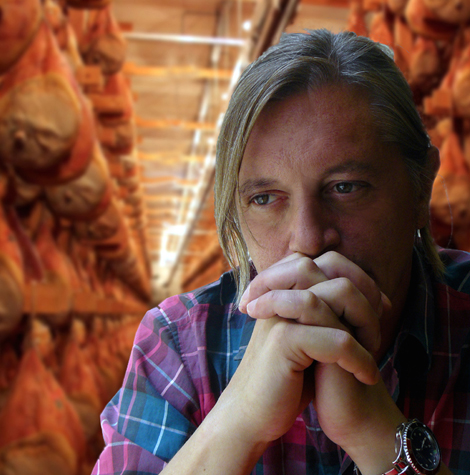
Paolo Sossai, a spiritual guide for pork forums like The Salt Cured Pig, embodied the restless pursuit of quality swine products.
Many people hold dual membership and foster friendships in both groups, and the kinship shows through more than any split—as the story of Paolo Sossai makes clear. Sossai, who died from cancer last month, may have been the pioneering digital community organizer for home charcutiers as the head of the Salumi Casalinghi Forum, an Italian listserv where he shared old-world techniques and facilitated discussion on the craft. He was a mentor to many in both The Salt Cured Pig and Sausage Debauchery, dropping in and out of discussions in both groups to offer patient, broken-English–infused explanations of things like the definition of porchetta di testa, and the regional difference between sopressa and sopressata. His death brought forth an outpouring of sympathy.
“Paolo’s legacy is the real sense of community in terms of passion for craft, willingness to help and a wonderful intolerance of showiness or lack of humility,” said John Gower, a member of both The Salt Cured Pig and Sausage Debauchery, who raises pigs on a sustainable farm in North Devon, England. “In life and death, he has only encouraged this sense all the more amongst many of us.”
Sossai, like Patterson, Stegen, and many others, was the bond that held the communities together and pushed them forward towards a vision of better, more sustainable farms and food. Which reminds me: I have a big batch of heritage pork shoulder in the freezer that needs my attention.
Read the original post: http://firstwefeast.com/eat/the-pork-obsessives/
Winfield Farm Fall Update
News Alert: We now have a fresh supply of Winfield Mangalitsa pork cuts in our Mangalitsa Market
Now on hand: sliced hickory-smoked bacon, bone-in chops, ground pork (sweet Italian); bone-in hickory smoked hams, bone-in loin roast, Boston butt roast, smoked hocks.
Visit our Mangalitsa Market online, but please call first to ensure availability. Supplies are going quickly!
Good grief! Where does time go?
Fall is in the air, even though the days were still uncommonly warm heading into Thanksgiving week. Bruce has been a busy man this summer, “pig-herding” our Mangalitsas, whose population doubled this spring when eight sows farrowed a total of 60 piglets. The “gang of 60” is now 5-6 months old, and a very rowdy bunch indeed, but it’s hilarious to watch them cavort (you can see the circus on video on the Winfield Farm Facebook page*. Check out the link: https://www.winfieldfarm.us/?p=1381).
Pigs cannot be herded, by the way. We discovered this after the group of “30”, farrowed last summer and ready for market, broke through the fence separating them from Bruce’s garden, where more than 100 grafted heirloom tomato plants were nearly ready to harvest, along with the rest of the produce we’d grown to stock our farm stand this summer. Porcine glee was evident – and not to be dissuaded – as the marauders systematically demolished everything in what seemed record time: 15 minutes was all it took to undo several months of hard labor. Asi es la vida…
(Lesson learned: Bruce will erect a double fence between garden and piggies next year!)
On a positive note, Winfield Farm Mangas have attracted attention from a growing number of world-class chefs. In the Santa Ynez Valley, Industrial Eats in Buellton is a steady customer, as is Full of Life Flatbread in Los Alamos. The Ballard Inn now also features Winfield Farm Mangalitsa pork, and Hitching Post II is a fan, too. In fact, chef/owner Frank Ostini took Winfield Mangalitsa chops to the Celebration of Harvest Festival in October and did a cooking demo. According to reviews: it was fabulous.
Frank also extolled Winfield Mangalitsa pork in a “Pairing Wine with Fire” feature article in the Santa Barbara Independent:
Which meat with chardonnay?
Ostini: I’m pining for a Winfield Farm Mangalitsa pork chop, grown by Santa Ynez Valley rancher Bruce Steele, who is my neighbor. It is for sure the greatest “other white meat.” The white part of this is the fat that is so flavorful, rich, and glorious when grilled and cuts through the acidity of the [Hitching Post] Sta. Rita Hills chardonnay, making it a perfect match….
Mattei’s Tavern in Los Olivos also will begin featuring Winfield Mangalitsa pork soon. We delivered our first pig on November 20, and charcuterie chef Drew Tarp is excited to create new head-to-hoof delicacies.
One outstanding feature of Mangalitsa is its pure white, mouth-watering fat. A rare heritage lard hog, prime Mangalitsa pork may contain as much as 50 percent fat – but it’s very high in oleic acid–the good fat!
Brian Polcyn, well-known chef/author of the book Charcuterie, gave us a lesson in Mangalitsa fat vs. other pigs at the Mangalitsa Breeders Conference in Michigan this past summer. Bruce and I actually escaped for a “vacation” — while son Eric came down from the Bay Area to mind our pigs. (*He created the video of a typical day in the life — feeding the rowdies, making wallows etc. – and filmed it double-time for effect!)
As part of the breeders conference, we toured the meat department at Michigan State University, an impressive facility, where Polcyn illustrated the difference between Manga and a typical market pig — at least double the fat cap, which is what makes Mangalitsa flavor so sublime. Fat is also responsible for making Mangalitsa perfect for charcuterie — ranked with Spanish Iberico Bellota as the best prosciutto in the world!
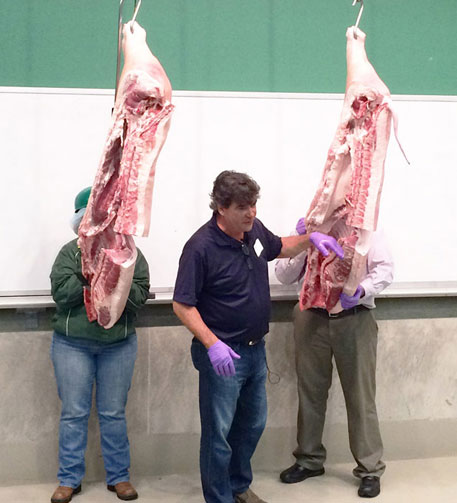
Brian Polcyn illustrates why chefs pay more for Mangalitsa pork: taste and quality.
“Fat is flavor. Fat is our friend. We love fat!”
The Mangalitsa Breeders Conference was a great getaway for both of us. Much of the activity took place at Wilhelm Kohl and partner Marc Santucci’s “Pure Mangalitsa” farm in Haslett MI, where they are importing new blood lines for blond and red Mangalitsas from Hungary via quarantine in the Netherlands.
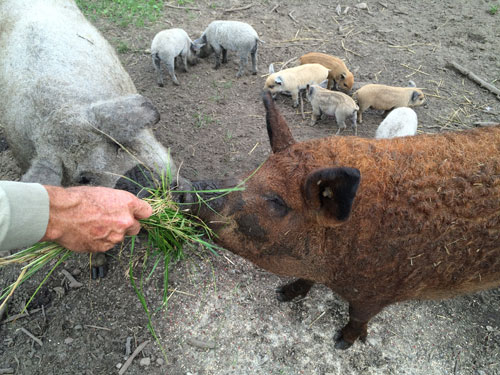
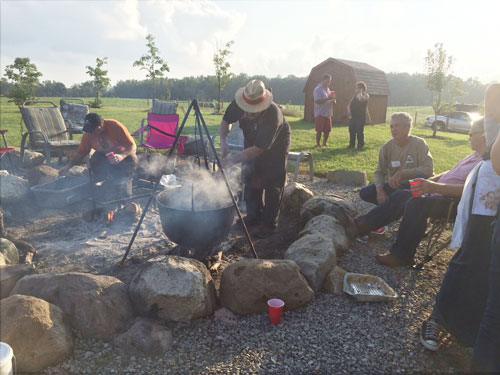
After the instructional class session at MSU’s meat lab, the conference transformed into a 2-day party – a Mangalitsa feast, where Mangalitsa breeders from all over the country networked, shared their home-made charcuterie and cooked up a stew of – Mangalitsa.
Another highlight of our adventure: we met Peter Toth, president of the Hungarian Mangalitsa Breeders Association, who is widely acclaimed as the person who saved Mangalitsa pigs from extinction.
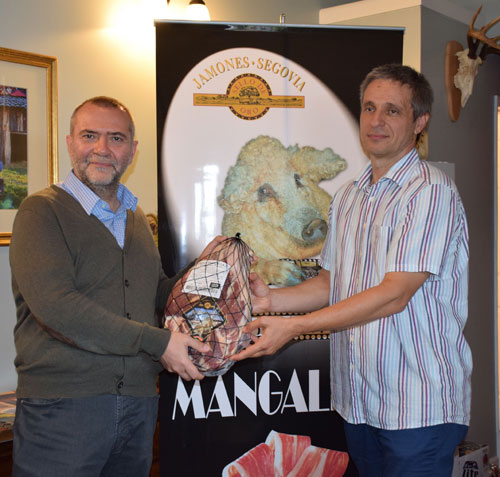
Peter Toth, left and Csaba Papp, Mangalitsa genetics expert, pose before a poster promoting Hungarian Mangalitsa
Now that the dog days of summer are waning, Bruce is scrambling to prepare for the monster El Niño that is predicted to strike this winter. Early forecasts project this as at least as tumultuous as the 1997 event, and perhaps a record-breaker (cautionary news for those of us who live in the 100-year flood plain of the Santa Ynez River…)
Bruce built an “ark”, a huge covered structure about 26 feet wide and 80 feet long, incorporating our farrowing sheds, to provide shelter on both sides of two pig pastures.
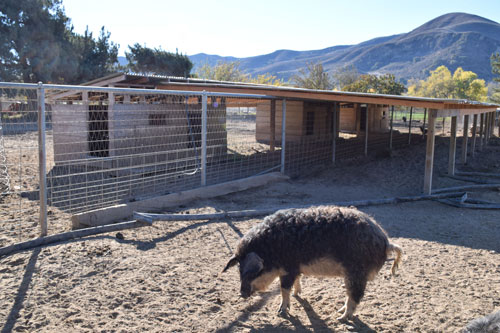
In addition, the gang of 60 will have access to our 70 x 30 hoop house and the old gray chicken coop that Bruce remodeled to shelter pigs.

We also leased several acres near by on Drum Canyon Road, on high ground, just in case our fields go underwater here… and that requires more fence building.
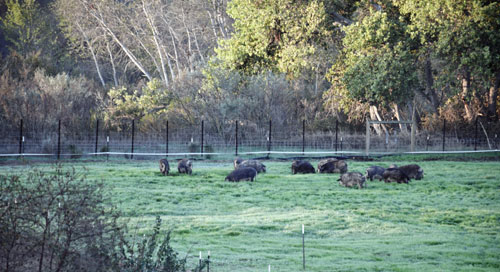
Bruce is also working to establish cover on our fields before the rains come, to retain the topsoil. Thankfully the grass he seeded last spring is regenerating nicely after rotating pigs off pasture — well enough to let our market-ready pigs back on it for a little foraging fun before they go to market.
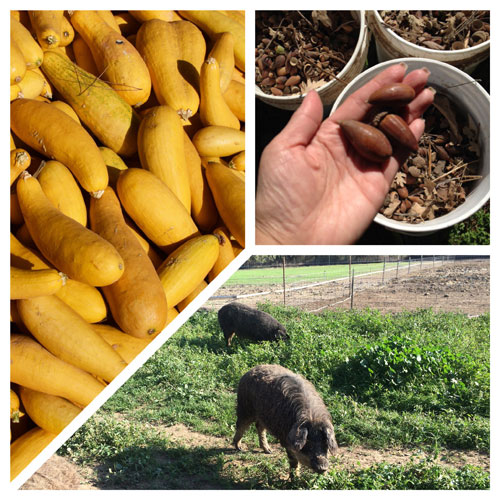
Winfield Mangalitsas have a good life — and a naturally good diet based on pasture, squash, acorns in season and barley (to keep white fat white and pure). Winfield pigs eat NO GMOs…
One more thing that we’re proud to say: We invested in solar last year, so we’re now running our entire farm, including 2 wells, the house and barn, 3 freezers – everything – on alternative energy this year.
We have a new supply of Mangalitsa pork on hand in time for the holidays. Please viist our Mangalitsa Market and email or call to order. Taste the magic for yourself!
We wish you a very Happy Holiday season.
All our best,
Bruce & Diane
La Maialata VIII
We’re delighted that Winfield Farm Mangalitsa will be featured at La Maialata VIII at the acclaimed Cantinetta Luca in Carmel.
La Maialata VIII
Thursday & Friday, December 10 & 11, 2015
5 – 9:30 pm
Executive Chef / Partner Jason Balestrieri presents two evenings where every dish on the menu features yet another amazing variation on the succulent hog to include multiple selections of antipasti, soups, sides, pizzas, first courses, and main courses.
This year will feature Mangalitsa Pig from Winfield Farm in Buellton, CA & Berkshire Pig from Linda’s in Carmel Valley.
Make your reservations now for these very special evenings.
Cantinetta Luca
Dolores Street between Ocean and Seventh
Carmel-by-the-Sea, California
Phone: 831.625.6500
Email: info@cantinettaluca.com
Online Reservations: opentable.com
There are just so many imaginative ways to deal with a pig’s head
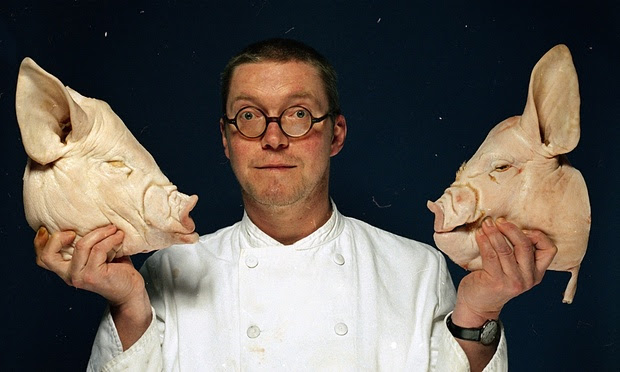
St John’s Fergus Henderson. King of nose to tail eating. Photograph: Suki Dhanda for the Observer
Boning a pig’s head isn’t easy. My friend, the food historian Dr Annie Gray, tried it once. It took her and a friend five hours. She was following the 1846 instructions of Charles Elmé Francatelli, once chef to Queen Victoria, who was an old hand at the whole pig boning business. The key is to get a head severed at the second vertebrae, so that when you have tunnel-boned the skull, working the blade carefully about the jaw and skull, and then refilled it with the forcemeat, you have a flap of skin to be re-stitched at the back.
Before you can do that, you have to take the pig’s head, the eyes stitched closed, and smear it with six pounds of salt, handfuls of saltpetre, sugar, cloves, mace, garlic, thyme, marjoram and basil. It then needs to be submerged in a quart of port for two weeks and turned every day.
Next you stuff it with sausagemeat, and a mixture of tongue, fatty bacon, truffles and pistachio kernels. It now needs to be wrapped in butter-rubbed muslin and simmered in a stock full of cow’s feet and grouse carcasses for five hours, before being allowed to cool. Finally, decorate it with piped lard and separately baked pastry pieces. Queen Victoria had a head like this on her table at Christmas every year. Apparently the upper classes have long appreciated the ceremony that attends the boning of pig heads.
Preparing a pig’s head this way is tricky, of course, because you’re trying to keep it in one piece. If that’s not an issue you can cut off the pieces you want: the cheeks ears and snout. Pig cheeks braise beautifully. The ears have many uses. Fuchsia Dunlop has a great recipe in her Revolutionary Chinese Cookbook for an aromatic salad, which is all about chilli oil and sesame oil, and the thin slices of gelatinous skin sandwiching a crunch of cartilage.
Alternatively, April Bloomfield does a crispy pig’s ear salad, in which they become the biggest curve of pork scratching imaginable. The Pitt Cue boys recommend boiling them for a couple of hours and refrigerating overnight, before cutting into strips, deep frying them and serving with a habanero sauce. At Duck & Waffle, they dust crispy strips of ear with a sweet salty mix. They taste like Frazzles.
If this doesn’t appeal, you can always boil a head until the flesh falls away. Next, remove all the meat. There are now two ways to go. Spice it up the old English way with lots of mace and white pepper, and press it to make a classic brawn. Or (again, pace Pitt Cue) form it into a sausage bound in clingfilm. Once refrigerated and set, cut it into discs, bread crumb and deep fry to make pig’s head croquettes.
Alternatively, take the whole thing and, as they do at St John, slow roast it for hours until the meat falls from the bones, and the skin shatters beneath your teeth like savoury glass. Think of this as a self-boning pig’s head, which is a neat trick if you can pull it off. Of course, there may be other ways to go about boning a pig’s head.
Originally posted: http://www.theguardian.com/
Mangalitsa life at Winfield Farm
[videojs_video url=”https://www.winfieldfarm.us/wp-content/uploads/video/lifeatwf.mp4″ width="384"]
Video: Eric Pleschner
Here’s Why You Should Be Cooking With Bones, Fat And Skin

Food Republic’s column Ask Your Butcher seeks to answer FAQs in the world of butchery. Ethically minded butcher Bryan Mayer founded Philadelphia’s Kensington Quarters and helped develop a renowned butcher-training program at Brooklyn’s Fleisher’s. Today, he consults with farmers, chefs, butchers and anyone else who will listen. In each column, Mayer tackles a pressing issue facing both meat buyers and home cooks. Here, he explores three things that you probably aren’t cooking with now, but you should.
Peer over the counter at your local whole-animal butcher shop and you’re more than likely going to see a whole lot of bones, fat and — depending on the animal — skin. And while our more industrially focused brethren don’t have to take much of this into consideration (being that you can order up just about anything skinless, boneless, and pretty much denuded of any and all fat), we who preach whole-carcass utilization take this as a challenge!
Our detractors would say that the industrial model is nothing if not efficient when it comes to utilizing the whole carcass. And that’s somewhat true, if you exclude certain parts that are routinely discarded due to their lack of economic viability. While I’ve read more than my fair share of blog posts pointing out that we, the so-called whole-animal butchers who claim to use everything but the oink, often fall short of these claims, it does bear mentioning that we are severely limited in what we actually receive from our slaughterhouses.
The limitations of these by-products, both edible and inedible, are not totally based on legality, but rather on a significant revenue stream for slaughterhouses. And rightfully so. Up until very recently, very few people in the U.S. were looking to prepare a traditional Burns Supper, which, among other things, calls for stomach and lung, the latter being a by-product that is illegal in the U.S. But what of all those bones going into that bone broth, or, as I like to call it, stock? It’s as if they magically appeared, to cure all your ailments, from gut issues to hair loss to nonexistent love life.
In fact, the list of uses for animal by-products — again, both inedible and edible — is endless. Here’s a sample, courtesy of the U.S. Department of Agriculture:
Adhesives, ceramics, cosmetics, feed use, fertilizer, foam in fire extinguishers, insecticides, buttons and handles, capsules for medications, emulsions, gelatins, glues, hardening steel, candies, dairy products, ointments, paper, photographic films, refining sugar, textiles, candies, chewing gum, germicides, industrial oils, lubricants, soap, glycerin, shortenings, tires, athletic equipment, brushes, felt, insulation, rugs, upholstery.
Sorry, vegans.
I’m hoping now you can see why these things are hard to come by, and more importantly, why they have such value. To put it all into context for you, by-products account for roughly 30 percent of the live weight (weight before slaughter and evisceration) of hogs and roughly 44 percent of the live weight of cattle. To devalue these items would ultimately mean devaluing the work of our farmers. We don’t want to do that.
With the proliferation of whole-animal butcher shops, we are starting to see an increased interest in using more by-products, specifically bones, fat and skin. So here are a few cooking ideas:
Bones

Auguste Escoffier once said, “Indeed, stock is everything in cooking. Without it, nothing can be done.” And since my grandma used it as a cure-all, I’m not one to disagree. Stocks contain minerals in a form that the body can absorb easily — not just trace minerals, but sulfur, magnesium and calcium. Add to that the stuff in cartilage, like chondroitin and glucosamine, and you’re liable to put GNC out of business. And while it’s easy to poke fun of your local dispensary, pouring cups of $9 broth from stainless steel urns, there clearly is some merit to this craze — certainly more so than kale!
Feel free to use any types of bones you’d like: neck, knuckle (the ends of long bones) and marrow all work great. Go ahead and experiment. Step outside the comfort zones of beef and chicken! Try lamb, goat and pork, and add any spices you wish. After all, it’s about what tastes good to you. For my simple beef stock, I add a bit of salt, ginger, clove and turmeric. You can simply simmer bones and water, or go ahead and make a full-on stock by adding your standard mirepoix. Or, in my case, suppengruen, to honor my German side.
Basic Beef Stock
Ingredients
Roughly 4 pounds of neck, knuckle, and/or marrow bones
4 quarts water (or enough to cover bones)
3 each celery, carrots and onions, if desired
Directions:
- The basic rule here is that it should be easy, or you won’t do it. So if you want to roast your bones, go for it. It’ll result in a darker, richer-tasting stock, but it’s not necessary.
- If you want to add things like onion, celery, carrots, vinegar and whatever other spices, go for it. Just add enough water to cover your bones while leaving some room at the top for expansion.
- You’ll want to bring to a boil and then simmer for as long as you can; 12 hours is preferable, but if you’ve only got four, then so be it. Some people like to skim the fat off the top; I don’t. But if you’ve got the time, go for it. That’s all there is to it.
- Let it cool and refrigerate up to four days or freeze. Season however you’d like.
Skin

It’s one of largest organs, if not the largest. You could say it’s one of the most important. It keeps the body safe from the extremes of temperatures, sunlight and chemicals. And if you’re a hog or a chicken, it also happens to be delicious. Roast a whole chicken in my house and someone’s picking off the crispy skin. Braise a picnic ham for pernil and that crispy skin is a great counterbalance to the tender meat. Skin alone, especially from pigs, has many uses. Aside from all the inedible examples mentioned above, it’s great to add skin to stocks. All that gelatin that it contains is a great thickener. It can make great noodles, and, of course, there’s the ol’ standby, chicharrónes.
Preparing pig skin for noodles is a bit of a process and removes something very dear to me and hopefully to you: pork fat. What you’re left with is something reminiscent of pasta, but with an obvious porkiness that is an excellent addition to any ramen. You’ll want to denude the skin of any fat and hair, add some salt and allow it to cure for a couple of hours. You can prepare a marinade, which is something that will help break down the skin over a 24-hour period. Once that’s done, you’ll want to cook for a couple more hours, cool for another 12 and you’re ready to add to your ramen. Yeah, that’s a lot of work.
Let’s stick to a chicharrón. I like my chicharrónes the way my mother-in-law does them: not the puffed, airy kind, but something with a bit more substance — some meat and some fat. The seasoning isn’t necessarily the important part here, but the process is, as you’ll want to follow it closely in order to get a crispy, crunchy chicharrón.
You’re still going to have to put in some time with this one, but you can make a few batches to sit up on your shelf (it’s right next to the granola on mine). I like to use pork belly for this as it has the best ratios of skin, meat and fat. I’ll use a little baking soda with my salt, as I cure the belly overnight. This will help with dehydration, which is important in order to achieve that crunchy skin. After your 24-hour cure, you’re ready to cook. Grab a large skillet and add some water for the wet-rendering method. This is much more forgiving than the dry method and the water will also help to braise the bit of meat and slowly render the fat over 3 to 4 hours. You’ll know when all the water has evaporated and you’re left with just rendered fat when you cease to see any bubbles rising. You’re all set to crank the heat to high and fry away, which should take about three to five minutes. Transfer to a paper towel–lined plate to cool a bit and then add some vinegar, preferably some Sukang Maanghang.
Chicharrón Baboy (Filipino Pork Rind Cracklings)
Ingredients
1 pound pork belly
2 teaspoons baking soda
1 teaspoon salt
Water to cover
Vinegar
Directions:
- Rub the surface of the skin with the baking soda and salt, making sure to distribute evenly. Place on a dish and into your fridge for 12 hours.
- Rinse off the belly, pat dry and cut into one-inch cubes. Place into your deep-sided skillet and cover with water.
- Using low heat, slowly render and braise for 3-4 hours. Remember to turn the pieces of belly every so often to evenly cook. Once the bubbles stop rising, your water has evaporated and you’ve got rendered fat.
- Turn the heat up to high and watch as they fry in their own rendered fat. This should take no more than five minutes. Transfer to a paper towel, add some vinegar and perhaps some salt and pepper to taste!
Fat

Since we briefly mentioned fat above, why don’t we really talk about it for a moment here? Fat has been vilified for far too long. Whether it was Sinclair’s fictional account of the horrors of rendering plants, Procter and Gamble’s marketing campaign for Crisco and the newly invented process of hydrogenation in the early 20th century, or scientists in the 1950s all but singling out animal fat as the cause of heart disease, it seemed we had good reason to avoid animal fats at any cost.
Well, that cost is our health. Fats from animals — consumed in moderation, of course — provide a concentrated source of energy in our diet, a source that cannot be supplemented. They are the building blocks for cell membranes and hormones. As if that weren’t enough, they are also the carriers for the extremely important, fat-soluble vitamins A, D, E and K. Fat doesn’t only taste good — it is now recognized as the sixth taste — but it does good for you! And not just animal fats. We’re talking oils: extra-virgin olive oil, unrefined flaxseed oil, and coconut oil, for example. Keep on using all that butter, which is hopefully from grass-fed, fully pastured cows!
Good oils and butter are fairly easy to come by these days. As for rendered animal fat, that’s a bit tricky. Your whole-animal butcher shop should have some already rendered for you. If not, you can always purchase a hunk of fat from them and render it yourself. Pork fat is the best, as it’s the most neutral of fats, but feel free to use beef, chicken or whatever you’d like. You’ll need a skillet, some water and a little bit of time — that’s all. You’ll want to cube the fat or, if possible, coarsely grind it to speed the process up a bit. I like the wet-rendering method, as you’re less likely to scorch the fat. While scorching won’t necessarily ruin the fat, it will definitely bring out the flavors a bit more in your lard, which is something that you may not want in a flaky pie crust. A low flame, and once the bubbles stop rising, you’ve got pure fat ready to fry potatoes or make some chicharrónes.
Rendered Fat
This can be as easy as removing some of the visceral fat from the chicken you’re about to roast or going to your local whole-animal butcher to order some pasture-raised animal fats.
Directions:
- Choose an animal fat — beef, pork or chicken. Dice, or coarsely ground, for beef and pork to speed the process.
- Set your flame to low in a deep-sided skillet or pot, and allow the fat to slowly melt. Again, your fat is fully rendered and all the water has evaporated when bubbles stop rising.
- All that’s left to do is strain out any impurities and you’ve got plenty of healthy animal fats to last for at least a few days. There are lots of opinions on how to store rendered fat. I’ll let you pick the method that you feel safest with. For me it’s about three months in the fridge and up to a year in my freezer.
Read the original post: http://www.foodrepublic.com/
Putting the Feet Before the Belly: How Pork Trotters Became Such a Thing
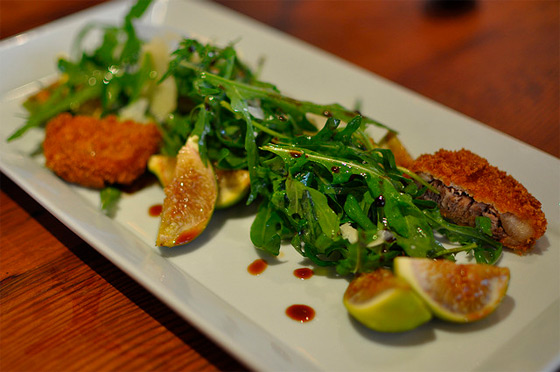
Crispy pork trotters with Mission figs at Flour + Water, ca. July 2009.
Some of the most welcome offal to come out of the trend of head-to-tail cuisine are pork trotters, a.k.a. pigs’ feet, and we’re now seeing more of this humble pork product pop up on respectable menus in New York, L.A. and San Francisco. More often than not, the meat is braised, deboned, and formed into a crab cake-like portion, browned on both sides, and served with any number of sauces likely to win over even picky eaters — as they were last spring on the menu at the critically adored Frances, with a sauce gribiche. Semi-rustic preparations of trotters have made appearances in New York over the last few years at places like Craft and Baba, and last winter Northern Spy did a trotter cake with mustard greens — a play on collard greens and ham hocks — that caught the attention of the Times and became the lede for their review. (“Slice into it and the pork spills out, outrageously tender. There is nothing to tip off the squeamish that we’ve entered hoof territory.”)
But how did pigs’ feet — which many of us probably associate with the pale, puckered, and all-too-anatomically-intact versions we saw pickled in jars in the ethnic foods section of grocery stores as kids — become the stuff of haute cuisine?
San Francisco food writer Marcia Gagliardi (The Tablehopper) points back to the first wave of chefs embracing offal here in the last few years. “It started with the whole-animal guys — like Nate Appleman when he was at A16, Chris Cosentino at Incanto, and Mark Denham when he was at Laiola,” she says. “What you’re seeing now in S.F. is a second wave of restaurants doing rustic European dishes (Flour + Water, Frances, Contigo), and diners perhaps being a bit more adventurous.”
Below, a rough timeline of the trotters’ recent rise to prominence:
1999: Thomas Keller features Pig’s Feet with French Green Lentils in The French Laundry Cookbook.
2001: Tom Colicchio opens Craft in New York, later begins featuring pork trotters among his mix-and-match menu offerings.
2002: Chris Cosentino comes on board as executive chef at Incanto, bringing with him a passion for head-to-tail cooking, and using trotters in his pork ragu. Later launches the website OffalGood.com.
2004: The Bouchon Cookbook features pieds de cochon with a sauce gribiche.
2007: Fergus Henderson publishes Beyond Nose to Tail, which contains the recipe for Trotter Gear.
2007-2008: Trotters make their appearance on Nate Appleman’s menus at A16 and SPQR in San Francisco. He later wins the James Beard Award for Rising Star Chef, as well as a Food & Wine Best New Chef nod. They continue to make appearances on both menus under new chefs Liza Shaw and Matt Accarrino, in ragus, terrinas, and Shaw’s pork trotter zampone, which are deboned foreshanks stuffed with either sausage or a meatball mixture, then braised and finished off in a wood-fired oven.
Early 2008: Hakata Tonton opens in New York, with 33 of its 39 dishes containing pigs’ feet. The UK Telegraph declares them ‘the new superfood.’
June 2008: Animal opens in Los Angeles, and chefs Vinny Dotolo and Jon Shook garner loads of attention for their bold use of offal, and they frequently work trotters into their menu.
June 2009: Bouchon opens in Beverly Hills, features trotters.
July 2009: Flour + Water opens to loads of press early in the year, and that summer begins featuring trotters breaded and fried and served with Mission figs and mustard greens.
December 2009: Josef Centeno’s Lazy Ox Canteen opens in L.A., and receives a bunch of attention for, among other things, pigs’ feet.
February 2010: The Times writes up Northern Spy and their trotter dish.
Spring 2010: Trotters appear on the menu at Frances, braised and seared in cakes, served with a sauce gribiche and pickled vegetables. Frances is nominated for a Beard Award for Best New Restaurant.
April 2010: Saveur spotlights the very rustic crispy pata (fried pigs’ feet) at Patio Filipino in San Bruno.
June 2010: Prospect opens in San Francisco, from the team behind the uber-successful Boulevard, featuring a dish that combines pork trotters with lobster. Critic Jonathan Kauffman later calls out the dish as a point where chef Ravi Kapur “hits a sweet spot” of edginess.
October 2010: Lowcountry opens in New York, offering “trotter tots” as a starter; Coi chef Daniel Patterson opens a casual offshoot in Oakland called Plum, featuring a pork trotter burger.
Original post: http://sanfrancisco.grubstreet.com