
I guess I’m trying to prove something proven millions of times thousands of years ago.
There will be villages bringing in grain again someday, but for now it’s just one old man on his hands and knees and not so romantic. I harvest with a nice sharp pair of kitchen shears. Handful by handful, I carefully place the wheat into a big cardboard box all lined up and neat so I can, one handful at a time, pull it out again to thresh. If it’s nice and neat it works better. My threshing floor is a big tarp set out in a field where it can catch lots of wind. It doesn’t rain here, so at least I have time to make it a daily half hour of work threshing and winnowing until I get through everything. Hand milling on 10,000 year old technology isn’t all that difficult, but it takes me an hour to get enough flour for one nice round loaf of bread. I haven’t timed the harvest and threshing times, but per pound they go faster than the hand milling. Harvest is time sensitive, whereas the milling can wait months, so milling can be something to while away winter hours.
I choose techniques that require zero steel. Yes, my grubbing hoe is steel, and my hand shears too, but they can both be converted back to stone, as they were in the Neolithic.
I have come to believe the quern stone was the invention that enabled civilization.
My project is to grow grain crops by hand with a hoe, but my project also involves milling the grain on a rhyolite metate that I pecked into a working form. I can mill about two cups of fine flour and another two cups of bran and semolina in an hour. The last part of the project has been capturing a sour dough starter and baking various sour dough loaves. Rye, rosemary acorn and spelt are some of the grains I have grown and used in the small loaves that I bake.
I know this has all been done before, and they tell us from such humble beginnings we built cities. Growing, threshing and winnowing fifty pounds of wheat isn’t difficult . There are plenty of crops far more fickle than wheat. My 50lb. red durum crop came off eight rows together in a thousand sq. ft. of garden space. Red durum is very productive and far easier than spelt to process into clean grain.
Milling time is a bit of a constant, like how much time it takes to hoe a given area of garden. Other chores, like dehulling grain, can be fairly quick or frustratingly slow depending on the grain you use. There is no secret technique, the hand tools are timeless: the quern, the mano, the wind.
I can tell you it’s easy, there are thousands of cultures to prove that a peasant with some seed and a quern stone can feed a family – lot of time or timeless tradition.
But we have largely forgotten making stone tools, or winnowing grain. Pecking Querns has probably always been a bit of a specialty, and farthest from a skill your digital assistant will ever help you with. Grind stones require a venture into our past, and finding your first effective quartzite hammer-stone and whacking it against another rock is a real walk into our past. Our hands remember quickly. The stone you want comes round, and another season of grains too, and the years slip away, until your work is part of what always was, like your tools and your time here on the land.
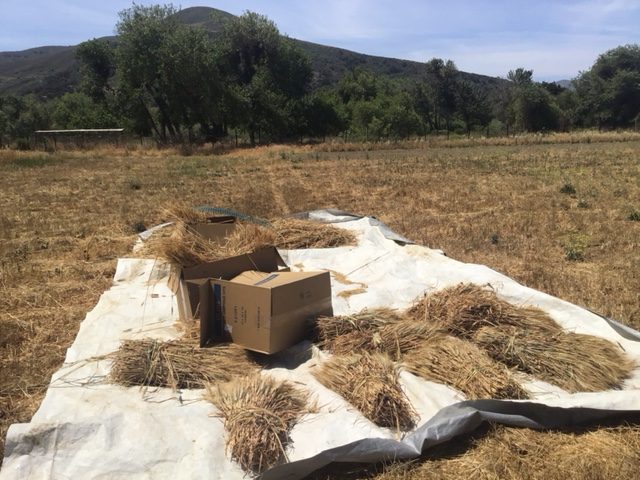
Wheat bundles in field
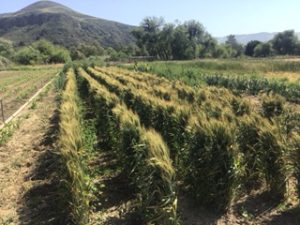
Red durum wheat in field
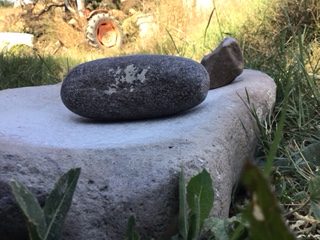
Quern stone & mano