Bruce documents his knowledge and accomplishments in subsistence farming on Substack. His Substack URL is Bruce Steele – Substack substack.com This is his latest post about stone milling tools.
***
Stone milling tools were on Aunt Shirley’s porch in Moorpark . They were mostly stone bowls and pestles used for preparing acorns. They came from the bean fields when a plow would turn them up. Aunt Shirley put dirt and succulents in them, one bowl on each step.
The bowls and the rocks they came from have come to into my life, one bowl or metate (quern stone) at a time. I started pecking bowls with a steel hammer and chisel, but smoothing them has always been done with a mano, and usually that same mano would eventually marry with the bowl, the surfaces worked together for a perfect fit.
For me pecking a metate without steel tools has been long dead lessons relearned. Saddle Querns were produced by every civilization prior to steel tools. The Quern made civilization possible. Wheat really wouldn’t have done us much good without a Quern. But when steel chisels came along so too did the Querns, and steel chisels enabled bee hive style round milling stones to be created and they replaced the old saddle shaped ones that served us for at least 8,000 years before steel and rotating mill stones.
I use three stones: The big relatively long and flat stone that will be shaped into the saddle, a river rock that is shaped like a rolling pin, and a quartzite hammer stone. The mano (rolling pin) needs to be of a harder stone than the saddle, and you can start to hit the saddle with it to remove bit by bit a crumble of grit. As the mano repeatedly hits the quern it smooths the end of the mano, and as the quern takes shape so does the mano. The quartzite hammer stone is smaller than the mano and it is used to peck surfaces after the larger mano has roughed it into shape. Also as you put more and more work into your quern, more delicacy is required to avoid breaking it. So a lot of the final shaping is with the quartzite hammer stone.
An interest in milling tools led to an interest in milling acorns and crops we humans milled in the past. Acorns kinda led to pigs, but that is a different story. Milling acorns is relatively easy because they are soft and can be milled wet. Wheat and grains are milled dry and require different tools than the bowl and pestle used for acorns.
Quern stones need to be hard because nobody wants grit in their flour. Our ancestors didn’t like grit either . Knowledge about what stones work is easy enough if you copy what stone our ancestors chose. Granite or basalt querns are common. You can look into what stones were used locally at a natural history museum near you.
So after pecking my quern and grinding some rice to clean it and rid it of grit, I tried grinding some dehulled spelt . I used a #50 sieve to sift the flour . The results are nice light colored flour with no grit.
[My interest has grown] From pecking stone bowls to preparing acorns, from hundreds of pounds of foraged acorns to pigs. From wheat to pecking a quern: Egg noodles, soba noodles, breads, cream of wheat from the bran, desserts.
It is easy enough to rake up 500 pounds of acorns and dry them for storage. With nothing more than a grubbing hoe and a hand sickle, one man can grow, harvest and process 50 pounds of wheat, another fifty pounds of spelt and several hundred pounds of corn on about a half acre and still have room for plenty of fresh vegetables.
A hoe and some stone milling tools are the basic tools that enabled our distant relatives access to enough food to support a village. Those same tools, without mechanization or steel, still can provide.
Once upon a time, the lords took the quern stones from the peasants. They were taking their freedom to farm untaxed. If all the grain had to go to the manor’s mill to get flour for bread, everything could be tallied and taxed. There is some freedom still in gardening and milling without anything but human power.
A stone hoe is still a future project but I suspect it would work as well as the steel grub hoe I currently use.
Red Durum Wheat, 50 pounds finished grain from a 1,000 sq.ft. garden space and a grub hoe. Threshed and winnowed by hand. Mostly milled with an electric mill but walking back is optional, right?
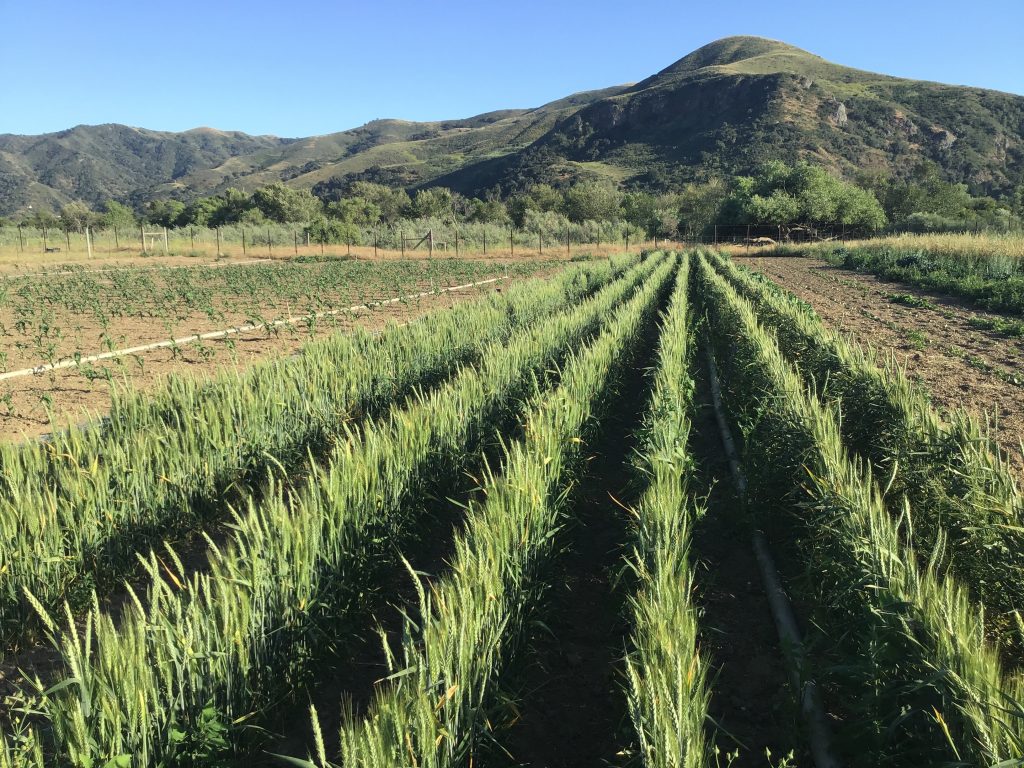
Wheat field at Winfield Farm
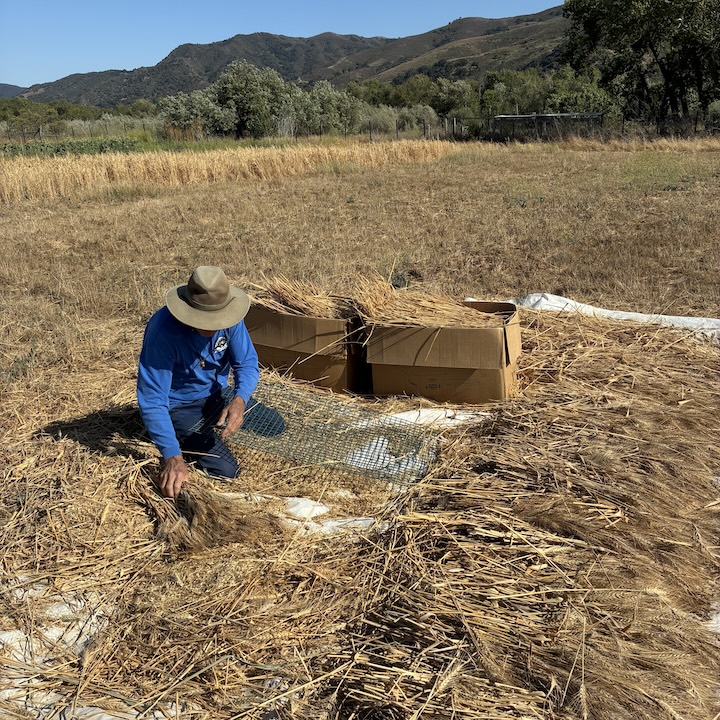
Threshing wheat by hand
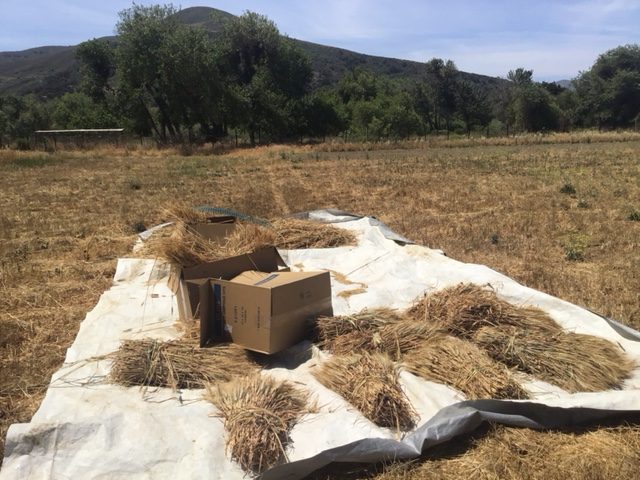
Wheat bundles in field