by Bruce Steele | Mar 12, 2015 | Recipes
The food world, like everything else, has its fads & fashions. Pork Belly may not the be the darling of star chefs that it was a year or two ago, but it’s always been a mainstay of rich, hearty ethnic cuisines. Pork is particularly esteemed in Eastern European cookery, and is a cornerstone of the cuisine of Hungary.
Lard is the cooking fat of choice for everyday Hungarian cooking (when cooking “light,” Hungarians use butter). Pork fat is such a big deal that the Mangalitsa pig, which has been getting a lot of press lately, was bred in Hungary especially for its abundant and luxurious fat.
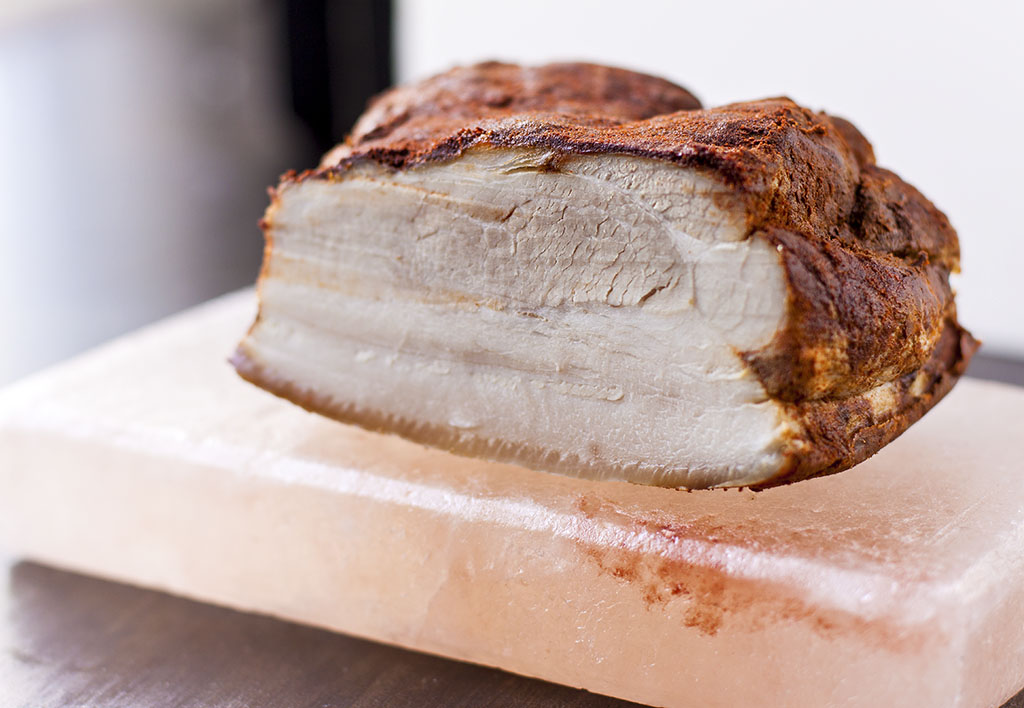
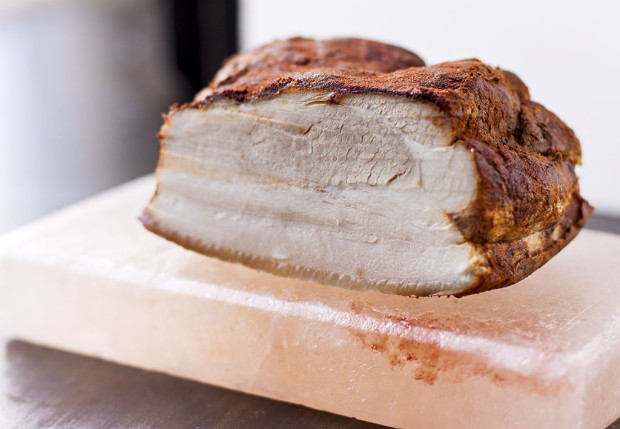
This preparation is inspired by a traditional Hungarian dish, Abált szalonna (roughly translated as “boiled bacon”). While this version is made with fresh, uncured pork belly instead of the usual bacon or smoked hog jowl, the essential flavor and aromas of pungent garlic and rich, dusky Hungarian paprika ring true to the original version. And oh – the silken, tender texture of long-simmered pork belly with its layers of soft skin and tender streaks of meat, held together with delicate pork fat!
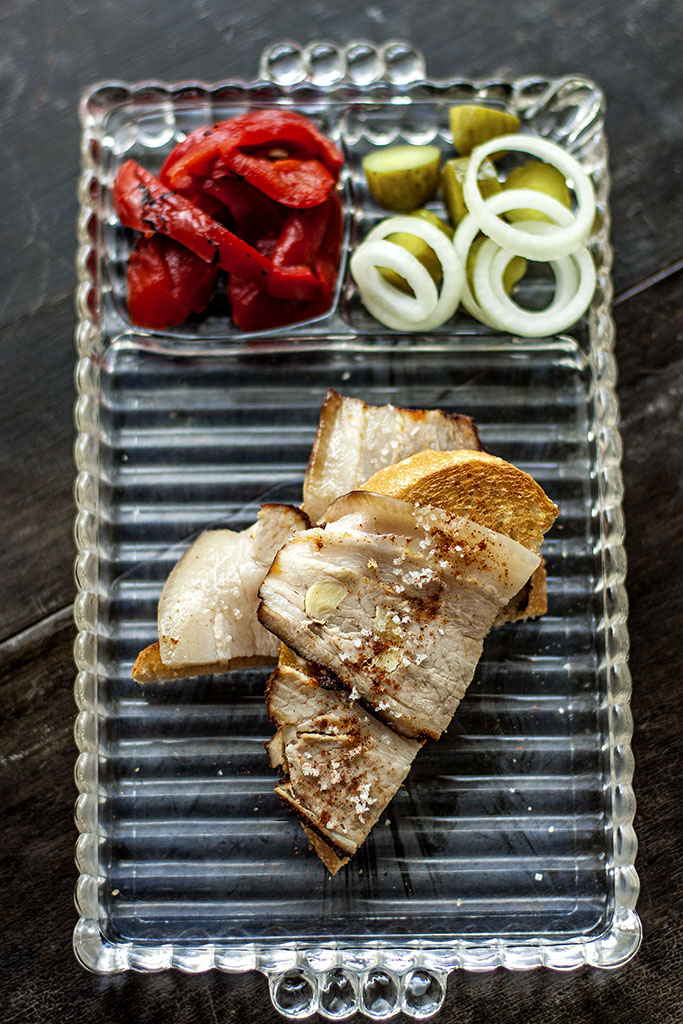
After cooking, the garlic-laden pork belly is liberally anointed with good Hungarian paprika, carefully wrapped and refrigerated until it is firm and completely chilled. The fully cooked pork is traditionally eaten cold, draped over a thick slice of warm, fresh bread with roasted peppers, sliced onions and lots and lots of homemade pickles. This is the quintessential Hungarian convenience food, something you’d take on a trip or offer to the guest who drops by for a visit.
While many Americans might be horrified at the thought of eating what amounts to pure, unadulterated fat, at the same time, they think nothing of consuming copious amounts of fried foods and snacks, all soaked with processed, hydrogenated fats.
But is pork fat bad? Recent research suggests that it’s not. According to Dr. Andrew Weil, medical doctor and well-known naturopath, the scientific analysis of 21 studies determined that there is no significant evidence that dietary saturated fat is associated with an increased risk of coronary artery disease.
Pork fat has only about one-fourth the saturated fat and more than twice the monounsaturated fat as butter. It’s very high in Vitamin D and is also low in omega-6 fatty acids, known to promote inflammation; and if your pork comes from free-range pigs that eat greens, not grains, it will have higher levels of omega-3 fatty acids.
The bottom line? Relax and enjoy this, and other traditional pork delicacies, in moderation. You’ll be glad you did.
Hungarian Style Pork Belly
- 1 lb slab of fresh pork belly, with skin on (not sliced)
- 6 cloves of fresh garlic, peeled
- 2 bay leaves
- 1 tsp whole black peppercorns
- 3 Tbsp salt
- water
- 3 Tbsp Hungarian Paprika, or more to taste
Using the tip of a thin-bladed knife, deeply pierce the fat side (not the skin side) of the pork belly in 10 or 12 places, making sure not to go all the way through the skin on the other side.
Poke whole cloves of garlic (or halved cloves, if they’re especially large) into the slits.
Place the pork belly, bay leaves, peppercorns, salt and 2 – 3 sliced garlic cloves in a large, heavy pot filled with cold water. Over medium heat, bring to a low simmer. Reduce the heat to just barely simmering, cover and cook about 3 hours, or until the skin is very soft and tender.
Remove from the heat and take the pork out of the pot and drain, reserving the broth for other uses. Using paper towels, pat the pork completely dry and place on a large piece of wax paper, skin side down. Sprinkle the top of the pork belly very generously with the paprika. Wrap tightly with the wax paper and a layer of aluminum foil and refrigerate overnight or until thoroughly chilled.
Place thin, almost transparent slices of the pork belly on warm slices of rustic bread with a sprinkle of coarse salt – and maybe a little extra pinch of paprika. Serve with roasted peppers, sliced onions and homemade pickles.
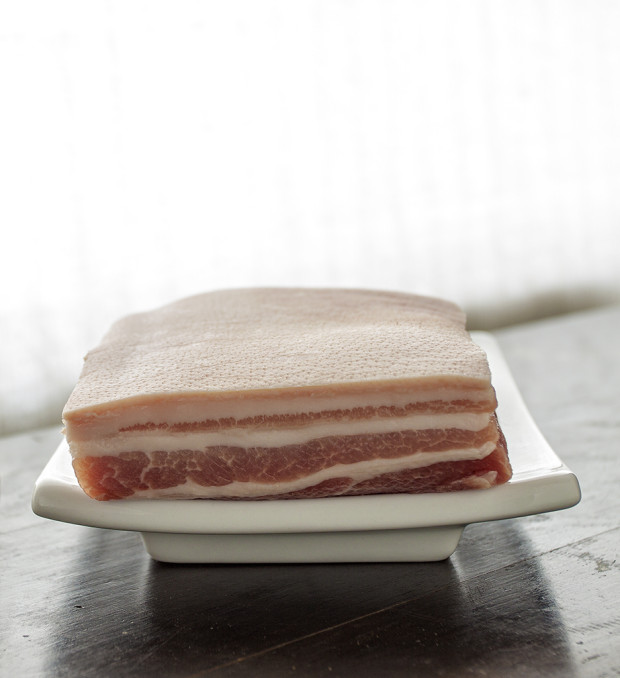
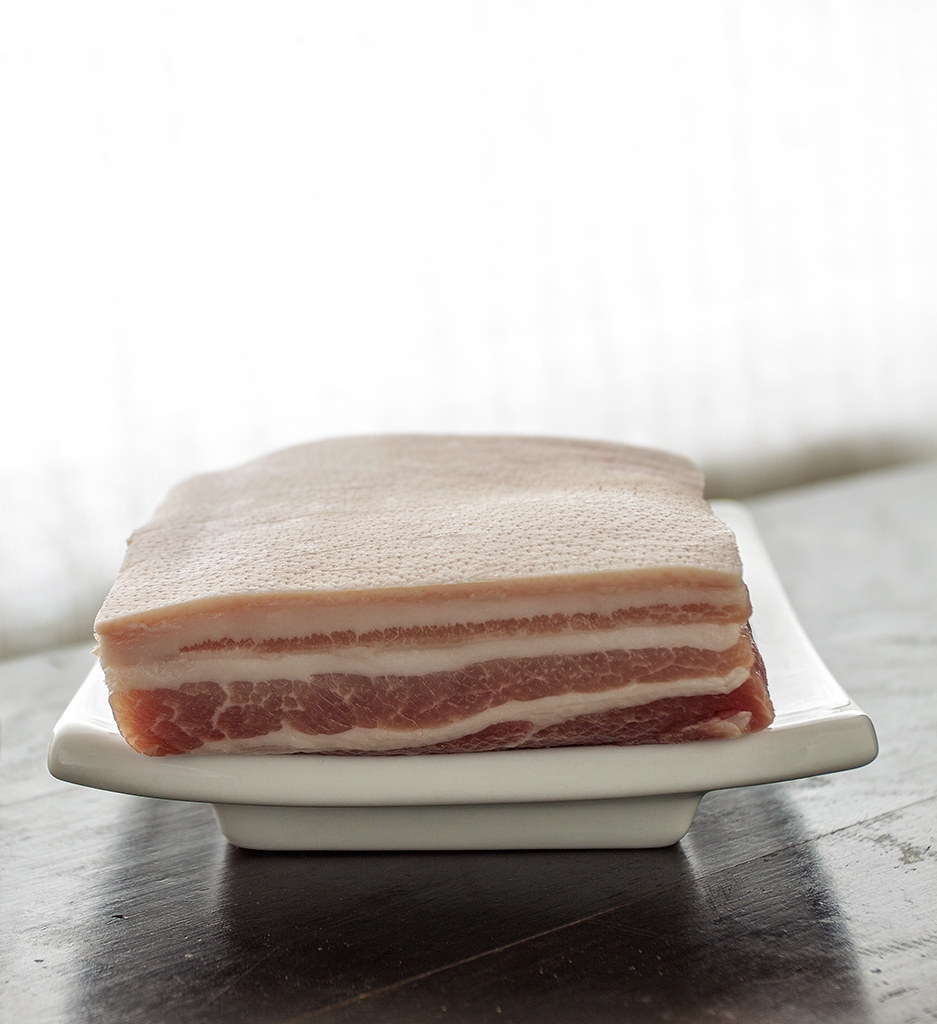
Fresh Pork Belly
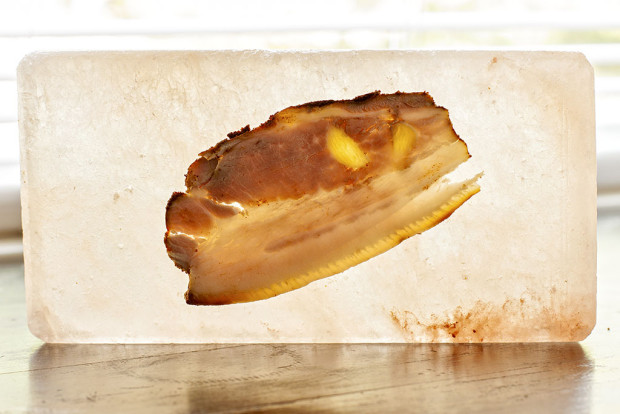
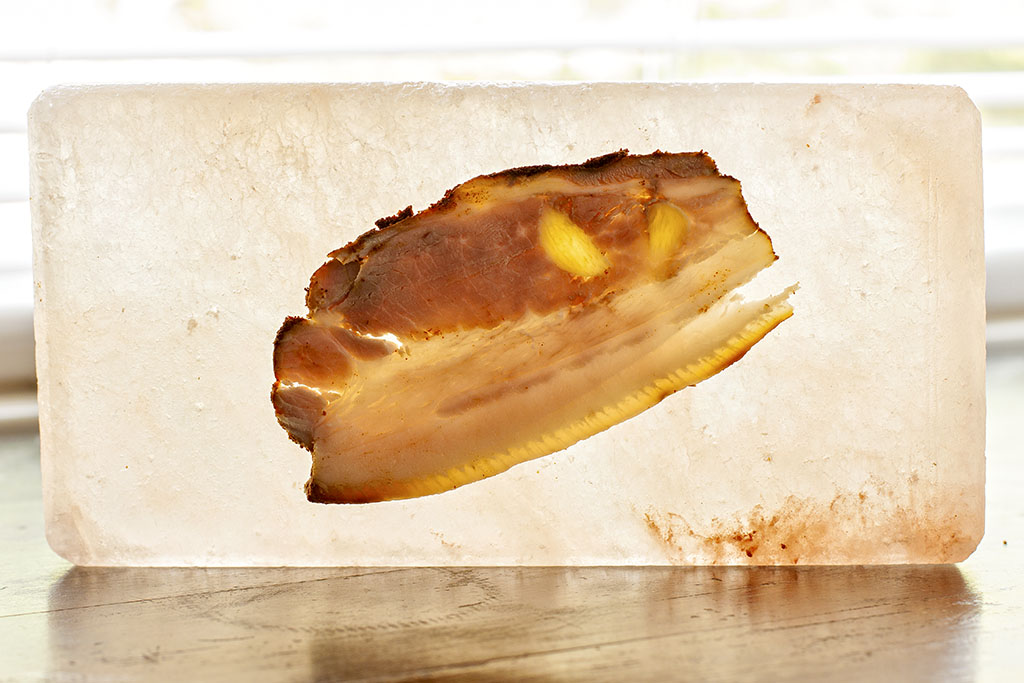
A thin slice of Hungarian-style pork belly pressed against a backlit translucent salt block. Note the slices of whole garlic cloves!
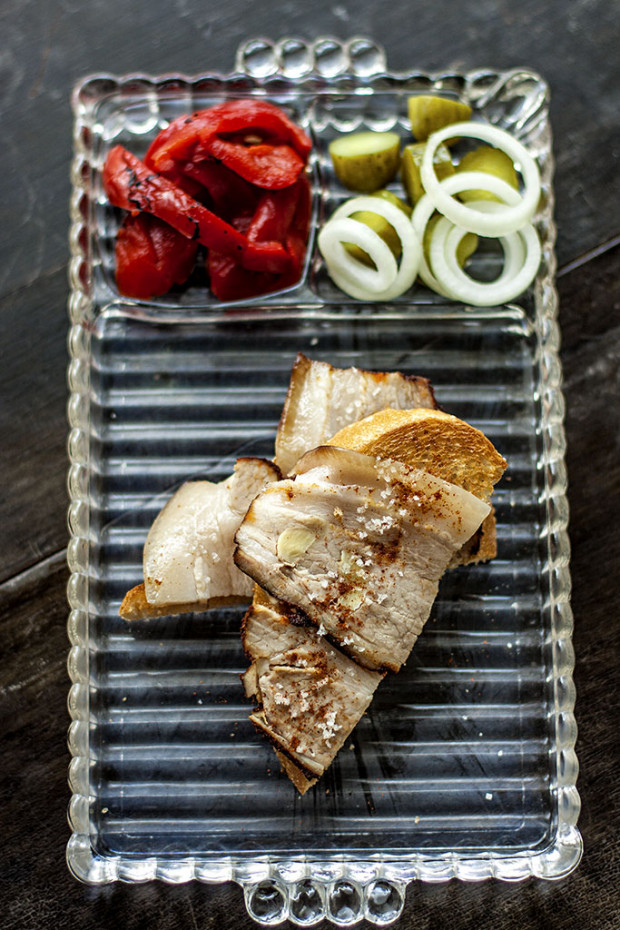
Pork Belly with traditional accompaniments
Read the original post: earthlydelightsblog.com
by Bruce Steele | Feb 22, 2015 | Mangalitsa Pigs
WINFIELD UPDATE –
A visit from Wilhelm Kohl, author of “The Mangalitsa Pig: Royalty is Coming to America”
[slider id=”visit”]
The power of social media to connect the world is amazing! Wilhelm Kohl co-authored “The Mangalitsa Pig: Royalty is Coming to America”, to document the history of these amazing Hungarian wooly pigs and share recipes from Hungarian chefs.
Wilhelm discovered the Winfield Farm website Mangalitsa page and subscribed to our e-letter, then responded to our Christmas greeting. Trading emails and phone calls back and forth, we learned that he is partner in a Mangalitsa farm in Michigan raising red and blonde Mangalitsa wooly pigs, is writing a sequel featuring American Mangalitsa farms and recipes from American chefs, and – the amazing part – he asked to visit us for the purpose of including Winfield Farm and Bruce in his new book!
Wilhelm arrived at the farm on February 18, accompanied by his photographer, Barbara Meyer zu Altenschildesche, a Royal red Mangalitsa farmer in the Netherlands who also runs a confinement breeding operation, raising Manga piglets for export, some to the United States.
Small world!
Barbara and Wilhelm showed up at feeding time, and spent the afternoon in the field, photographing our swallow-belly Mangalitsas. Barbara made friends with our 450-pound foundation boar Augustus (Gus), “speaking” to him and scratching his belly (albeit through the fence of his paddock).
Following the introduction to our porcine menagerie, we gave Barbara and Wilhelm the proverbial cooks tour of restaurants in the Santa Ynez Valley who have purchased Winfield Mangalitsa pork.
[slider id=”synchefs”]
On Wednesday evening we visited Root 246 Restaurant in Solvang for a special dining experience. Root 246 bills itself as offering the ultimate in farm-to-table cuisine. Chef Seth Nelson exceeded expectations with an elegant entrée, Winfield Farm bone-in Mangalitsa loin chops, brined in whey crafted from house-made ricotta cheese, which also adorned the plate.
On Thursday Barbara photographed our newest addition to the farm, 17 six-week old Manga piglets – so adorable with their wooly coats still colored with racing stripes. (The stripes fade when the pigs mature.) Then we were off to lunch at Industrial Eats in Buellton, a bustling European-style restaurant featuring two custom “beehive” pizza ovens and its own charcuterie case. Owners Jeff and Janet Olsson, who also operate New West Catering and have been great customers of Winfield Farm produce, bought our first Mangalitsa – in fact Jeff has purchased several over the last year. His interest in charcuterie –– he makes yummy prosciutto, melt-in-your-mouth lomo (which we devoured as it was served on their large meat plate) and other cured delicacies from our pigs –– is a big reason why we settled on raising Mangalitsa pigs in the first place. (Mangalitsa, a heritage lard breed originating in Hungary, is renown worldwide for charcuterie… and a natural fit for us after visiting Hungary four times and falling in love with the country.)
After lunch we visited Chef Pink and Courtney Rae DeLongpré at Bacon & Brine – a relatively new and very popular lunch spot in Solvang that features ONLY local sustainable produce — and Winfield Mangalitsa pork when available.
Barbara posted a series of photos of our visit to Chef Pink on her Mangalitsa Breed Facebook page afterward, commenting “Facebook is amazing. .. without it we never would have met.”
Our culinary tour concluded Thursday evening at Full of Life Flatbread in Los Alamos, where owner/chef Clark Staub served us a five-course Mangalitsa feast truly fit for Royalty! First came home-made levain bread with avocado and Mangalitsa lardo, garnished with rose-pickled Winfield Farm “Gen Red” onions, grown from seed stock that Bruce created himself. Then we dove into a wild boar and Mangalitsa “Scotch” egg, and shaved puntarell, fennel and radish salad bedecked with Mangalitsa speck. A signature Flatbread ‘pizza’ featured house-made shamen’s bread with rosemary lardo.
The entreé was oven-roasted bone-in Mangalitsa loin roast on a bed of charred blood orange, with fennel and paprika, served with broccolini, fingerling potatoes and wild nettles. To top off the meal Euro style, we finished with little gem lettuce salad with cherry tomatoes, sheep’s milk cheese and Mangalitsa ‘croutons’. All in all, a truly amazing!!! dining experience crowning a visit that we won’t forget!
Wilhelm and Barbara departed early on Friday morning and we will continue to stay in touch. In fact, Wilhelm suggested that I write Bruce’s profile for his new book – he called it a great story… from covered wagon days (Bruce’s family crossed the prairie in the mid 1800s to settle in CA), to sea urchin diving to Mangalitsa farming. As Bruce says, he’s moving up in the world!
Postscript: Now that we have some 80 Mangalitsas to raise for market, we have begun our own social media campaign. Please check out our new Mangalitsa webpage and News Blog, as well as our Winfield Farm Facebook page (www.facebook.com/WinfieldFarmBuellton)
Also FYI: We now have USDA certified, frozen cryovac-packaged Mangalitsa rib chops, a few Boston butt and Tri-Tip roasts (2 lb pkg), smoked ham (2 lb pkg) and bacon (1 lb pkg), as well as trotters and smoked ham hocks. Characteristic of this heritage breed, we also have lots of leaf fat! Please visit our Mangalitsa Market online to order.
We will be going to market again in April. Please sing out now to reserve your Mangalitsa pig (or custom cuts).
All the best,
Bruce and Diane
Photo credits: DB Pleschner | Barbara Meyer zu Altenschildesche — Visit the gallery for full size and additional photos taken during this visit.
by Bruce Steele | Feb 13, 2015 | What Chefs Say
The Best Burgers in the Country, According to Chefs
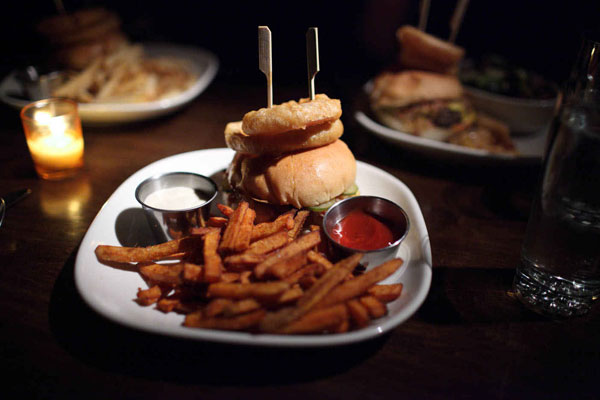
Double Bacon Mangalitsa Pork Burger
Burger & Barrel
New York, NY
Recommended by: Cliff Crooks, chef at BLT Steak, BLT Prime, and The Wayfarer (New York, NY)
“Any one of the burgers at my friend Josh Capon’s place Burger & Barrel. If forced to pick, I’d say the Double Bacon Mangalitsa Pork Burger. He had me at Mangalitsa, which is a type of pig — so delicious!”
by Bruce Steele | Jan 22, 2015 | Mangalitsa Pigs
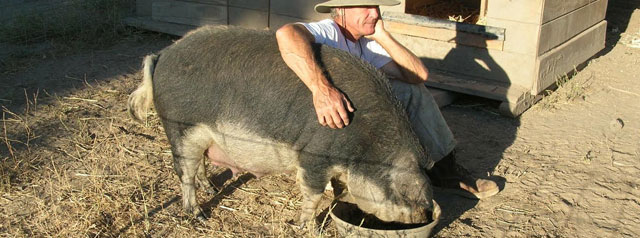
Winfield Farm Mangalitsas are raised naturally on pasture, and are fed barley and organically grown pumpkins and squash, much of it grown right here. All pigs going to market are finished on acorns, walnuts, and almonds when available – their diet like the famed Iberico pigs that are cured for premium prosciutto – pata negra.
by Bruce Steele | Jan 15, 2015 | What Chefs Say
April Bloomfield of the Spotted Pig: “When I tasted this pig,” Ms. Bloomfield said of the Mangalitsa, “it took me back to my grandmother’s kitchen on a Sunday afternoon, windows steaming from the roasting pork in the oven. Back then pork tasted as it should: like a pig. This pork has that same authentic taste.”
[divider style=”solid”]
Devin Knell, executive sous-chef at the French Laundry: “Unlike workaday pork,” Mr. Knell said, “Mangalitsa is marbled, and the fat dissolves on your tongue — it’s softer and creamier, akin to Wagyu beef.”
[divider style=”solid”]
Keith Luce, the executive chef at the Herbfarm Restaurant outside Seattle.
“Because it’s so great for curing,” Mr. Luce said, “we’re laying it down and curing the legs predominantly, making lardo, all the traditional things. It’s a true nose-to-tail experience with the Mangalitsa, and there’s not any part we’re not using.” The restaurant has also featured the meat on its tasting menu in a different form almost every night recently. “We were laughing when we tasted it,” Mr. Luce continued. “We couldn’t control ourselves. The taste, the texture was so unbelievable.”
Source: (Quotes from “ An Old Breed of Hungarian Pig is Back in Favor”, by Michael S. Sanders, published March 26, 2009 in the New York Times – Dining and Wine)
[divider style=”solid”]
Pastry chefs also clamor for the leaf lard derived from Mangalitsas – the silky magic ingredient for the flakiest, tastiest pie crusts. Rendered lard can be whipped until so fluffy and white it looks like vanilla ice cream. Former New York Times food critic Ruth Reichl called it “the single best pastry fat I’ve ever found.” “Mangalitza’s are the prettiest pigs. And their lard is perfect in pastry. Easy to roll out, very flaky, lovely, fresh flavor.”
Source for quote: https://twitter.com/ruthreichl/status/9025609827
[divider style=”solid”]
Sam Hazen, executive chef at Veritas in New York, says the pork is the best he has tasted. “For me, it’s the best pork in the world,” says Sam Hazen who uses only Mangalitsa for his pork dishes. “It’s got incredible texture and it’s consistent; it’s never dry. It’s very, very special.”
Source: Bringing Home The Woolly Bacon From Hungary — by Adee Braun
Posted on the Winfield Mangalitsa Page https://www.winfieldfarm.us/?page_id=770
[divider style=”solid”]