by Bruce Steele | Jun 25, 2015 | Mangalitsa Pigs
The conference called Fatty Pig on fat-type hogs (including the more and more famous Hungarian Mangalitsa) might bring scientific and economic results. The conference was organized for the second time by the Research Institute for Animal Breeding and Nutrition and WESSLING Hungary Kft. on November 21 and 22 in Herceghalom, and it was attended by researchers and businessmen from all around the world.
Fat-type hogs play a key role in the production of high quality pork! Fat-type hogs are usually bred only in small populations, but in many parts of the world, and they represent a premium segment within the sector, and also enormous national, genetic and economic value. To utilize these values, it is outstandingly important to investigate and to understand more thoroughly their physiological and genetic properties. Mangalitsa is more and more well-known in the world and more and more sought-after by consumers – said Dr. József Rátky, director general of the Research Institute for Animal Breeding and Nutrition, co-organizer of the conference.
With genetic analysis against counterfeiting
For successful performance of a premium product on the market, in order to eliminate counterfeiting, traceability is indispensable, which is achieved by performing the necessary background analyses and molecular biological-genetic research. This was the goal of the MANGFOOD project, an undertaking of Biomi Biotechnological Service Kft., a joint venture of the independent analytical laboratory WESSLING Hungary Kft. and the Agricultural Biotechnological Center.
As Adrienn Micsinai, general manager of Biomi told us that, together with several other enterprises and scientific laboratories, a gene sequence specific to the Mangalitsa was found during the MANGFOOD project, which is suitable for the fast and highly accurate determination of whether the given product is really made of Mangalitsa. This way it was possible to differentiate genetically between Mangalitsa and other pigs. This solution can be used not only for products containg only one type of meat, but also for mixed products, e.g. sausages, and even the percentage Mangalitsa content can be determined.
The journey of the Mangalitsa
Elimination of counterfeiting is extremely important, since Mangalitsa today has an outstanding role in the Hungarian meat industry – emphasized Dr. Lajos Bognár, deputy undersecretary of the Ministry of Rural Development responsible for food chain contol supervision and agricultural administration. Mangalitsa was in a critical state in the 1990’s, but it was resurrected thanks to the gene preservation program that was started in 1995.
The fate of other fat-type hogs all over the world was similar to that of the Mangalitsa – said Péter Tóth, president of the National Society of Fat-Type Hog Breeders and the Genetic Resources Council of Indigenous Livestock. Ancient breeds were close to extinction and they were revived – concurrently with the appearance of a new demand for quality meat – by a few eager breeders, learning almost in a self-educated way all there is to know about this animal. And then they were joined by research institutes and economic players.
Lo Chin-Hsien Ra, owner of 551 HORAI, an Osaka-based Japanese restaurant chain came to Hungary specifically for the sake of Mangalitsa. He had heard a lot about the breed, and had already encountered Mangalitsa products in Japan. This was not an accident, because – as was told by Endre Nagy, general manager of Pick Szeged Zrt., known internationally for its excellent salami, among other things – the leading product of the company, “téliszalámi”, has been present in the Hungarian and world markets for 145 years, and its raw material is high weight, high quality pork, i.e. Mangalitsa.
by Bruce Steele | Jun 7, 2015 | Mangalitsa Pigs
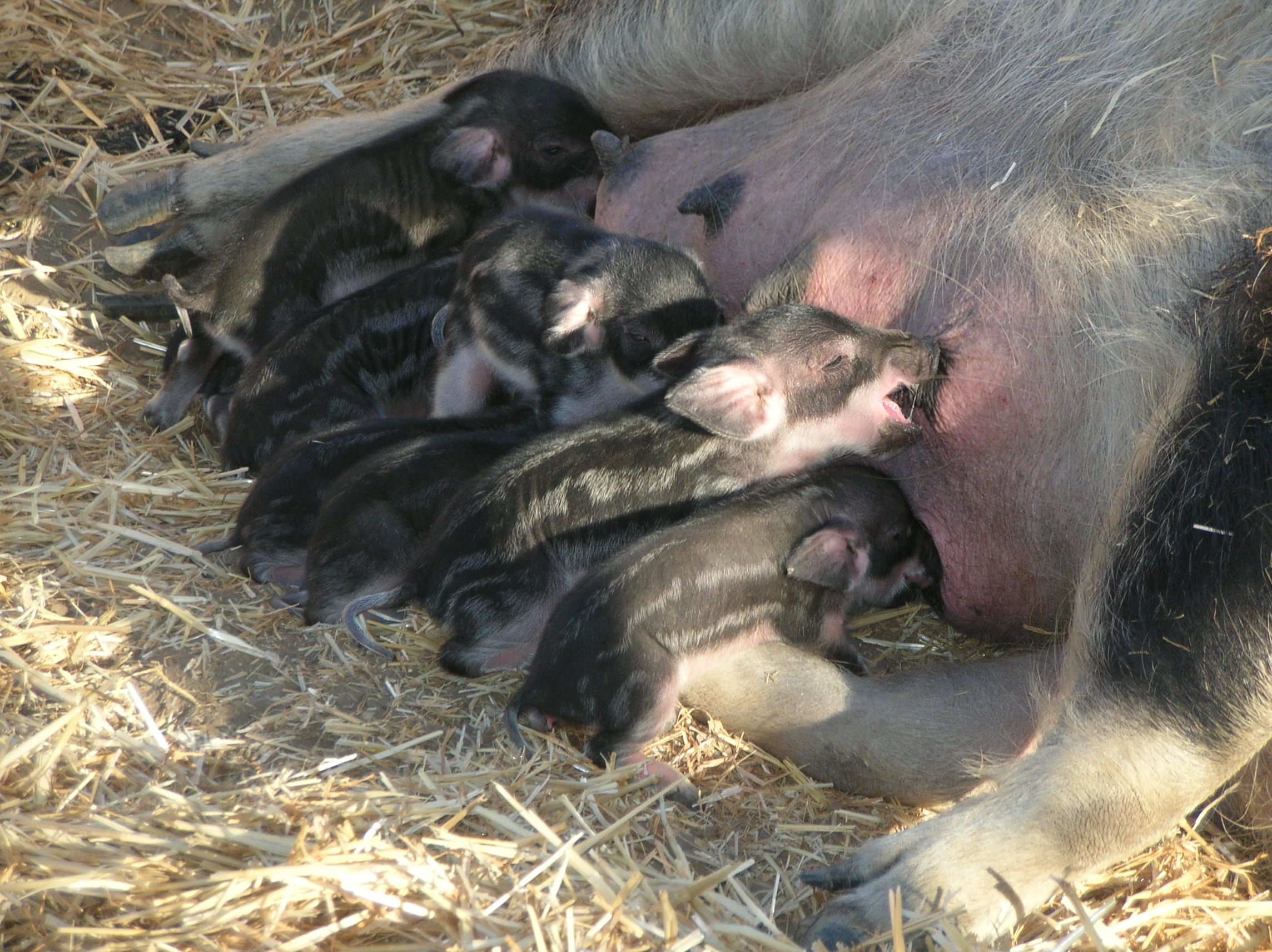
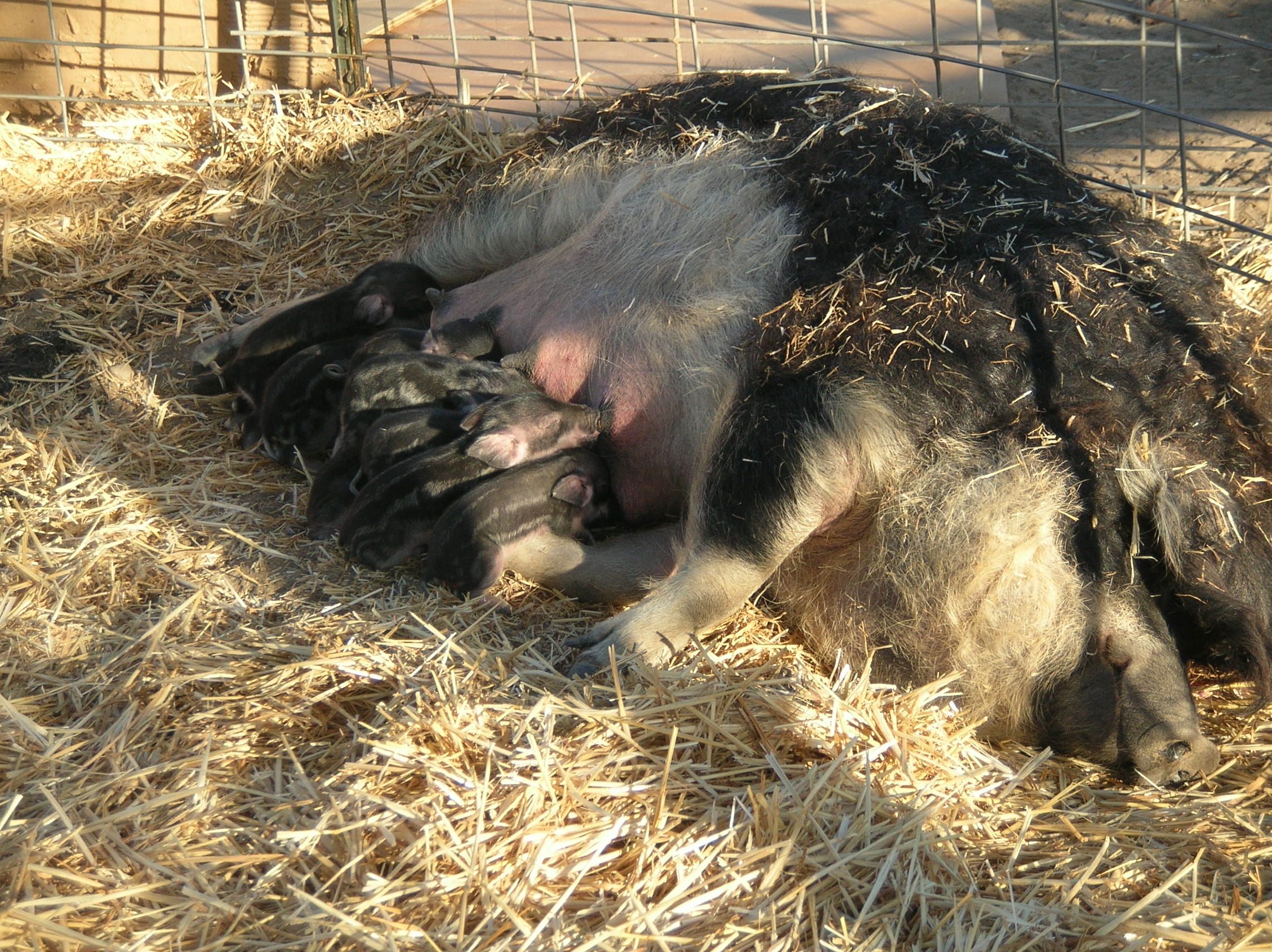
Spring is usually a busy time of year at Winfield Farm: tilling the soil, seeding and out-planting vegetable starts. This spring was doubly busy, with the arrival of 54 Mangalitsa piglets since March 18!
Although Bruce managed to plant some spring carrots, beets, potatoes, shishito peppers and heirloom tomatoes, and just finished planting a row of Costa Romanesco zucchini squash, most of his waking hours have been devoted to pig husbandry. In fact, heirloom Mangalitsa wooly pigs have become Winfield Farm’s mainstay!
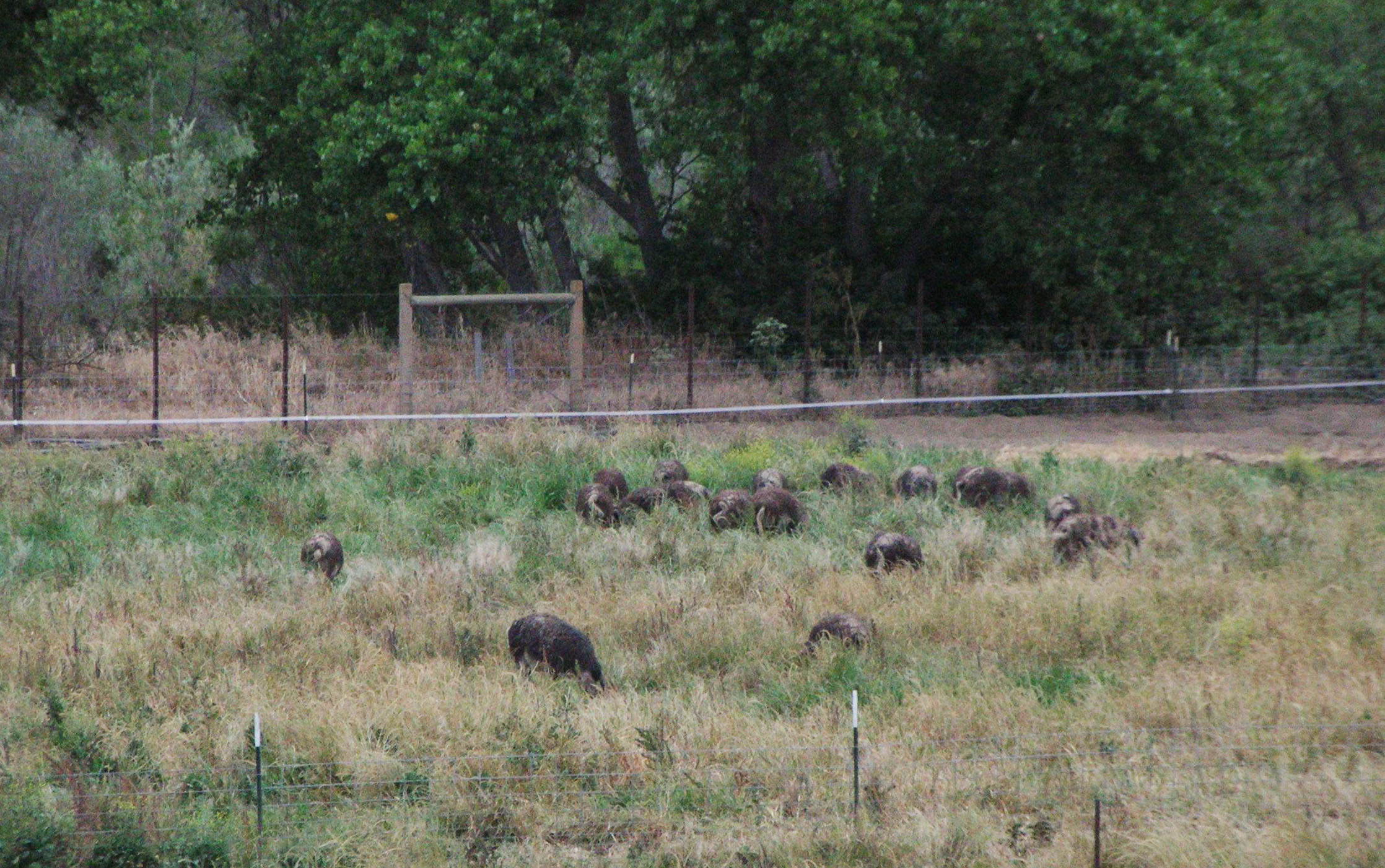
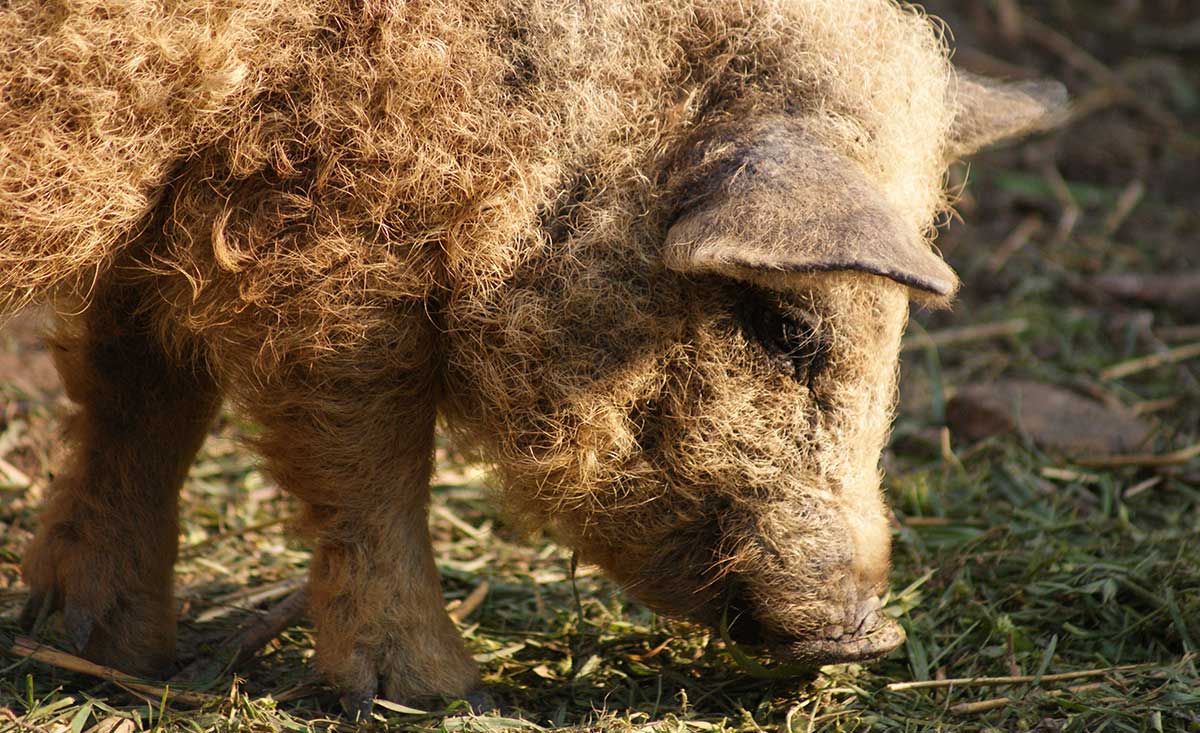
Bruce has turned over most of our fields to pig rearing, so planted pasture instead of produce, and spends a lot of time building and moving fence. We corral our pigs with hog panels wired together so he can rotate the herd: when the little shovel-noses root up one section, he moves them to new turf. People driving along Highway 246 from Lompoc to Buellton can spy our herd of purebred swallow-belly Mangalitsas cavorting in the field. These wooly haired pigs look a lot like black sheep.
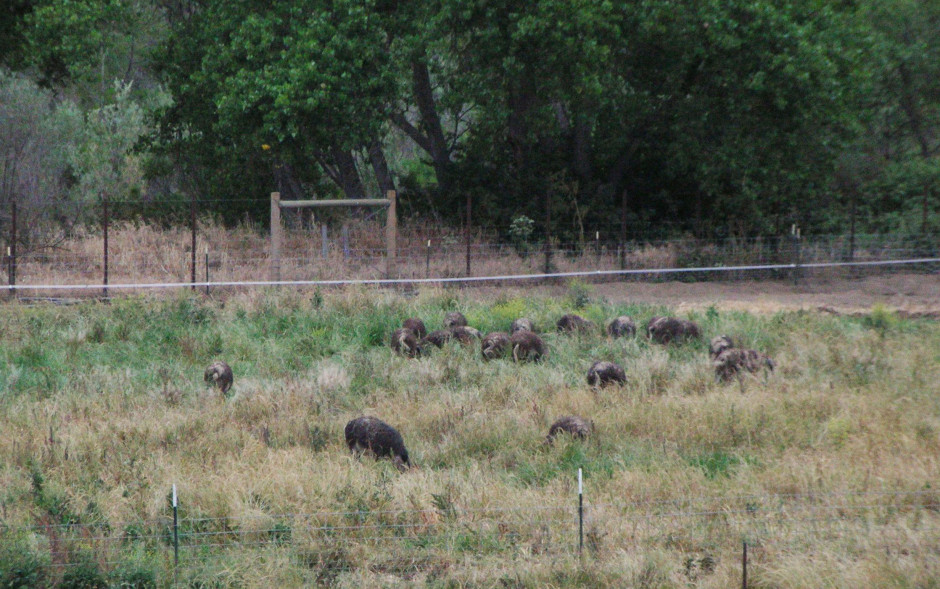
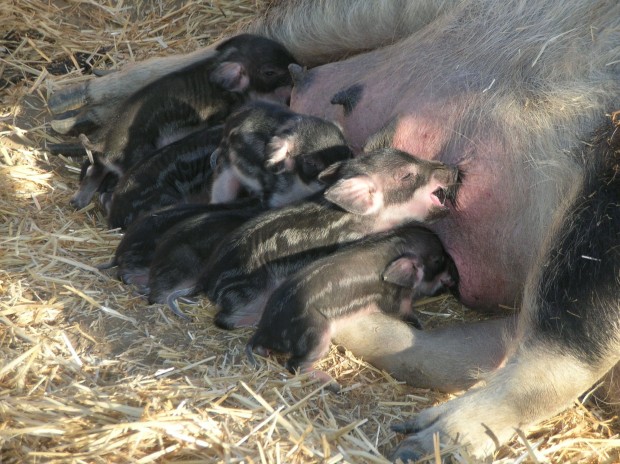
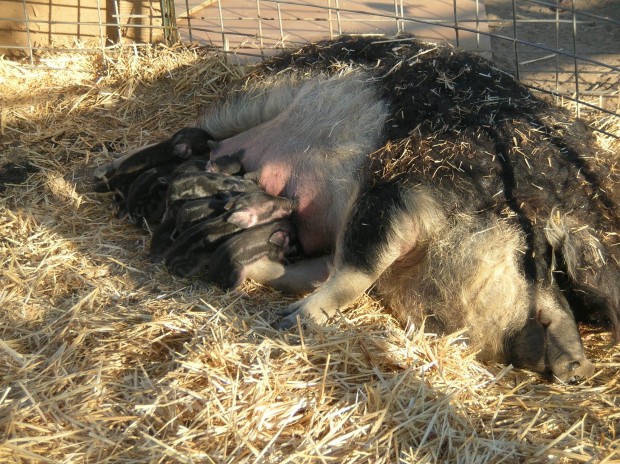
The 54 new arrivals are the offspring of 8 sows and 4 boars (3 more sows produced another 20 piglets last winter) – so our Mangalitsa herd now numbers more than 100 pigs total. It’s amazing to think that just 2 years ago we began this pigdom with only two pigs. We’re now able to provide fresh (or fresh-frozen) Mangalitsa pork virtually year-round.
We’re marketing our heritage Mangalitsa pigs to a growing number of discerning restaurants in the Santa Ynez Valley and beyond. For example, you’ll often find Winfield Mangalitsa prosciutto, lomo and pancetta at Industrial Eats restaurant in Buellton, and Clark Staub at Full of Life Flatbread in Los Alamos makes magical dishes – and pizzas – with Winfield Mangalitsa pork.
We also offer USDA certified, cryovac packaged frozen Mangalitsa pork products on our online Mangalitsa Market store.
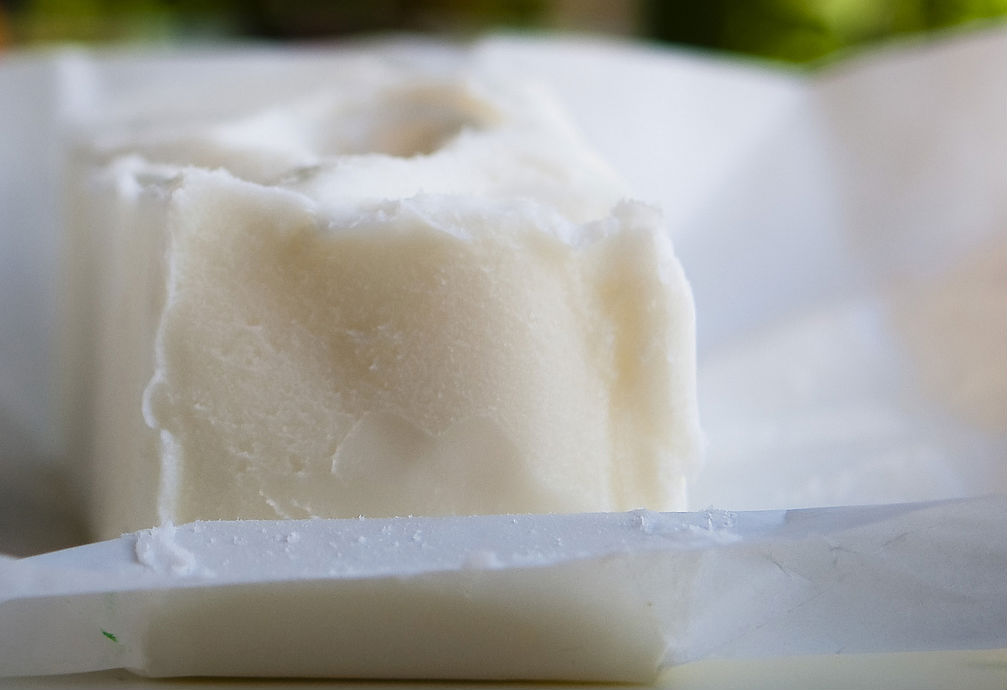
We recently took several pigs to market, so have a fresh supply of frozen cuts available, including chops (a handful of skin-on, bone-in loin and a lot of skin-on, bone-in rib with a glorious cap of pure white Mangalitsa fat), bone-in sirloin roasts, smoked hams (both bone-in and boneless), sliced bacon (and a couple of belly slabs), ground sausage (fresh and sweet Italian flavors in bulk 2-lb packs), smoked hocks (yummy!), trotters and leaf lard (the best baking fat EVER!).
Please call us at (805) 686-9312 or email us at bruce@winfieldfarm.us to order.
Or you can order from our online store, but please call first to make sure we still have what you want. If we don’t have it now, we can custom-order it for you the next time we go to market. We’ll be taking more pigs to market in late June, and at least monthly throughout the summer and fall.
If you haven’t tried Mangalitsa pork yet, you’re in for a treat. Try Winfield Mangalitsa and taste the magic for yourself!
by Bruce Steele | May 29, 2015 | Mangalitsa Pigs
By Francesca Shanks on May 1, 2015
This book is a love letter to a unique Hungarian pig breed, a breed whose history seems miraculous when compared to America’s agricultural traditions.

The curly-haired Mangalitsa’s “genetics have remained untouched since 1833”—an almost unbelievable story for those acquainted with large-scale agriculture in the U.S. But raising these pigs is a long game—they aren’t bred to fatten up quickly. They’re renowned for their taste and the quality of their lard, and they’ve found their way to several of the country’s highest-rated restaurants in recent years.
But, according to the book’s authors, this almost wasn’t so: in the early 1990s, less than 200 Mangalitsa pigs remained, prompting Peter Toth and a partner to buy a herd of 50 from a Hungarian farmer in order to expand the Mangalitsa’s numbers. Today, Toth is president of the Hungarian National Association of Mangalitsa Breeders, and, he writes, the breed is 10,000 strong.
TheMangalitsa_recipes-1Mangalitsa pigs are now (again) a big part of Hungarian cuisine, as 23 Hungarian chefs demonstrate with recipes that incorporate Mangalitsa cuts, from lard to brain to loin. Each beautifully photographed recipe comes with a short chef profile and detailed instructions—make Zsolt Litauszki’s Mangalitsa rillette in breadcrumbs with fermented wax beans, or simply marvel at Antonio Fekete’s “Apple dessert,” a white chocolate-covered molded apple mousse complete with dark chocolate stem (no pig included in this recipe).
If you’re desperate to taste Mangalitsa for yourself, there’s a list, including a map, of Hungarian restaurants at the back of the book, plus a couple of pages advertising Mangalitsa farmers in the U.S.
This beautiful book, with gold-embossed title and incredible photography, is translated from Hungarian, which, unfortunately, results in some typographical errors. This may drive you crazy if you’re an editor type, but don’t let it get in the way of the opportunity to read about this fascinating pig breed. If you are interested in a story that merges fine cuisine with a passion for animal husbandry, you’ll enjoy The Mangalitsa Pig, and probably learn something, too.
The Mangalitsa Pig: Royalty is Coming to America
by Mate Dobesch, Wilhelm W. Kohl, Peter Toth, Beata Bencsics, Eszter Szalai (Translator)
247 pages; Boook Publishing Hungary, 2014
Read the original post: modernfarmer.com
by Bruce Steele | May 11, 2015 | What Chefs Say
The Huffington Post | By Julie R. Thomson
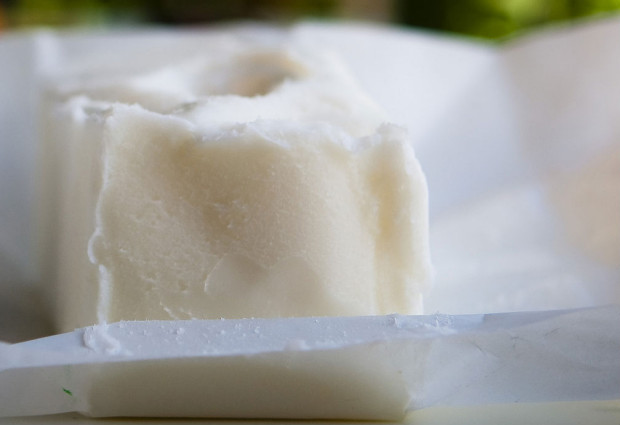
In a not so distant past (about a century ago) and in a not so foreign land (like, in America), lard was the fat that people cooked with. It wasn’t butter. Nor canola oil. And definitely not extra virgin olive oil.
Lard — rendered pig fat — was what people used when they needed to make pastry; when dinner needed frying; and even as a quick breakfast, eaten smeared on a piece of bread. So much has changed in our recent history. Lard is not only out of favor, it’s even considered a derogatory word.
We’re not going to get into how or why this happened — though Crisco and Upton Sinclair have gotten most of the blame — we’d just like to focus on bringing this glorious cooking (and baking) fat back into people’s kitchens. It’s time to let go of the lard stigma and enjoy great pie crust again. Let us make our case:
- Lard makes the best fried chicken. Crisp like a spring morning.
- It’s an extremely versatile fat. It doesn’t smoke at high temperatures so it’s perfect for frying. It does wonders while roasting. And its large fat crystals mean it makes the flakiest of pastries.
- Mexican tamales just wouldn’t be the same without it. Word.
- It has less saturated fat than butter. (Though not the same glorious flavor.) We’re not going to make any health claims about lard — because what do we Taste editors know about health? — but we can report what we’ve learned: lard has 20 percent less saturated fat than butter; it’s higher in monounsaturated fats which are said to lower LDL cholesterol; and it has none of the trans fat that shortening does. Chew on that.
- It makes for the flakiest of pie crusts. And one that’s pliable and easy to form.
- Despite what you may think, it does not impart a pork flavor. This is not bacon grease here, but rendered lard — preferably leaf lard which surrounds the loin and kidneys. It makes everything cripsy without leaving a trace of flavor behind.
- Vegetables roasted in lard come out crisper than you thought possible. As much as we love olive oil roasted veggies, sometimes they’re just too greasy and, well, a little soggy too.
- It’s sustainable. Cooking with lard is one way of guaranteeing you use every part of the hog. Some of the best restaurants, like Husk, are focused on that aim and bringing lard into fine dining.
- Biscuits. A southern lard biscuit recipe will make you wonder why you mess with anything else.
- Lard is even good on a piece of bread, in place of butter. Try it.
Read the original story: www.huffingtonpost.com
by Bruce Steele | May 1, 2015 | Mangalitsa Pigs, What Chefs Say
by Kerry Acker | www.epicurious.com | February, 2014
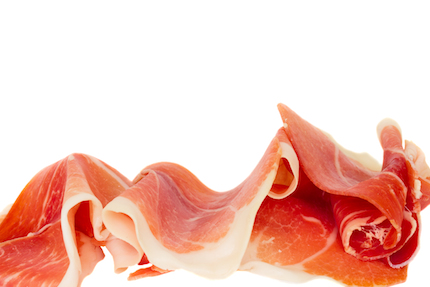
Not all pork products are created equal. Just imagine for a moment that money was no object, that no supernal slice of lavishly marbled ham or haute hunk of succulent pork was too high-end or high-falutin’ for your budget. Here, our mini guide to some of the finest, most exclusive, pork, ham, and bacon in the world.
Jamon Iberico de Bellota
Celebrated El Bulli chef Ferran Adria once said of this traditionally cured Spanish ham, “Iberian pork meat is extraordinary. There’s nothing like it elsewhere in the world. There’s a great difference between a superior ham and all the rest.”
Raised along the Spain/Portugal border, the pata negra (black-hooved) pig roams free-range through old-growth oak forests, dining on herbs, grass, and, most significantly, acorns (bellota means “acorn”), resulting in an intensely flavored, distinctly nutty, and richly marbled meat unparalleled in the ham universe.
Get It: A 14.5-pound bone-in whole Jamon Iberico de Bellota ham from elite Spanish brand Cinco Jotas retails for $1,290 at La Tienda. But, wait, you’ll need to properly slice it, too, so consider investing in the Cinco Jotas Cortador kit–including a 13-pound bone-in Bellota ham, a black ham holder, two carving knives, serving pincers, and a protective chain-mail glove–which will set you back $2,450.
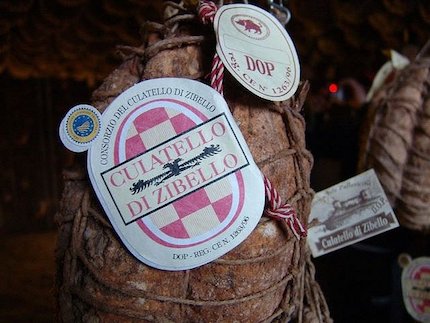
Culatello di Zibello
Among the rarest, most highly esteemed charcuterie in Italy, culatello is a boneless ham with a velvety texture and a robust, slightly sweet flavor. Produced in the foggy Po Valley, outside of Parma, culatello (“little backside”) is made from the muscle in the rear leg of the pig, and is related to prosciutto, but pig purists consider the version labeled with the D.O.P. “Culatello di Zibello” superior to its cousin. Because it takes a whole ham to make the culatello, and producers must adhere to strict D.O.P. regulations–including using only pigs born and raised in Lombardia or Emilia-Romagna, and a slow aging (without refrigeration) of 12 to 20 months–Culatello di Zibello is pretty hard to find. (Approximately 20,000 pieces of culatello are produced annually.)
Get It: Head to Italy’s lovely Antica Corte Pallavicina, a hotel/restaurant situated in Polesine Parmense and run by Chef Massimo Spigaroli, chairman of the Consortium of the Culatello di Zibello since its inception and widely considered one of the best producers of the exclusive ham. You can visit the on-site cellars, where the ham is aged to meltingly tender perfection, then sample it afterward at the Michelin-starred restaurant.
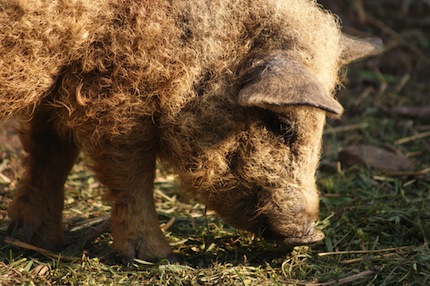
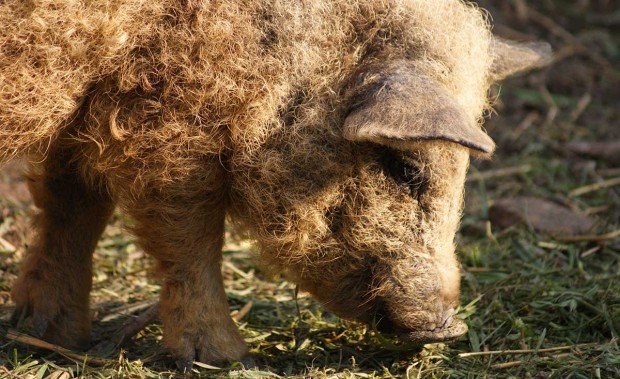
A Mangalitsa pig
Mangalitsa Pork, Bacon, and Lard
This rare breed of pig, the result of a 19th-century Austro-Hungarian experiment cross-breeding a wild boar with a pig raised for lard, is pretty darn funny-looking: Its distinct “fleece” coat gives it the look of a sheep-pig–which is why the Mangalitsa is also known as a “woolly pig”–and the pigs can weigh over 300 pounds. The animal was near extinction until the 1990s, when a Hungarian breeder revived it, and in recent years a handful of American farmers have started raising Mangalitsas. Though the woolly pigs are more expensive to produce than other heritage breeds, the buttery meat has been enjoying considerable popularity among chefs: Mangalitsa pork has been served on menus at the likes of the French Laundry, Le Cirque, and Blue Hill Stone Barns, and it’s also increasingly available as cured ham, bacon, and other products.
Get It: D’Artagnan sells a bone-in 12- to 16-pound Mangalitsa ham–dry-cured in Spain–for $400, Murray’s offers bacon ($17/12 oz.) from New Jersey-raised Mangalitsa pigs, and Florida-based Pasture Prime sells ground Mangalitsa pork, lard, and custom pork.
Edwards’ Surryano Ham
When it comes to dry-cured American ham, Surry, Virginia’s Edwards’ Surryano is a fabulous bet. Produced from Berkshire hogs and other heritage breeds–who dine on peanuts, grass, corn, and soy, according to Food Republic’s interview with Sam Edwards–the meat is dry-cured, smoked over hickory wood for seven days, then aged for 400 days. The ham that results is rich, smoky, and silky, and beloved by such chefs as David Chang, who serves it at Momofuku Ssam Bar.
Get It: A 15- to 17-pound bone-in Surryano will set you back $215, while $39 will get you 3.4 ounces of sliced Surryano heaven.
Benton’s Bacon
North Madisonville, Tennessee’s Benton’s Country Hams, famous for its world-class traditional dry-cured ham and (also dry-cured) bacon, is another American company that just makes us proud. New York Times writer John T. Edge said it best: “Allen Benton is the rock star of American bacon. There’s just something very primal about his bacon. It’s like barbecue and is so distinctive.” Chef devotees of Benton’s intensely, beautifully smoky bacon are many, and include David Chang, Sean Brock, and Hugh Acheson, to name just a few.
Get It: Four 1-pound packs of Benton’s famous hickory-smoked bacon cost just $26 via Benton’s website, but bear in mind that there may be a 5-week delay in delivery–which you will totally understand once you taste this extraordinary bacon, which would satisfy even the pickiest one-percenter.
Originally posted: 2/18/2014 : http://www.epicurious.com